(Originally posted on Digby’s Hullabaloo on June 13, 2026)
Mama, don’t take my Kodachrome away. Leaving his wife and young daughter to tend the home fires in Tokyo, a young urban professional treks to a rural burg for an extended stay to assist his father-in-law, who is nursing a broken leg. The father-in-law is the proprietor of an old-school photo studio. Life ensues, and a portrait of the family emerges.
Despite its meditative approach and unhurried pacing, writer-director Miiku Sakanishi’s drama almost feels like a revolutionary act; in this age of phone cameras and instant digital gratification, he dares us to slow down and smell the photo chemicals. Not for all tastes, but if you don’t mind waiting around a bit for your prints to get developed, your patience will be rewarded, and your memories assured.
(Originally posted on Digby’s Hullabaloo on May 30, 2026)
Ah, Summertime …when the livin’ is easy and the movin’- pitcher Pickens are Slim:
Now, I have no personal beef with crowd-pleasing spectacles centering on video game characters, supernatural toys, hitchhiking demons, sheep detectives, the Star Wars universe, the world of high fashion, or the planet of rocky aliens-but if you are in the mood for something more off the beaten path that, you know …isn’t primarily targeting 15 year-old males-summer movie season can be exasperating.
If you are of like mind, no worries. I’ve been covering film festivals for Hullabaloo since 2006. So if you’d rather pass on Indy Jones and satisfy your “indie” Jones instead, I’ve combed the archives and curated a “Best of the Festivals Festival” that you can program from the comfort of your living room (since its acronym is BOFF, I thought it best not to use that as a header).
These 15 fine selections are all available via various platforms. Add popcorn and enjoy!
Another Earth (USA, 2011) – Writer-director Mike Cahill’s auspicious narrative feature debut concerns an M.I.T.-bound young woman (co-scripter Brit Marling) who makes a fateful decision to get behind the wheel after a few belts. The resultant tragedy kills two people, and leaves the life of the survivor, a music composer (William Mapother) in shambles. After serving prison time, the guilt-wracked young woman, determined to do penance, ingratiates herself into the widower’s life (he doesn’t realize who she is). Complications ensue.
Another Earth is a “sci-fi” film mostly in the academic sense; don’t expect to see CGI aliens in 3-D. Orbiting somewhere in proximity of Andrei Tarkovsky’s Solaris, its concerns are more metaphysical than astrophysical. And not unlike a Tarkovsky film, it demands your full and undivided attention. Prepare to have your mind blown.
Bad Black (Uganda, 2016) – Some films defy description. This is one of them. Written, directed, filmed, and edited by Ugandan action movie auteur Nabwana I.G.G.at his self-proclaimed “Wakaliwood studios” (essentially his house in the slums of Wakaliga), it’s best described as Kill Bill meets Slumdog Millionaire, with a kick-ass heroine bent on revenge. Despite a low budget and a high body count, it’s winningly ebullient and self-referential, with a surprising amount of social realism regarding slum life packed into its 68 minutes. The Citizen Kane of African commando vengeance flicks.
Becoming Who I Was (South Korea, 2016) – Until credits rolled for this South Korean entry by co-directors Chang-Yong Moon and Jeon Jin, I was unsure whether I’d seen a beautifully cinematic documentary, or a narrative film with amazingly naturalistic performances. Either way, I experienced the most compassionate, humanist study this side of Ozu.
Turns out, it’s all quite real, and an obvious labor of love by the film makers, who went to Northern India and Tibet to document young “Rinpoche” Angdu Padma and his mentor/caregiver for 8 years as they struggle hand to mouth and strive to fulfill the boy’s destiny (he is believed to have been a revered Buddhist teacher in a past life). A moving journey (in both the literal and spiritual sense) that has a lot to say about the meaning of love and selflessness.
Big Star: Nothing Can Hurt Me (USA, 2012) – Founded in 1971 by singer-guitarist Chris Bell and ex-Box Tops lead singer/guitarist Alex Chilton, the Beatle-esque Big Star was a musical anomaly in their hometown of Memphis, which was only the first of many hurdles this talented band was to face during their brief, tumultuous career. Now considered one of the seminal influences on the power pop genre, the band was largely ignored by record buyers during their heyday (despite critical acclaim from the likes of Rolling Stone).
Then, in the mid-1980s, a cult following steadily began to build around the long-defunct outfit after college radio darlings like R.E.M., the Dbs and the Replacements began lauding them as an inspiration. In this fine rockumentary, director Drew DeNicola also tracks the lives of the four members beyond the 1974 breakup, which is the most riveting (and heart wrenching) part of the tale. Pure nirvana for power-pop aficionados.
Brian Wilson: Long Promised Road (USA, 2021) – It’s been a long, strange trip for Beach Boys founder/primary songwriter Brian Wilson. After a 2-year streak of hit singles about sun, surf, cars and girls (beginning with the 1963 release of “Surfin’ U.S.A.”), Wilson hit a wall. The pressures of touring, coupled with his experimentation with LSD and his increasing difficulty reconciling the heavenly voices in his head led to a full scale nervous breakdown (first in a series).
Still, he managed to hold the creeping madness at bay long enough to produce the most innovative work of his career (Pet Sounds, in 1966). Wilson’s roller coaster ride was only beginning, with a number of well-documented ups and downs (personal and professional); but his unique creative faculties remained intact. Considering what he has been through, it is amazing Wilson is even alive to tell the tale.
Brent Wilson’s documentary borrows the “Comedians in Cars Getting Coffee” concept, following Rolling Stone editor Jason Fine and Brian Wilson as they cruise around L.A., listening to Beach Boys tunes. Fine gently prompts Wilson to reminisce about the personal significance of various stops along the way. Most locales prompt fond memories; others clearly bring Wilson’s psyche back to dark places he’d sooner forget. What keeps the film from feeling exploitative is the fact that Wilson demonstratively trusts Fine (they are longtime friends). A sometimes sad, but ultimately moving portrait.
Drunken Birds (Canada, 2021) – Ivan Grbovic’s languidly paced, beautifully photographed culture clash/class war drama (Canada’s 2022 Oscar submission) concerns a Mexican cartel worker who finds migrant work in Quebec while seeking a long-lost love. Grbovic co-wrote with Sara Mishara. Mishara pulls double duty as DP; her painterly cinematography adds to the echoes of Terrence Malick’s Days of Heaven. It also reminded me of Ang Lee’s The Ice Storm; a network narrative about people desperately seeking emotional connection amid a minefield of miscommunication.
Hacking Hate (Denmark/Norway/Sweden, 2024) – Move over, Lisbeth Salandar…there’s a new hacker in town, and she’s stirring up a hornet’s nest of wingnuts. Simon Klose’s timely documentary follows award-winning Swedish journalist My Vingren as she meticulously constructs a fake online profile, posing as a male white supremacist. Her goal is to smoke out a possible key influencer and glean how he and others fit into right-wing extremist recruiting.
Vingren is like a one-woman Interpol; her investigation soon points her to U.S.-based extremist networks as well, leading her to consult with whistle-blower Anika Collier Navaroli (the former Twitter employee who was instrumental in getting Trump booted off the platform) and Imrab Ahmed (another one of Elon Musk’s least-favorite people, he was sued by the X CEO for exposing the rampant hate speech on the platform).
This isn’t a video game; considering the inherently belligerent nature of the extremist culture she is exposing, Vingren is taking considerable personal risk in this type of investigative journalism (she’s much braver than I am). Especially chilling is the shadowy figure at the center of her investigation, who is like a character taken straight out of a Frederick Forsyth novel.
Hallelujah: Leonard Cohen, A Journey, A Song (USA/Canada, 2021) – Several years ago, I saw Tom Jones at the Santa Barbara Bowl. Naturally, he did his cavalcade of singalong hits, but an unexpected moment occurred mid-set, when he launched into Leonard Cohen’s “Tower of Song”. Jones’ performance felt so intimate, confessional and emotionally resonant that you’d think Cohen had tailored it just for him. When Jones sang, I was born like this, I had no choice/I was born with the gift of a golden voice, I “got” it. Why shouldn’t Tom Jones cover a Cohen song? I later learned “Tower of Song” has also been covered by the likes of U2, Nick Cave, and The Jesus and Mary Chain.
A truly great song tends to transcend its composer, taking on a life of its own. The reasons why can be as enigmatic as the act of creation itself. In an archival clip in Dan Geller and Dayna Goldfine’s beautifully constructed documentary, the late Cohen muses, “If I knew where songs came from, I’d go there more often.” Using the backstory of his beloved composition “Hallelujah” as a catalyst, the filmmakers take us “there”, rendering a moving, spiritual portrait of a poet, a singer-songwriter, and a seeker.
I Like Movies (Canada, 2023) – Too call Lawrence (Isaiah Lehtinen), the 17-year-old hero of writer-director Chandler Levack’s coming of age dramedy a “film freak” is an understatement. When his best bud ribs him by exclaiming in mock horror, “I can’t believe you never masturbate!” Lawrence’s responds with a shrug, “I’ve tried to, but…I’d rather watch Goodfellas or something.” Levack’s film (set in the early aughts) abounds with such cringe-inducing honesty; eliciting the kind of nervous chuckles you get from watching, say, Todd Solondz’s Happiness (a film that Lawrence enthusiastically champions to a hapless couple in a video store who can’t decide on what they want to see).
Lawrence, who dresses (and pontificates) like a Canadian version of Ignatius J. Reilly, is obsessed with two things: Paul Thomas Anderson’s oeuvre, and the goal of getting into NYU film school in the fall (despite not even having been accepted yet, and that he’s not likely to save up the $90,000 tuition working as a minimum wage video store clerk over the summer). Wry, observant, and emotionally resonant, with wonderful performances by all.
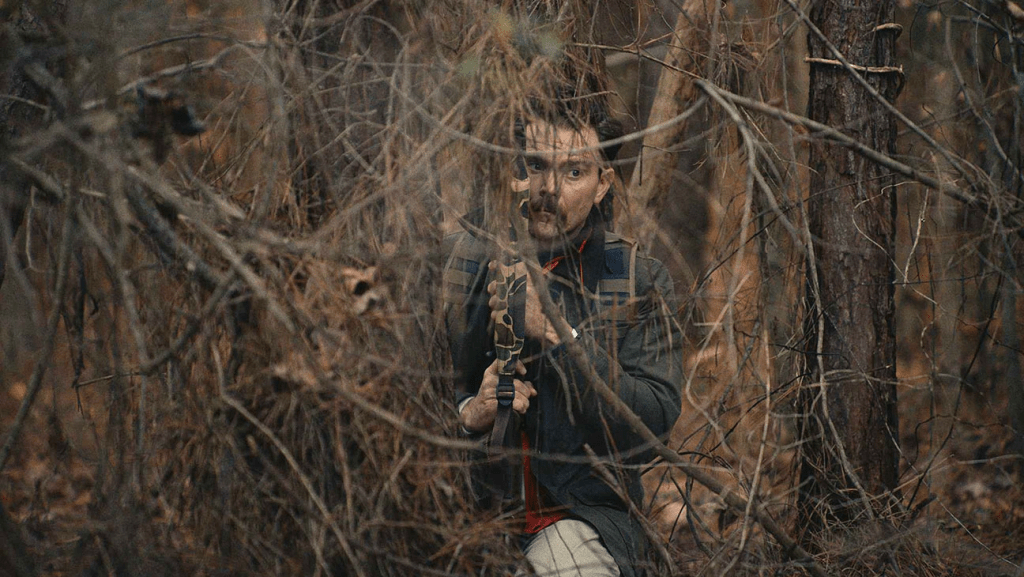
he Integrity of Joseph Chambers (USA, 2022) – This psychological thriller has a slow burn, but really gets under your skin. Early one morning, a white-collar father of two (Clayne Crawford) rolls out of his warm bed and readies himself to go deer hunting. His half-awake (and concerned) wife reminds him he has never gone hunting by himself and has limited experience with firearms. Undeterred, he insists that the best way to get experience is to “just go out and do it.” After stopping at a friend’s house to borrow his pickup truck (and a rifle), he heads for the woods. What could possibly go wrong? Anchored by Crawford’s intense performance, writer-director Robert Machoian has fashioned a riveting tale infused with a dash of Dostoevsky and a dollop of Deliverance.
The Last Film Show (India, 2021) – Child actor Bhavin Rabari gives an extraordinary performance in writer-director Pan Nalin’s moving drama. Set in contemporary India in 2010, the story centers on Samay, a cinema-obsessed 9-year-old boy who lives with his parents and younger sister. He is frequently beaten by his father, who is embittered by having to support his family as a railway station “tea boy” after losing his cattle farm. He forbids Samay to watch movies unless they are “religious” in nature.
This of course drives Samay to play hooky from school and sneak into the local theater whenever possible. Eventually he befriends the projectionist, who takes Samay on as a kind of protégé, in exchange for the delicious school lunches that Samay’s mother packs for him.
There are obvious parallels with Giuseppe Tornatore’s Cinema Paradiso and Francois Truffaut’s The 400 Blows, but Nalin puts his own unique stamp on a familiar narrative. Gorgeously photographed and beautifully acted, this is a colorful and poetic love letter to the movies.
Love Spreads (USA/UK, 2020) – I’m a sucker for stories about the creative process, because as far as I’m concerned, that’s what separates us from the animals (even if my “inner Douglas Adams” persists in raising the possibility that “there’s an infinite number of monkeys outside who want to talk to us about this script for Hamlet they’ve worked out.”). Welsh writer-director Jamie Adams’ dramedy is right in that wheelhouse.
“Glass Heart” is an all-female rock band who have holed up Led Zep style in an isolated country cottage to record a follow-up to their well-received debut album. Everyone is raring to go, the record company is bankrolling the sessions, and the only thing missing is…some new songs. The pressure has fallen on lead singer and primary songwriter Kelly (Alia Shawcat) to cough them up, pronto.
Unfortunately, the dreaded “sophomore curse” has landed squarely on her shoulders, and she is completely blocked. The inevitable tensions and ego clashes arise as her three band mates and manager struggle to stay sane as Kelly awaits the Muse. It’s a little bit This is Spinal Tap, with a dash of Love and Mercy-bolstered by a smart script, wonderful performances, and catchy original songs.
Monkey Warfare (Canada, 2006) – Written and directed by Reginald Harkema, Monkey Warfare is a nice little cinematic bong hit of low-key political anarchy. The film stars Don McKellar and Tracy Wright (the Hepburn and Tracy of quirky Canadian cinema) as a longtime couple who are former lefty radical activists-turned “off the grid” Toronto slackers.
When McKellar loans the couple’s free-spirited young pot dealer and budding anarchist (Nadia Litz) his treasured “mint copy” of a book about the Baader-Meinhof Gang, he unintentionally triggers a chain of events that will reawaken long dormant passions between the couple (amorous and political) and profoundly affect the lives of all three protagonists.
Monkey Warfare is not exactly a comedy, but Harkema’s script is awash in trenchant humor. If you liked Jeremy Kagan’s The Big Fix, Sidney Lumet’s Running on Empty, or Paul Thomas Anderson’s One Battle After Another (my review), I think this film should be right in your wheelhouse.
Nowhere Boy (UK, 2009) – There’s nary a tricksy or false note in this little gem from U.K. director Sam Taylor-Wood. Aaron Johnson gives a terrific, James Dean-worthy performance as a teenage John Lennon. The story focuses on a specific, crucially formative period of the musical icon’s life beginning just prior to his first meet-up with Paul McCartney, and ending on the eve of the “Hamburg period”.
The story is not so much about the Fabs, however, as it is about the complex and mercurial dynamic of the relationship between John, his Aunt Mimi (Kirstin Scott Thomas) and his mother Julia (Anne-Marie Duff). The entire cast is excellent, but Scott Thomas (one of the best actresses strolling the planet) handily walks away with the film as the woman who raised John from childhood.
Polisse (France, 2011) – Winner of the Jury Prize at Cannes in 2011, this is a docudrama-style police procedural in the tradition of Jules Dassin’s Naked City. You do have to pay very close attention, however, because it seems like there are about 8 million stories (and just as many characters) crammed into the 127 minutes of French director Maiwenn’s complex film.
Using a clever “hall of mirrors” device, the director casts herself in the role of a “fly on the wall” photojournalist, and it is through this character’s lens that we observe the dedicated men and women who work in the Child Protective Unit arm of the French police. As you can imagine, these folks are dealing with the absolute lowest of the already lowest criminal element of society, day in and day out, and it does take its psychic toll on them.
Still, there’s a surprising amount of levity sprinkled throughout Maiwenn’s dense screenplay (co-written by Emmanuelle Bercot), which helps temper the heartbreak of seeing children in situations that they would never have to suffer through in a just world. The film fizzles a bit at the end, and keeping track of all the story lines is challenging, but it’s worthwhile, with remarkable performances from the ensemble.
Settlers (UK, 2021) – Writer-director Wyatt Rockefeller’s sci-fi drama is Once Upon a Time inthe West on Mars. The story centers on 9-year-old Remmy (Brooklyn Prince), who lives with her settler parents (Sofia Boutella and Jonny Lee Miller) at a remote homestead. Following an attack by hostile parties and subsequent arrival of a drifter who claims that the homestead rightfully belongs to him, Sofia’s life (as well as the family’s dynamic) changes drastically. The story takes place over a 9-year period; with Nell Tiger Free playing 18-year-old Remmy. Not wholly original, but smartly written and well-acted, with great production design and cinematography (exteriors were filmed in South Africa).
Sorry, Baby (USA, 2025) – Mumblecore is alive and well, as evidenced by SIFF’s 2025 Closing Night Gala selection. Written, directed and starring Eva Victor (who you may recognize from Showtime’s Billions) this dramedy is a sometimes meandering but generally affable portrait of an independent young woman’s long recovery in the aftermath of a traumatic betrayal of trust. Victor slowly reveals her character’s arc in episodic fashion, using a non-linear timeline. Solid performances all around in a story that chugs along at the speed of life. The film left me thinking about something Mr. Rogers once said…“Look for the helpers. You will always find people who are helping.” He was right, you know.
Trollhunter (Norway, 2010) – Like previous entries in the “found footage” sub-genre, Trollhunter features an unremarkable, no-name cast; but then again you don’t really require the services of an Olivier when most of the dialog is along the lines of “Where ARE you!?”, “Jesus, look at the size of that fucking thing!”, “RUN!!!” or the ever popular “AieEEE!”.
Seriously, though- what I like about Andre Ovredal’s film (aside from the surprisingly convincing monsters) is the way he cleverly weaves wry commentary on religion and politics into his narrative. The story concerns three Norwegian film students who initially set off to do an expose on illegal bear poaching, but become embroiled with a clandestine government program to rid Norway of some nasty trolls who have been terrorizing the remote areas of the country (you’ll have to suspend your disbelief as to how the government has been able to “cover up” 200 foot tall monsters rampaging about). The “trollhunter” himself is quite a character. Not your typical creature feature!
U Are the Universe (Ukraine, 2025) – As Elton John sang, it’s lonely out in space. Especially if there’s no Earth to come home to. Andriy (Volodymyr Kravchuk) is the pilot on a garbage scow loaded with nuclear waste destined for disposal on one of Jupiter’s moons (it’s just his job, 5 days a week). When he gleans that the world’s entire population has been wiped out by a cataclysmic event, he’s saddled by the realization he may be the last living human in the universe.
Considering that there is an ample yet finite supply of food on the ship, Andriy has calculated he can survive for a while, but obviously not as long as he would have expected, had the Earth not been destroyed. His growing sense of existential despair is kept somewhat in check by the presence of his onboard AI technical assistant/personality-enhanced companion Maxim, which at least gives him “someone” to interact with.
Then, one day, out of the vacuum, a glimmer of hope. He receives a voice-only communication from a Frenchwoman named Catherine, who tells him she’s the sole occupant of a space station on a collision course with Saturn (she figures she only has a couple weeks before there’s an earth-shattering kaboom). Andriy now has a raison d’être; he immediately sets course for a rescue mission (despite Maxim’s dire warnings about his ship’s limited power reserves).
While this may be familiar territory (with shades of 2001, Solaris, Silent Running, and Miracle Mile), Ukrainian director Pavlo Ostrikov’s film (which was in the midst of wrapping production in Kyiv in 2022 as Putin began sending salvos of missiles into the city) is armed with a smart script, tight direction, a nuanced performance by Kravchuk, and a beautiful statement on love, compassion and self-sacrifice-adding up to one of the best genre entries I’ve seen in some time.
Waves (Czech Republic, 2025) – While it is set on the eve of the 1968 Prague Spring in Czechoslovakia, in some respects writer-director Jiří Mádl’s riveting political thriller could have been ripped from today’s headlines.
In 1967 Prague, a young man named Tomás (Vojtěch Vodochodský) lives in a cramped apartment with his younger brother Paja (Ondřej Stupka). Tomás is Paja’s legal guardian. The conservative and apolitical Tomás is concerned about rebellious Paja’s increasing involvement with an anti-regime activist group. One day, he is chagrined to learn that Paja has sneaked off to an open audition for a job as an assistant to a popular but controversial radio journalist. Tomás rushes down to the station to intervene, but stumbles into landing the gig himself.
While he cannot foresee it, Tomás is about to get swept up into the vortex of tumultuous political upheaval in his country, culminating in the August 1968 invasion of Czechoslovakia by Soviet and Warsaw Pact forces (the film is based in part on the rousing story of how Czech Radio managed to keep broadcasting, even after Soviet troops forced their way in and seized control of the main studios).
Waves plays like a mashup of Three Days of the Condor and The Unbearable Lightness of Being, and is a welcome throwback to films that hit that sweet spot between historical sweep and intimate drama. Oh, and don’t forget to support your favorite independent journalists, because democracy dies in…well, you know. Full review
Makoto Nagahisa’s Burn is an ensemble piece reminiscent of the uncompromising youth subculture dramas by outsider filmmakers like Gregg Araki and Larry Clark. A teenage girl, fed up with being constantly ostracized and physically abused by her strict, ultra-religious parents, runs away from home and ends up in Tokyo’s red light district. She is welcomed into a community of street kids, who, like her, are estranged from their families and psychically damaged in one way or the other. You could call it a support system by definition, but it’s a tenuous one at best, as she eventually comes to learn. Frankly, it’s a bit of a downer, but the impressive young cast commits 100% to this realistic, brutally honest portrait of life on the fringe.
For two and a half hours, the lead character in Ildikó Enyedi’s multi-generational drama doesn’t utter a single word, nor move an inch. Yet, our star suggests a rich “inner life”, simply by…being. Alright, it’s a tree.
More specifically, it’s a huge ginkgo tree, housed on the campus of a venerable German university in Marburg. The ginkgo remains the constant in a triptych of narratives set at the school over a period spanning 100-plus years: the travails of a young woman at the turn of the 20th Century who is the university’s first female science grad, a shy young man who pines for a fellow student in the early 1970s, and a visiting professor from China who gets stranded on campus during the early days of the COVID pandemic.
Enyedi ties her disparate story threads together in much the same manner one nurtures a plant; she patiently observes, knows when to illuminate a plot point, and is careful not to over-water grace notes. The tree, in the meantime, says nothing; but ultimately, it stands for everything. That’s the beauty of this film.
(Originally posted on Digby’s Hullabaloo on May 9, 2026)
I don’t think it’s controversial to say that that nearly all Hitler era Nazis were Germans (granted, there was the odd Austrian). But it still makes people twitch when you say that not all Germans were card-carrying Nazis.
There have been films that flirt with that conundrum (Das Boot, The Good German, Schindler’s List, et. al.). Amrum is the latest film to do same. Director Fatih Akin (who also co-wrote, along with Hark Bohm) sets his story during the waning days of the war, focusing on the tenuous relationship between “mainlanders” who have fled bombed-out German cities to resettle on a resource-strained North Sea island and the resentful local residents. The narrative unfolds through the eyes of a 12 year-old boy, as he comes to grips with revelations about his family’s Nazi past.
I was reminded of John Boorman’s Hope and Glory; while that was a childhood memoir about a boy coming of age in wartime London, there is a commonality as to the effects of war on those still too young to fully grasp the concept of “borders”, much less political ideology.
(Originally posted on Digby’s Hullabaloo on March 7, 2026)
There’s just something about (Castro’s) Cuba that affects (U.S. presidential) administrations like the full moon affects a werewolf. There’s no real logic at work here.
-an interviewee from the documentary 638 Ways to Kill Castro
If I could only live to see it, to be there with you. What I wouldn’t give for twenty more years! Here we are, protected, free to make our profits without Kefauver, the goddamn Justice Department and the F.B.I. ninety miles away, in partnership with a friendly government. Ninety miles! It’s nothing! Just one small step, looking for a man who wants to be President of the United States, and having the cash to make it possible. Michael, we’re bigger than U.S. Steel. – From The Godfather, Pt. II, screenplay by Francis Ford Coppola and Mario Puzo
Which reminds me of a funny story…
Trump: "We're looking forward to the great change that will soon be coming to Cuba. Cuba is at the end of the line. They're very much at the end of the line."
“End of the line”? Would you care to…elaborate on that, Mr. Preznit?
Trump: "Cuba is in its last moments of life … but our focus right now is on Iran. Marco will take one hour off and finish up a deal on Cuba. That'll be an easy one."
During his second term, President Donald Trump has authorized military action in a string of countries, including Iran, Venezuela, Ecuador, Nigeria, Somalia, and Yemen. Now, he’s hinted that Cuba could be next, declaring that the Caribbean island nation is “in its last moments of life.”
Trump delivered his stark warning during a Saturday speech in Florida, where leaders from several Latin American nations were gathered at his Doral resort.
There, he unveiled a new coalition called “The Shield of the Americas,” aimed at bolstering security across the Western Hemisphere. Kristi Noem has been tapped as a special envoy for the initiative, following her dismissal as Homeland Security secretary.
Upon taking the podium, the president said he is “looking forward to the great change that will soon be coming to Cuba.” He described the nation as “at the end of the line” and experiencing its “last moments of life.”
The country, which has been under communist rule since the 1959 Cuban revolution, has no money, no oil, and a “bad philosophy,” he continued.
While his administration is currently focused on Iran, Trump said that Secretary of State Marco Rubio will “take one hour off and finish up a deal on Cuba,” adding, “That’ll be an easy one.”
Since returning to office, Trump has taken an aggressive posture towards Cuba. He’s slapped steep tariffs on the island nation and threatened to impose duties on goods from countries that export oil to Cuba. He’s also urged the communist state to “make a deal” or face unspecified repercussions.
The country’s president, Miguel Diaz-Canel, has frequently criticized the Trump administration’s hostile rhetoric.
“Cuba is a free, independent and sovereign nation. No one tells us what to do,” he wrote on X in January, adding that his government was “ready to defend the homeland to the last drop of blood.”
For all you youngsters in the audience, the cigar-chomping dictator who once inspired a documentary entitled 638 Ways to Kill Castro (more on that below) was finally taken out in 2016 by method #639: Old age. Regardless of who is in charge of the island nation now, it’s been a long, strange trip for U.S.-Cuban relations since Castro seized power in 1959.
But I’m sure Secretary Rubio will get it straightened out in an hour or so.
While we’re holding our breath, here are 10 Cuba-themed films worth a peek:
Bananas– Yes, I know. This 1971 Woody Allen film takes place in the fictional banana republic of “San Marcos”, but the mise en scene is an obvious stand-in for Cuba. There are also numerous allusions to the Cuban revolution, not the least of which is the ridiculously fake beard donned at one point by hapless New Yawker Fielding Mellish (Allen) after he finds himself swept up in Third World revolutionary politics. Naturally, it all starts with Allen’s moon-eyed desire for a woman completely out of his league, an attractive activist (Louise Lasser). The whole setup is utterly absurd…and an absolute riot. This is pure comic genius at work. Howard Cosell’s (straight-faced) contribution is priceless. Allen co-wrote with his Take the Money and Run collaborator, Mickey Rose.
Buena Vista Social Club- This engaging 1999 music documentary was the brainchild of musician Ry Cooder, director Wim Wenders, and the film’s music producer Nick Gold. Guitarist/world music aficionado Cooder coaxes a number of venerable Cuban players out of retirement (most of whom had their careers rudely interrupted by the Revolution and its aftermath) to cut a collaborative album, and Wenders is there to capture what ensues (as well as ever-cinematic Havana) in his inimitable style. He weaves in footage of some of the artists as they make their belated return to the stage, playing to enthusiastic fans in Europe and the U.S.
Che– Let’s get this out of the way. Ernesto “Che” Guevara was no martyr. By the time he was captured and executed by CIA-directed Bolivian Special Forces in 1967, he had put his own fair share of people up against the wall in the name of the Revolution. Some historians have called him “Castro’s brain”.
That said, there is no denying that he was a complex, undeniably charismatic and fascinating individual. By no means your average revolutionary guerrilla leader, he was well-educated, a physician, a prolific writer (from speeches and essays on politics and social theory to articles, books and poetry), a shrewd diplomat and had a formidable intellect. He was also a brilliant military tactician.
Steven Soderbergh and his screenwriters (Peter Buchman and Benjamin A. Van Der Veen) adapted their 4 ½ hour opus from Guevara’s autobiographical accounts. Whereas Part 1 (aka The Argentine) is a fairly straightforward biopic, Part 2 (aka Guerilla) reminded me of two fictional films with an existential bent, both also set in torpid South American locales-Clouzot’s The Wages of Fear and Herzog’s Aguirre, theWrath of God. Like the doomed protagonists in those films, Guevara is fully committed to his journey into the heart of darkness, and has no choice but to cast his fate to the wind and let it all play out. Benicio del Toro shines in the lead role. Full review
The Godfather, Part II– While Cuba may not be the primary setting for Francis Ford Coppola’s superb 1974 sequel to The Godfather, it is the location for a key section of the narrative where powerful mob boss Michael Corleone (Al Pacino) travels to pre-Castro Havana to consider a possible business investment. He has second thoughts after witnessing a disturbing incident involving an anti-Batista rebel. And don’t forget that the infamous “kiss of death” scene takes place at Batista’s opulent New Year’s Eve party…just as the guests learn Castro and his merry band of revolutionaries have reached the outskirts of the city and are duly informed by their host…that they are on their own! And remember, if you want to order a banana daiquiri in Spanish, it’s “banana daiquiri”.
Harold and Kumar Escape from Guantanamo Bay– Picking up where they left off in their surprise stoner comedy hit Harold and Kumar Go to White Castle, roomies Harold (John Cho) and Kumar (Kal Penn) excitedly pack their bags for a dream European vacation in weed-friendly Amsterdam. Unbeknownst to Harold, Kumar has smuggled his new invention, a “smokeless” bong, on board.
When a “vigilant” passenger, already eyeballing Kumar with suspicion due to his ethnic appearance, catches a glimpse of him attempting to fire up his homemade contraption in the bathroom, all hell breaks loose. Before they know it, Harold and Kumar have been handcuffed by on-board air marshals, given the third degree back on the ground by a jingoistic government spook and issued orange jumpsuits, courtesy of the Gitmo quartermaster.
Through circumstances that could only occur in Harold and Kumar’s resin-encrusted alternate universe, they break out of Cuba, and hitch a boat ride to Florida. This sets off a series of cross-country misadventures. As in the first film, the more ridiculously over-the-top their predicament, the funnier it gets. It’s crass, even vulgar; but it’s somehow endearingly crass and vulgar, in a South Park kind of way (i.e. the goofiness is embedded with sharp political barbs). (Full review)
I Am Cuba – There is a tendency to dismiss this 1964 film about the Cuban revolution as Communist propaganda. Granted, it was produced with the full blessing of Castro’s regime, who partnered with the Soviet government to provide the funding for director Mikhail Kalatozov’s sprawling epic. Despite the dubious backers, the director was given a surprising amount of creative freedom.
On the surface, Kalatozov’s film is in point of fact a propagandist polemic; the narrative is divided into a quartet of rhetoric-infused vignettes about exploited workers, dirt-poor farmers, student activists, and rebel guerrilla fighters.
However it is also happens to be a visually intoxicating masterpiece that, despite accolades from critics over the decades, remains relatively obscure. The real stars of the film are the director and his technical crew, who will leave you pondering how they produced some of those jaw-dropping set pieces and logic-defying tracking shots.
The Mambo Kings– Arme Glimcher’s underrated 1992 melodrama concerns two musician brothers (Armand Assante and Antonio Banderas) who flee Cuba in the mid-1950s to seek fame and fortune in America. Hugely entertaining, with fiery performances by the two leads, great support from Cathy Moriarty and Maruschka Detmers, topped off by a fabulous soundtrack. Tito Puente gives a rousing cameo performance, and in a bit of stunt casting Desi Arnaz, Jr. is on hand to play (wait for it) Desi Arnaz, Sr. (who helps the brothers get their career going). Cynthia Cidre adapted her screenplay from Oscar Hijuelos’ novel.
Our Man in Havana– A decade after their collaboration on the 1949 classic, The Third Man, director Carol Reed and writer Graham Greene reunited for this wonderfully droll 1960 screen adaptation of Greene’s seriocomic novel. Alec Guinness gives one of his more memorable performances as an English vacuum cleaner shop owner living in pre-revolution Havana. Strapped for cash, he accepts an offer from Her Majesty’s government to do a little moonlighting for the British Secret Service. Finding himself with nothing to report, he starts making things up so he can stay on the payroll. Naturally, this gets him into a pickle as he keeps digging himself into a deeper hole. Reed filmed on location, which provides an interesting snapshot of Havana on the cusp of the Castro era.
Scarface (1983)– Make way for the bad guy. Bad guy comin’ through. Tony Montana (Al Pacino) is a bad, bad, bad, bad man, a Cuban immigrant who comes to America as part of the 1980 Mariel boat lift. A self-proclaimed “political refugee”, Tony, like the millions of immigrants before him who made this country great, aims to secure his piece of the American Dream. However, he’s a bit impatient. He espies a lucrative shortcut via Miami’s thriving cocaine trade, which he proves very adept at (because he’s very ruthless). Everything about this film is waaay over the top; Pacino’s performance, Brian De Palma’s direction, Oliver Stone’s screenplay, the mountains of coke and the carnage. Yet…it remains a guilty pleasure.
638 Ways to Kill Castro- History buffs (and conspiracy-a-go-go enthusiasts) will definitely want a peek at British director Dolan Cannell’s documentary. Mixing archival footage with talking heads (including a surprising number of would-be assassins), Cannell highlights some of the attempts by the U.S. government to knock off Fidel over the years. The number (638) of “ways” is derived from a list compiled by former members of Castro’s security team.
Although Cannell initially plays for laughs (many of the schemes sound like they were hatched by Wile E. Coyote) the tone becomes more sobering. The most chilling revelation concerns the 1976 downing of a commercial Cuban airliner off Barbados (73 people killed). One of the alleged masterminds was Orlando Bosch, an anti-Castro Cuban exile living in Florida (he had participated in CIA-backed actions in the past).
When Bosch was threatened with deportation in the late 80s, many Republicans rallied to have him pardoned, including Florida congresswoman Ileana Ros-Lehtinen, who used her involvement with the “Free Orlando Bosch” campaign as part of her running platform. Her campaign manager was a young up and coming politician named (wait for it) Jeb Bush. Long story short? Jeb’s Pappy then-president George Bush Sr. granted Bosch a pardon in 1990. Oh, what a tangled web, Jeb! BTW, Bosch was publicly referred to as an “unrepentant terrorist” by Richard Thornburgh, President Bush the First’s Attorney General. (Full review)
UPDATE: I dug up this pic froma 2011 post on then-Senator Rubio’s Facebook account :
“Sen. Marco Rubio, with Rep. Ileana Ros-Lehtinen, addressing the Bay of Pigs veterans.”
A tangled web, indeed.
Here are a few more recommendations:
Memories of Underdevelopment Honey for Oshun Chico and Rita The Perez Family Popi
(Originally posted on Digby’s Hullabaloo on February 28, 2026)
Now a note to the President, and the Government, and the judges of this place
We’re still waitin’ for you to bring our troops home, clean up that mess you made
‘Cause it smells of blood and money and oil, across the Iraqi land
But its so easy here to blind us with your united we stand
Israel and the US have launched a war on Iran, unleashing waves of air attacks across the country in an attempt to bring about regime change and plunging the region into a conflict that could last weeks or months.
The sudden offensive triggered Iranian retaliatory strikes throughout the day across a swathe of the Middle East, with explosions reported in Israel, Bahrain, Syria, Iraq, the United Arab Emirates, Kuwait and Saudi Arabia.
In a televised address, the Israeli prime minister, Benjamin Netanyahu, indicated that the strikes had killed Iran’s supreme leader, Ayatollah Ali Khamenei. Khamenei has not been heard from since the strikes began and satellite imagery has shown that his secure compound was heavily damaged in the initial barrage. “There are many signs that [Khamenei] is no longer alive,” Netanyahu said on Saturday evening. Netanyahu said that Israeli strikes had also killed “several leaders” involved in the Iranian nuclear programme and that strikes against sites linked to the programme would continue in the coming days.
The remarks, which stopped short of confirming Khamenei’s death, were the strongest official indication yet that the missing leader is dead. Abbas Araghchi, Iran’s foreign minister, had earlier claimed to NBC News that Khamenei and president Masoud Pezeshkian were alive “as far as I know”.
In a televised address, Donald Trump claimed Operation Epic Fury would end a security threat to the US and give Iranians a chance to “rise up” against their rulers. Netanyahu in his evening address called on Iranians to “flood the streets and finish the job”.
Iranian officials said they had not been surprised by the US attacks and that the consequences would “be long lasting and extensive. All scenarios were on the table including ones that were not previously considered.”
Sorry I asked.
With the 25th twin anniversary of September 11th and America’s “war on terror” coming up this Fall, and in light of today’s concomitant developments in the Middle East, I thought I might peruse my 20 years of Hullabaloo movie reviews for some perspective. As I plumbed the archives, I was surprised at the number of documentaries and feature films related to our involvement in Iraq and Afghanistan that I have covered. Collectively, these films not only paint a broad canvas of these endless wars themselves, but put the full spectrum of humanity on display, from “the better angels of our nature” to the absolute worst (mostly the worst).
So in lieu of a 3,000-word dissertation, I’ve culled 9 films that perhaps best represent what’s gone down “over there” (and on the home front) since the World Trade Center towers fell, and one film that serves as a preface. It doesn’t feel appropriate to call this a “top 10” list, so let’s just call it, “food for thought”.
Pray for peace.
Charlie Wilson’s War – Aaron Sorkin, you silver-tongued devil, you had me at: “Ladies and gentlemen of the clandestine community…”
That line is from the opening scene of Charlie Wilson’s War, in which the titular character, a Texas congressman (Tom Hanks) is receiving an Honored Colleague award from the er-ladies and gentlemen of the clandestine community (you know, that same group of merry pranksters who orchestrated such wild and woolly hi-jinx as the Bay of Pigs invasion.)
Sorkin provides the snappy dialog for director Mike Nichols’ political satire. In actuality, Nichols and Sorkin may have viewed their screen adaptation of Wilson’s real-life story as a cakewalk, because it falls into the “you couldn’t make this shit up” category.
Wilson, known to Beltway insiders as “good-time Charlie” during his congressional tenure, is an unlikely American hero. He drank like a fish and loved to party but could readily charm key movers and shakers into supporting his pet causes and any attractive young lady within range into the sack. So how did this whiskey quaffing Romeo circumvent the official U.S. foreign policy of the time (1980s) and help the Mujahedin rebels drive the Russians out of Afghanistan, ostensibly paving the way for the collapse of the Soviet Union and the end of the Cold War? While a (mostly) true story, it plays like a fairy tale now; although in view of recent events we know the Afghan people didn’t necessarily live happily ever after. (Full review)
Fair Game – Doug Liman’s slightly uneven 2010 dramatization of the “Plame affair” and the part it played in the Bush administration’s “weapons of mass destruction” fiasco may hold more relevance now, with the benefit of hindsight. Jez and John-Henry Butterworth based their screenplay on two memoirs, The Politics of Truth by Joe Wilson, and FairGame by Valerie Plame.
Sean Penn and Naomi Watts bring their star power to the table as the Wilsons, portraying them as a loving couple who were living relatively low key lives (she more as a necessity of her profession) until they got pushed into a boiling cauldron of nasty political intrigue that falls somewhere in between All the President’s Men and Three Days of the Condor.
Viewers unfamiliar with the back story could be misled by the opening scenes, which give the impression you may be in for a Bourne-style action thriller. The conundrum is that the part of the story concerning Valerie Plame’s CIA exploits can at best be speculative in nature. Due to the sensitivity of those matters, Plame has only gone on record concerning that part of her life in vague, generalized terms, so what you end up with is something along the lines of Confessions of a Dangerous Mind.
However, the most important part of the couple’s story was the political fallout that transpired once Valerie was “outed” by conservative journalist Robert Novak. Liman wisely shifts the focus to depicting how Wilson and Plame weathered this storm together, and ultimately stood up to the Bush-Cheney juggernaut of “alternative facts” that helped sell the American public on Operation Iraqi Freedom. (Full review)
The Kill Team – In an ideal world, no one should ever have to “go to war”. But it’s not an ideal world. For as long as humans have existed, there has been conflict. And always with the hitting, and the stoning, and the clubbing, and then later with the skewering and the slicing and stabbing…then eventually with the shooting and the bombing and the vaporizing.
So if we absolutely have to have a military, one would hope that the majority of the men and women who serve in our armed forces at least “go to war” as fearless, disciplined, trained professionals, instilled with a sense of honor and integrity. In an ideal world. Which again, this is not.
In 2011, five soldiers from the Fifth Stryker Brigade, Second Infantry Division (stationed near Kandahar) were officially accused of murdering three innocent Afghan civilians. Led by an apparently psychopathic squad leader, a Staff Sgt. Calvin Gibbs, the men were all members of the 3rd Platoon, which became known as “The Kill Team”.
Artfully blending intimate interviews with moody composition (strongly recalling the films of Errol Morris), director Dan Krauss coaxes extraordinary confessionals from several key participants and witnesses involved in a series of 2010 Afghanistan War incidents usually referred to as the “Maywand District murders“.
This is really quite a story (sadly, an old one), and because it can be analyzed in many contexts (first person, historical, political, sociological, and psychological), some may find Krauss’ film frustrating, incomplete, or even slanted. But judging purely on the context he has chosen to use (first person) I think it works quite well. (Full review)
The Messenger – I think this is the film that comes closest to getting the harrowing national nightmare of the wars in Iraq and Afghanistan “right”. Infused with sharp writing, smart direction and compelling performances, The Messenger is one of those insightful observations of the human condition that sneaks up and really gets inside you, haunting you long after the credits roll.
First-time director Owen Moverman and co-writer Alessandro Camon not only bring the war(s) home but proceed to march up your driveway and deposit in on your doorstep. Ben Foster, Samantha Morton and Woody Harrelson are outstanding. I think this film is to the Iraq/Afghanistan quagmire what The Deer Hunter was to Vietnam. It’s that good…and just as devastating. (Full review)
Son of Babylon – This heartbreaking Iraqi drama from 2010 is set in 2003, just weeks after the fall of Saddam. It follows the arduous journey of a Kurdish boy named Ahmed (Yasser Talib) and his grandmother (Shazda Hussein) as they head for the last known location of Ahmed’s father, who disappeared during the first Gulf War.
As they traverse the bleak, post-apocalyptic landscapes of Iraq’s bomb-cratered desert, a portrait emerges of a people struggling to keep mind and soul together, and to make sense of the horror and suffering precipitated by two wars and a harsh dictatorship.
Director Mohamed Al Daradji and co-screenwriter Jennifer Norridge deliver something conspicuously absent in the Iraq War(s) movies from Western directors in recent years-an honest and humanistic evaluation of the everyday people who inevitably get caught in the middle of such armed conflicts-not just in Iraq, but in any war, anywhere. (Full review)
Standard Operating Procedure – I once saw a fascinating TV documentary called Nazi Scrapbooks from Hell. It was the most harrowing depiction of the Holocaust I’ve seen, but it offered nary a glimpse of the oft-shown photographs of the atrocities themselves. Rather, it focused on photos from a scrapbook (discovered decades after the war) that belonged to an SS officer assigned to Auschwitz.
Essentially an organized, affably annotated gallery of the “after hours” lifestyle of a “workaday” concentration camp staff, it shows cheerful participants enjoying a little outdoor nosh, catching some sun, and even the odd sing-along, all in the shadow of the notorious death factory where they “worked”.
If it weren’t for the Nazi uniforms, you might think it was just a bunch of guys from the office, hamming it up for the camera at a company picnic. As the filmmakers point out, it is the everyday banality of this evil that makes it so chilling. The most amazing fact is that these pictures were taken in the first place.
What were they thinking?
This is the same rhetorical question posed by one of the interviewees in this documentary about the Abu Ghraib prisoner abuse scandal from renowned filmmaker Errol Morris. The gentleman is a military C.I.D. investigator who had the unenviable task of sifting through the hundreds of damning photos taken by several of the perpetrators.
Morris makes an interesting choice here. He aims his spotlight not on the obvious inhumanity on display in those sickening photos, but rather on our perception of them (echoes of Antonioni’s Blow-Up).
So just who are these people that took them? What was the actual intent behind the self-documentation? Can we conclusively pass judgment on the actions of the people involved, based solely on what we “think” these photographs show us? A disturbing, yet compelling treatise on the fine line between “the fog of war” and state-sanctioned cruelty. (Full review)
Stop/Loss – This powerful and heartfelt 2008 drama is from Boys Don’t Cry director Kimberly Peirce. Co-written by the director along with Mark Richard, it was one of the first substantive films to address the plight of Iraq war vets.
As the film opens, we meet Sgt. Brandon King (Ryan Phillippe), an infantry squad leader leading his men in hot pursuit of a carload of heavily armed insurgents through the streets of Tikrit. The chase ends in a harrowing ambush, with the squad suffering heavy casualties.
Brandon is wounded in the skirmish, as are two of his lifelong buddies, Steve (Channing Tatum) and Tommy (Joseph Gordon-Levitt). They return to their small Texas hometown to receive Purple Hearts and a hero’s welcome, infusing the battle-weary vets with a brief euphoria that inevitably gives way to varying degrees of PTSD for the trio.
A road trip that drives the film’s third act becomes a metaphorical journey through the zeitgeist of the modern-day American veteran. Peirce and her co-writer (largely) avoid clichés and remain low-key on political subtext; this is ultimately a soldier’s story. Regardless of your political stance on the Iraq War(s), anyone with an ounce of compassion will find this film both heart wrenching and moving. (Full review)
W – No one has ever accused Oliver Stone of being subtle. However, once you watch his 2008 take on the life and times of George W. Bush (uncannily played by Josh Brolin), I think the popular perception about the director, which is that he is a rabid conspiracy theorist who rewrites history via Grand Guignol-fueled cinematic polemics, could begin to diminish. I’m even going to go out on a limb and call W a fairly straightforward biopic.
Stone intersperses highlights of Bush’s White House years with episodic flashbacks and flash forwards, beginning in the late 60s (when Junior was attending Yale) and taking us up to the end of his second term.
I’m not saying that Stone doesn’t take a point of view; he wouldn’t be Oliver Stone if he didn’t. He caught some flak for dwelling on Bush’s battle with the bottle (the manufacturers of Jack Daniels must have laid out serious bucks for the ubiquitous product placement). Bush’s history of boozing is a matter of record.
Some took umbrage at another one of the underlying themes in Stanley Weisner’s screenplay, which is that Bush’s angst (and the drive to succeed at all costs) is propelled by an unrequited desire to please a perennially disapproving George Senior. I’m no psychologist, but that sounds reasonable to me. (Full review)
A War – This powerful 2015 Oscar-nominated drama is from writer-director Tobias Lindholm. Pilou Aesbaek stars as a Danish military company commander serving in the Afghanistan War. After one of his units is demoralized by the loss of a man to a Taliban sniper while on recon, the commander bolsters morale by personally leading a patrol, which becomes hopelessly pinned down during an intense firefight. Faced with a split-second decision, the commander requests air support, resulting in a “fog of war” misstep. The commander is ordered back home, facing charges of murdering civilians.
For the first two-thirds of the film Lindholm intersperses the commander’s front line travails with those of his family back home, as his wife (Yuva Novotny) struggles to keep life and soul together while maintaining as much of a sense of “normalcy” as she can muster for the sake their three kids. The home front and the war front are both played “for real” (aside from the obvious fact that it’s a Danish production, this is a refreshingly “un-Hollywoodized” war movie).
Some may be dismayed by the moral and ethical ambivalence of the denouement. Then again, there are few tidy endings in life…particularly in war, which (to quote Bertrand Russell) never determines who is “right”, but who is left. Is that a tired trope? Perhaps; but it’s one that bears repeating…until that very last bullet on Earth gets fired in anger. (Full review)
Zero Dark Thirty – “Whadaya think…this is like the Army, where you can shoot ‘em from a mile away?! No, you gotta get up like this, and budda-bing, you blow their brains all over your nice Ivy League suit.”
–from The Godfather, screenplay by Mario Puzo and Francis Ford Coppola
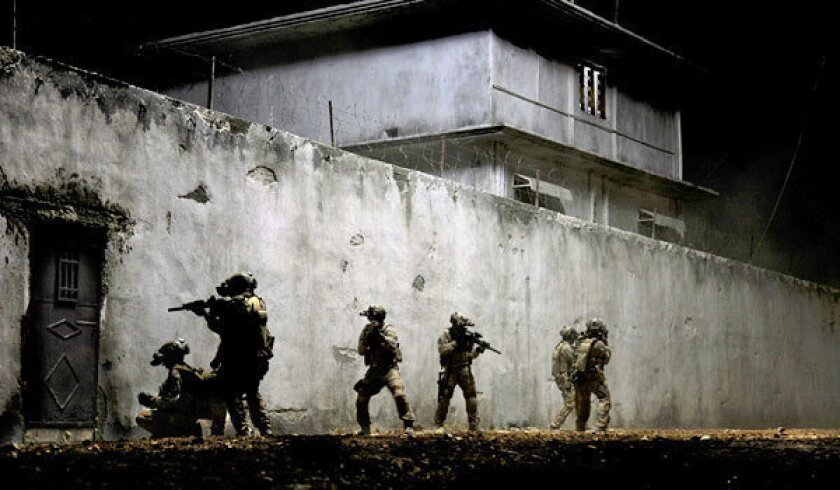
If CIA operative Maya (Jessica Chastain), the partially fictionalized protagonist of Zero Dark Thirty had her druthers, she would “drop a bomb” on Osama Bin Laden’s compound, as opposed to dispatching a Navy SEAL team with all their “…Velcro and gear.” Therein lays the crux of my dilemma regarding Kathryn Bigelow’s film recounting the 10-year hunt for the 9-11 mastermind and events surrounding his take down; I can’t decide if it’s “like the Army” or a glorified mob movie.
But that’s just me. Perhaps the film is intended as a litmus test for its viewers (the cries of “Foul!” that emitted from both poles of the political spectrum, even before its wide release back in 2013 would seem to bear this out). And indeed, Bigelow has nearly succeeded in making an objective, apolitical docudrama.
Notice I said “nearly”. But if you can get past the fact that Bigelow or screenwriter Mark Boal are not ones to necessarily allow the truth to get in the way of a good story (and that The Battle of Algiers or The Day of the Jackal…this definitely ain’t), in terms of pure film making, there is an impressive amount of (if I may appropriate an oft-used phrase from the movie) cinematic “trade craft” on display.
While lukewarm as a political thriller, it does make a terrific detective story, and the recreation of the SEAL mission, while up for debate as to accuracy (only those who were there could say for sure, and keeping mum on such escapades is kind of a major part of their job description) is quite taut and exciting. The best I can do is arm you with those caveats; so you will have to judge for yourself. (Full review)
It seems like a good time to re-post this one. Ocean waves, Bob. -D.H.
(Originally posted on Digby’s Hullabaloo on February 4, 2023)
Dee: Jane, do you ever feel like you are just this far from being completely hysterical twenty-four hours a day?
Jane: Half the people I know feel that way. The lucky ones feel that way. The rest of the people ARE hysterical twenty-four hours a day.
— from Grand Canyon, screenplay by Lawrence and Meg Kasdan
HAL 9000: Look Dave, I can see you’re really upset about this. I honestly think you ought to sit down calmly, take a stress pill, and think things over.
— from 2001: A Space Odyssey, screenplay by Stanley Kubrick and Arthur C. Clarke
George Fields: [to Dorothy/Michael] I BEGGED you to get therapy!
— from Tootsie, screenplay by Murray Schisgal
As if the mid-winter blues weren’t enough, there’s been an odd confluence of celestial events recently – a close encounter with a hurtling asteroid, an eerie green comet lighting up the night skies, and the mysterious appearance of a high altitude “spy balloon” the size of three metro buses that has the conspiracy nuts twisting themselves into pretzels. Not that I believe in heavenly portents, but I am feeling the need for some “cinema therapy” right about now.
With that in mind, here are 12 films I’ve watched an unhealthy number of times; the ones I’m most likely to reach for when I’m depressed, anxious, uncertain about the future…or all the above. These films, like my oldest and dearest friends, have never, ever let me down. Take one or two before bedtime; cocktail optional.
Black Orpheus – Marcel Camus directed this mesmerizing 1959 film, a modern spin on a classic Greek myth. Fueled by the pulsing rhythms of Rio’s Carnaval and tempered by the gentle sway of Luiz Bonfa and Antonio Carlos Jobim’s samba soundtrack, Black Orpheus fully engages the senses. Camus and Jacques Viot adapted the screenplay from the play by Vinicius de Moraes.
Handsome tram operator Orfeo (Breno Mello) is engaged to vivacious Mira (Lourdes de Olivera) but gets hit by the thunderbolt when he meets sweet, innocent Eurydice (Marpessa Dawn). As in most romantic triangles, things get complicated, especially when Mr. Death (Ademar da Silva) starts lurking about the place.
You may be scratching your head as to why I’m “comforted” by a story based on a Greek tragedy; but Black Orpheus is graced by one of the most beautiful, life-affirming denouements in cinema; which always assures me that everything is going to be alright.
The Dish – This 2000 Australian sleeper dramatizes the story behind the live televised images of Neil Armstrong setting foot on the moon in 1969. The worldwide broadcast was facilitated by a tracking station located on a sheep farm in New South Wales.
Quirky characters abound in Rob Sitch’s culture-clash comedy (reminiscent of Bill Forsyth’s Local Hero). It’s not all played for yucks; the re-enactment of the telecast is genuinely stirring. Sam Neill heads a fine cast. Director Sitch and co-writers Santo Cilauro, Tom Gleisner, and Jane Kennedy also collaborated on the charming 1997 dramedy The Castle (recommended!).
Diva – Jean-Jacques Beineix’s 1981 cult fave kicked off a sub-genre labelled Cinéma du look (e.g. Beineix’s Betty Blue, and Luc Besson’s Subway, La Femme Nikita, and Leon the Professional).
Our unlikely antihero is mild-mannered postman Jules (Frédéric Andréi), a 20-something opera fan obsessed with a Garbo-like diva (American soprano Wilhelmenia Wiggins Fernandez). She has never recorded a studio album and stipulates that her live performances are never to be taped and/or reproduced in any medium.
An enraptured Jules attends one of her concerts and makes a high-quality recording, for his own edification. By pure chance, a pair of nefarious underworld characters witness Jules bootlegging the concert, sparking a chain of events that turns his life upside down.
Diva is an entertaining pop-art mélange of neo-noir, action-thriller, and comic-book fantasy. Chockablock with quirky characters, from a pair of hipster hit men (Gérard Darmon and Dominique Pinon) to a Zen-like international man of mystery named Gorodish (Richard Bohringer) who is currently “going through his cool period” as his girlfriend (Thuy Ann Luu) confides to Jules. Slick, stylish and thoroughly engaging.
A Hard Day’s Night – This 1964 masterpiece has been often copied, but never equaled. Shot in a semi-documentary style, the film follows a “day in the life” of John, Paul, George and Ringo at the height of their youthful exuberance and charismatic powers. Thanks to the wonderfully inventive direction of Richard Lester and Alun Owen’s clever script, the essence of what made the Beatles “the Beatles” has been captured for posterity.
Although it’s meticulously constructed, Lester’s film has an improvisational feel; and feels as fresh and innovative as when it first hit theaters all those years ago. I still catch subtle gags that surprise me (like John snorting the Coke bottle). Music highlights: “I Should Have Known Better”, “All My Loving”, “Don’t Bother Me”, “Can’t Buy Me Love”, and the fab title song.
Harold and Maude – Harold loves Maude. And Maude loves Harold. It’s a match made in heaven-if only society would agree. Because Harold (Bud Cort) is a teenager, and Maude (Ruth Gordon) is just shy of 80. Falling in love with a woman old enough to be his great-grandmother is the least of Harold’s quirks. He’s a chronically depressed trustafarian who amuses himself by staging fake suicides to freak out his patrician mother (wonderfully droll Vivian Pickles). He also “enjoys” funerals-which is where Harold and Maude Meet Cute.
The effervescent Maude is Harold’s polar opposite; while he wallows in morbid speculation how any day could be your last, she seizes each day as if it actually were. Obviously, she has something to teach him. Despite dark undertones, this is one “midnight movie” that manages to be life-affirming. Hal Ashby directed, and Colin Higgins (who would later write and direct Foul Play and 9 to 5) wrote the screenplay. Outstanding soundtrack by Cat Stevens.
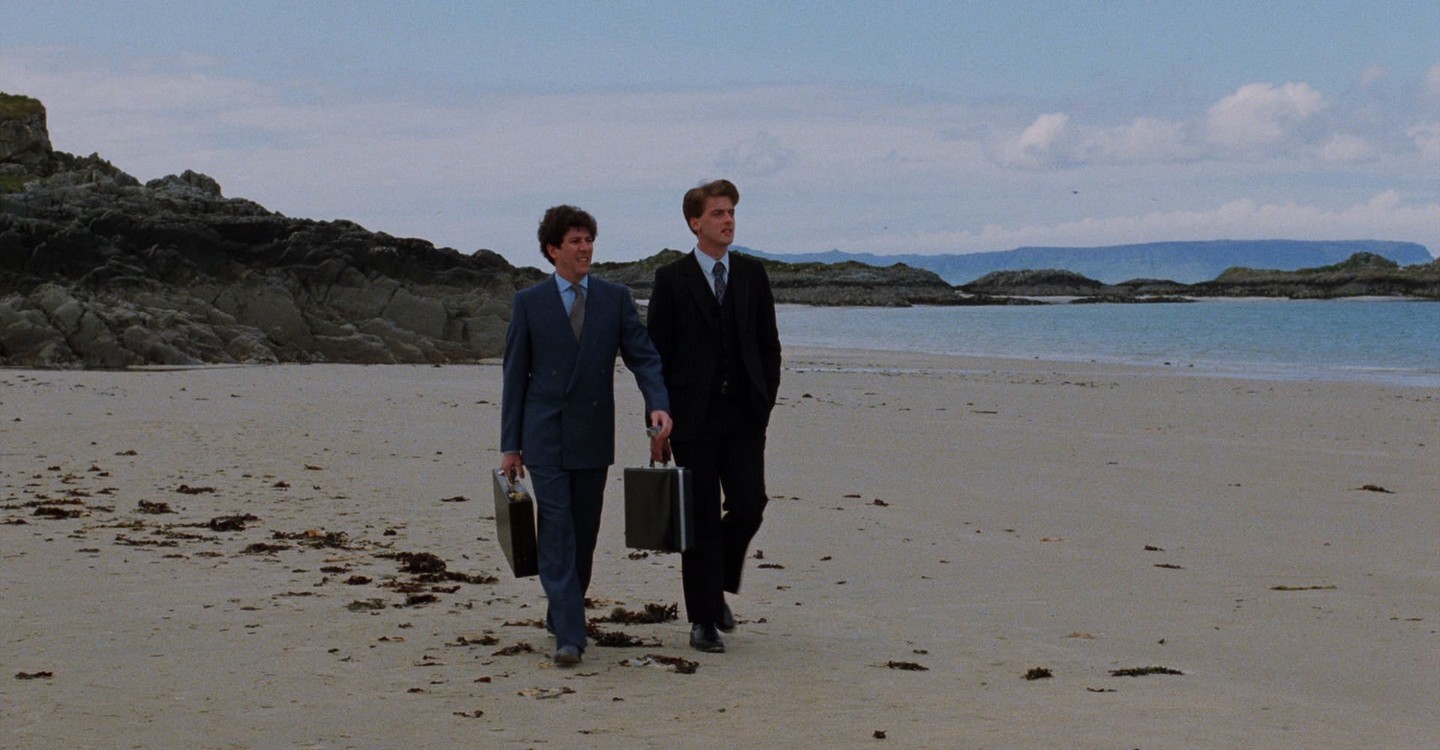
Local Hero – This low-key, observant 1983 social satire from Scottish writer-director Bill Forsyth stars Peter Reigert as Macintyre, a Texas-based executive who is assigned by the head of “Knox Oil & Gas” (Burt Lancaster) to scope out a sleepy Scottish hamlet that sits on an oil-rich bay. He is to negotiate with local property owners and essentially buy out the town so that the company can build a huge refinery.
While he considers himself “more of a Telex man”, who would prefer to knock out such an assignment “in an afternoon”, Mac sees the overseas trip as a possible fast track for a promotion within the corporation. As this quintessential 80s Yuppie works to ingratiate himself with the unhurried locals, a “fish out of water” transformation ensues. It’s the kindest and gentlest Ugly American tale you’ll ever see.
Man on the Train – There are a only a handful of films I have become emotionally attached to, usually for reasons I can’t completely fathom. This 2002 drama is one of them. Best described as an “existential noir”, Patrice LeConte’s relatively simple tale of two men in their twilight years with disparate life paths (a retired poetry teacher and a career felon) forming an unexpected deep bond turns into a transcendent film experience. French pop star Johnny Hallyday and screen veteran Jean Rochefort deliver mesmerizing performances. I feel an urge to watch it right now.
My Neighbor Totoro – While this 1988 film was anime master’s Hayao Miyazaki’s fourth feature, it was one of his (and Studio Ghibli’s) first international hits.
It’s a lovely tale about a young professor and his two daughters settling into their new country house while Mom convalesces at a nearby hospital. The rambunctious 4 year-old goes exploring and stumbles into the verdant court of a “king” nestled within the roots of a gargantuan camphor tree. This king rules with a gentle hand; a benign forest spirit named Totoro (an amalgam of every plush toy you ever cuddled with as a child).
Granted, it’s Miyazaki’s most simplistic and kid-friendly tale…but that’s not a put down. Miyazaki’s usual themes remain intact; the animation is breathtaking, the fantasy elements magical, yet the human characters are down-to-earth and universally relatable. A charmer.
Sherman’s March – Filmmaker Ross McElwee is one of America’s hidden treasures. McElwee, a genteel Southern neurotic (Woody Allen meets Tennessee Williams) has been compulsively documenting his personal life since the mid 70’s and managed to turn the footage into some of the most hilarious, moving and thought-provoking films most people have never seen.
Audiences weaned on “reality TV” may wonder “what’s the big deal about one more schmuck making glorified home movies?” but they would be missing an enriching glimpse into the human condition. Sherman’s March began as a project to retrace the Union general’s path of destruction through the South, but ended up as rumination on the eternal human quest for love and acceptance, filtered through McElwee’s search for the perfect mate.
Despite its 3 hour length, I’ve found myself returning to this film for repeat viewings, and enjoying it just as much as the first time. The unofficial “sequel”, Time Indefinite, is also worth a peek.
The Thin Man – W.S. Van Dyke’s delightful mix of screwball comedy and murder mystery (adapted from Dashiell Hammett’s novel by Albert Hackett and Frances Goodrich) never gets old for me. Story takes a backseat to the repartee between private investigator (and perpetually tipsy socialite) Nick Charles (William Powell) and his wisecracking wife Nora (sexy Myrna Loy). Top it off with a scene-stealing wire fox terrier (Asta!) and you’ve got a winning formula that has spawned countless imitations; particularly a bevy of sleuthing TV couples (Hart to Hart, McMillan and Wife, Moonlighting, Remington Steele, et.al.).
True Stories – Musician/raconteur David Byrne enters the Lone Star state of mind with his subtly satirical Texas travelogue from 1986. Not easy to pigeonhole; part social satire, long-form music video, and mockumentary. The vignettes about the quirky but generally likable inhabitants of sleepy Virgil, Texas should hold your fascination once you buy into “tour-guide” Byrne’s bemused anthropological detachment. Among the town’s residents: John Goodman, “Pops” Staples, Swoosie Kurtz and the late Spalding Gray. The outstanding cinematography is by Edward Lachman. Byrne’s fellow Heads have cameos performing “Wild Wild Life”.
Wings of Desire – I’ve never attempted to compile a Top 10 list of my all-time favorite films (I’ve just seen too many damn movies…I’d be staring at an empty page for weeks, if my head didn’t explode first) but I’m certain Wim Wenders’ 1987 stunner would be a shoo-in. Now, attempting to describe this film is something else altogether.
If I told you it’s about an angel (Bruno Ganz) who hovers over Berlin in a trench coat, monitoring people’s thoughts and taking notes, who spots a beautiful trapeze artist (Solveig Dommartin) and follows her home, wallows in her deepest longings, watches her undress, then falls in love and decides to chuck the mantle of immortality and become human…you’d probably say “That sounds like a story about a creepy stalker.” And if I told you it features Peter Falk, playing himself, you’d laugh nervously and say, “Oh, look at the time.” Of course, there is more to it-about life, the universe, and everything.
BONUS!
If you really want to go all out for movie night (which is pretty much every night for me), you have to watch a cartoon before the movie, right? Here’s my 2011 review of a Blu-ray box set always guaranteed to lift your spirits. Keep it handy, right next to the first aid kit.
The Looney Tunes Platinum Collection, Vol. 1– During those long, dark nights of my soul, when all seems hopeless and futile, there’s one thought that never fails to bring me back to the light. It’s that feeling that somewhere, out there in the ether, there’s a frog, with a top hat and a cane, waiting for his chance to pop out of a box and sing:
Hello my baby, hello my honey, hello my ragtime gal
Send me a kiss by wire, baby my heart’s on fire…
If you don’t know what I’m talking about, just go ahead and skip to the next review now.
The rest of you might want to check out this fabulous 3-disc collection, which features 50 classic animated shorts (and 18 rarities) from the Warner Brothers vaults. Deep catalog Looney Tunes geeks may quibble until the cows come home about what’s not here (Warner has previously released six similar DVD collections in standard definition), but for the casual fans (like yours truly) there is plenty to please. I’m just happy to have “One Froggy Evening”, “I Love to Singa”, “Rabbit of Seville”, “Duck Amuck”, “Leghorn Lovelorn”, “Three Little Bops” and “What’s Opera Doc?” in one place. The selections cover all eras, from the 1940s onward.
One thing that does become clear, as you watch these restored gems in gorgeous hi-def (especially those from the pre-TV era) is that these are not “cartoons”, they are 7 ½ minute films, every bit as artful as anything else cinema has to offer. Extras include a trio of excellent documentaries about the studio’s star director, the legendary Chuck Jones. The real diamond among the rarities is The Dot and the Line: A Romance in Lower Mathematics (directed by Jones for MGM), which won the 1965 Oscar for Best Animated Short Film.
(Originally posted on Digby’s Hullabaloo on December 13, 2025)
Yes, it’s that special season…for those obligatory “top 10” lists. Keep in mind, I can’t see ’em all; these picks are culled from the first-run features that I reviewed this year. Alphabetically:
Birthright– As Queen Eleanor muses in The Lion in Winter: “What family doesn’t have its ups and downs?” Writer-director Zoe Pepper’s twisted dark comedy thriller is like a 21st-Century take on James Goldman’s classic tale of family dysfunction. In this case, the prodigal son has not returned to the manor for a brief visit, but for an indeterminate stay.
Cory (Travis Jeffrey) and his very pregnant wife Jasmine (Maria Angelico) have been hit with a double whammy: Cory has been laid off and the couple have been evicted. Broke and desperate, Cory shows up on the doorstep of his upper middle-class parents’ estate and asks if it’s okay that they stay a few days . His judgemental father (Michael Hurst) and ice-queen mother (Linda Cropper) seem wary at best. They agree, but with some “tough love” caveats. As temporary lodging morphs into “taking up residence”, family tensions mount, old wounds reopen and an epic battle between father and son for the title of King of the Castle ensues. This is the most trenchant Australian social satire I’ve seen since Don’s Party.
Color Book -Everyone processes grief differently. In the case of recently widowed Lucky (William Catlett) and his 9 year-old son Mason (Jeremiah Daniels) there lies an additional complication in the healing process: Mason is developmentally disabled and doesn’t appear to understand why his mother is no longer with them.
Now more than ever, Lucky’s paternal instinct drives him to bond with his son; and even if Mason isn’t registering the same emotional pain over their mutual loss, he wants to do everything in his power to be a comforting and reassuring presence for him. But Mason’s chief concerns remain steadfast: drawing in his coloring book and watching televised ball games.
Lucky hits on an idea to break the impasse: he’ll take his son to his first pro baseball game. It’s perfect…a father and son bonding experience that will make Mason happy and get both of them out of the house for a day. What ensues is a veritable Homeric journey across the Atlanta metro area, driven by Lucky’s determination to get his son to the ball park on time to catch the game, regardless of any number of obstacles.
They say there is beauty in simplicity, and this is a simple story, beautifully told. It’s an astonishingly assured debut for writer-director David Fortune, shot in black and white by cinematographer Nikolaus Summerer. A truly compassionate drama that keeps it real at all turns, capped off by two outstanding lead performances. Color Book is a must-see.
Four Mothers -SIFF’s 2025 Opening Night Gala selection is the latest from writer-director Darren Thornton (A Date For Mad Mary). James McArdle stars as a gay novelist about to embark on an important American book tour. While he is excited about the prospect, he is torn about what to do about his mother while he is away (he’s her caregiver).
Adding to his stress level, he is unexpectedly saddled with taking care of three additional elderly women when several of his friends drop their mams off with him before heading off to a Pride festival for a weekend (he’s too nice a fellow to say no).
A delightful dramedy inspired by the Italian film Mid-August Lunch (my 2009 SIFF review). Bolstered by crackling dialog (co-written by the director and Colin Thornton) and endearing performances all round (particularly by Fionnula Flanagan as the writer’s mother, who steals all her scenes without uttering a word). (Streaming on Apple TV)
Nouvelle Vague – A heady and freewheeling backstage drama/fan fiction from Richard Linklater about the making of Breathless, the film that ushered in the French New Wave. Linklater not only offers a “fly on the wall” perspective with an uncanny recreation of the original production (right down to the camera work, film stock and screen ratio), but renews your faith in a medium that has become more about bombast, box office, and back end than characters, concept, and conflict. Full review (Streaming on Netflix)
One Battle After Another – It’s tempting to call Paul Thomas Anderson’s sprawling action-thriller/sociopolitical satire “one chase after another”, as it doesn’t pause often for a breather. Upon a second viewing (which I enjoyed more than the first) I detected more nuance. While the chase scenes are expertly choreographed, breathtakingly filmed (in vintage VistaVision) and genuinely exciting, it’s the little details I loved. The populous cast is uniformly excellent, but stars Leonardo DiCaprio and Sean Penn are at the peak of their powers here. Certain elements evoke the anarchic political spirit of late 60s/early 70s films like Punishment Park, The StrawberryStatement, Zabriskie Point, and Getting Straight, but One Battle After Another can simply be enjoyed as pure, exhilarating film making for grownups. Full review (In theaters and streaming on PPV)
Sorry, Baby– Mumblecore is alive and well, as evidenced by SIFF’s 2025 Closing Night Gala selection. Written, directed and starring Eva Victor (who you may recognize from Showtime’s Billions) this dramedy is a sometimes meandering but generally affable portrait of an independent young woman’s long recovery in the aftermath of a traumatic betrayal of trust. Victor slowly reveals her character’s arc in episodic fashion, using a non-linear timeline. Solid performances all around in a story that chugs along at the speed of life. The film left me thinking about something Mr. Rogers once said…“Look for the helpers. You will always find people who are helping.” He was right, you know. (Streaming on HBO/MAX)
U Are the Universe-As Elton John sang, it’s lonely out in space. Especially if there’s no Earth to come home to. Andriy (Volodymyr Kravchuk) is the pilot on a garbage scow loaded with nuclear waste destined for disposal on one of Jupiter’s moons (it’s just his job, 5 days a week). When he gleans that the world’s entire population has been wiped out by a cataclysmic event, he’s saddled by the realization he may be the last living human in the universe.
Considering that there is an ample yet finite supply of food on the ship, Andriy has calculated he can survive for a while, but obviously not as long as he would have expected, had the Earth not been destroyed. His growing sense of existential despair is kept somewhat in check by the presence of his onboard AI technical assistant/personality-enhanced companion Maxim, which at least gives him “someone” to interact with.
Then, one day, out of the vacuum, a glimmer of hope. He receives a voice-only communication from a Frenchwoman named Catherine, who tells him she’s the sole occupant of a space station on a collision course with Saturn (she figures she only has a couple weeks before there’s an earth-shattering kaboom). Andriy now has a raison d’être; he immediately sets course for a rescue mission (despite Maxim’s dire warnings about his ship’s limited power reserves).
While this may be familiar territory (with shades of 2001, Solaris, Silent Running, and Miracle Mile), Ukrainian director Pavlo Ostrikov’s film (which was in the midst of wrapping production in Kyiv in 2022 as Putin began sending salvos of missiles into the city) is armed with a smart script, tight direction, a nuanced performance by Kravchuk, and a beautiful statement on love, compassion and self-sacrifice-adding up to one of the best genre entries I’ve seen in some time.
Vermiglio – Once I got pulled into writer-director Maura Velpero’s intimate World War 2 family drama Vermiglio (winner of the Silver Lion at the 2024 Venice Film Festival and Italy’s Official Selection for the 2025 Academy Awards), I didn’t want it to end. Imbued with shades of The Leopard, The Last Valley, and Little Women, this is a simple, yet universal tale that transcends the era it is set in (which is captured with great verisimilitude). It works as both an elegy to the final vestiges of Old World traditionalism and as a harbinger of post-war mores. Naturalistic performances all around. Lovely cinematography by Mikhail Krichman (that lush Alpine scenery paints itself). An honest, raw, and emotionally resonant film. Full review (Streaming on Prime Video, Apple TV, Fandango at Home, and other platforms)
Waves – While it is set on the eve of the 1968 Prague Spring in Czechoslovakia, in some respects writer-director Jiří Mádl’s riveting political thriller could have been ripped from today’s headlines.
In 1967 Prague, a young man named Tomás (Vojtěch Vodochodský) lives in a cramped apartment with his younger brother Paja (Ondřej Stupka). Tomás is Paja’s legal guardian. The conservative and apolitical Tomás is concerned about rebellious Paja’s increasing involvement with an anti-regime activist group. One day, he is chagrined to learn that Paja has sneaked off to an open audition for a job as an assistant to a popular but controversial radio journalist. Tomás rushes down to the station to intervene, but stumbles into landing the gig himself.
While he cannot foresee it, Tomás is about to get swept up into the vortex of tumultuous political upheaval in his country, culminating in the August 1968 invasion of Czechoslovakia by Soviet and Warsaw Pact forces (the film is based in part on the rousing story of how Czech Radio managed to keep broadcasting, even after Soviet troops forced their way in and seized control of the main studios).
Waves plays like a mashup of Three Days of the Condor and The Unbearable Lightness of Being, and is a welcome throwback to films that hit that sweet spot between historical sweep and intimate drama. Oh, and don’t forget to support your favorite independent journalists, because democracy dies in…well, you know. Full review
Yanuni– Tribeca’s 2025 closing night selection is a riveting eco-doc that profiles Indigenous rights activist Juma Xipaia (the first female Indigenous chief of her people in the Middle Xingu) and her husband Hugo, who heads up a government special ops team that locates and shuts down illegal mining operations in Brazil’s Amazon region.
Richard Ladkani’s doc unfolds like a Costa-Gavras political thriller; early on in the film we see harrowing footage of Juma participating in a protest outside of the National Congress Palace in Brasilia where riot police suddenly fire a fusillade of live rounds into the crowd. A distraught Juma kneels beside a tribal activist who appears to be gravely wounded, pleading for him to respond (he doesn’t) until fellow demonstrators pull her away, out of the line of fire.
Juma, we learn, is no stranger to the threat of violence; she has survived a number of assassination attempts over the years and continues to be under threat. Yet she soldiers on, fighting outside and (eventually) inside of Brazil’s political system for her people…as does her husband (Juma and Hugo form an eco-warrior power couple).
Ladkani follows Hugo and his team on several missions; these scenes play like they are straight out of an action film, but instilled with an all-too-real sense of danger (the illegal miners are frequently armed and rarely happy to see the government commandos). Mining has been prohibited since Brazil’s Federal Constitution of 1988, as it not only wreaks havoc on the Amazonian ecosystem, but has a number of negative health effects on the Indigenous peoples of the region.
Ladkani’s film is slickly made and lushly photographed, but doesn’t pull any punches regarding its heavy subject matter. When you consider 10,000 acres of the Amazon rainforest are destroyed every day, the sense of urgency here becomes all the more palpable. (Streaming on eventive and Apple TV)
…and just for giggles
Holy Krampus…have I really been writing reviews here for 19 years?! I was but a child of 50 when I began in November of 2006 (I was much older then, but I’m younger than that now). Here are my “top 10” picks for each year since I began writing for Hullabaloo.
(You may want to bookmark this post as a handy reference for movie night).
(Originally posted on Digby’s Hullabaloo on November 1, 2025)
Time keeps on slippin’, slippin’. I can’t believe I’m entering my 20th year contributing to Hullabaloo. Technically, it was 19 years ago that my pal Digby graciously offered me a crayon, a sippy cup and weekly play date on her otherwise grownup site so I can do my little scribbles about pop culture (to be precise, my first review was published November 18, 2006). That’s a lot of sticky floors and buckets of stale popcorn under my belt, so for giggles I thought I’d comb through the archives and pick the top 25 from the (estimated) 600 first-run films I’ve reviewed since 2006. As per usual-not ranked, but presented alphabetically.
Roll film!
Another Earth (2011) – Writer-director Mike Cahill’s auspicious narrative feature debut concerns an M.I.T.-bound young woman (co-scripter Brit Marling) who makes a fateful decision to get behind the wheel after a few belts. The resultant tragedy kills two people, and leaves the life of the survivor, a music composer (William Mapother) in shambles.After serving prison time, the guilt-wracked young woman, determined to do penance, ingratiates herself into the widower’s life (he doesn’t realize who she is). Complications ensue.
Another Earth is a “sci-fi” film mostly in the academic sense; don’t expect to see CGI aliens in 3-D. Orbiting somewhere in proximity of Andrei Tarkovsky’s Solaris, its concerns are more metaphysical than astrophysical. And not unlike a Tarkovsky film, it demands your full and undivided attention. Prepare to have your mind blown.
After the Storm (2017) – This elegant family drama from writer-director Hirokazu Kore-eda is a wise, quietly observant and at times genuinely witty take on the prodigal son story. All the performances are beautifully nuanced; particularly when star Hiroshi Abe and scene-stealer Kirin Kiki are onscreen. Kudos as well to DP Yutaka Yamazaki’s painterly cinematography, and Hanargumi’s lovely soundtrack. Granted, some could find the proceedings too nuanced and “painterly”, but those with patience will be richly rewarded. Full review
Applause (2009) – Paprika Steen delivers a searing performance in this Danish import, directed and co-written (with Anders Frithiof August) by Martin Zandvliet. Technically, Steen is giving two searing performances; one as an embittered, middle-aged alcoholic stage actress named Thea Barfoed, and another as the embittered, middle-aged alcoholic “Martha”, as in “George and Martha”, the venomous, bickering couple who fuel Edward Albee’s classic play, Who’s Afraid of Virginia Woolf.
As you might guess, the clever theatrical allusions abound throughout, with interwoven vignettes of Thea’s nightly performances as “Martha” serving a Greek Chorus for her concurrent real-life travails. While she continues to wow adoring fans with her stagecraft, the acid-tongued Thea makes a less-than-glowing impression on the people she encounters in her off-stage life (mostly due to the fact that she’s usually half in the bag by lunchtime).
While I’ve seen this story before, it’s been some time since I’ve seen it played with the fierce commitment Steen brings to it. Thea’s shame spiral binges evoke Patty Duke’s Neely O’Hara in Valley of the Dolls at times, but I felt Steen’s overall performance (and the writing and directing ) strongly recallsJohn Cassavetes’ Opening Night.
In that 1977 film, Gena Rowlands plays, well, an insecure, middle-aged alcoholic stage actress, who is starring in a play that mirrors her real life angst. And just like the late, great Rowlands, Steen is a force of nature; a joy to watch. She is fearless, compassionate and 100% convincing. After all…she is an actress. (Full review)
Blade Runner 2049 (2017) – So many films passing themselves off as “sci-fi” these days are needlessly loud and jarringly flash-cut. Not this one. Which is to say that Blade Runner 2049 is leisurely paced. The story is not as deep or complex as the film makers want you to think. The narrative is essentially a 90 minute script (by original Blade Runner co-screenwriter Hampton Fancher and Michael Green), stretched to a 164-minute run time.
So why is it on my list? Well, for one thing, the “language” of film being two-fold (aural and visual), the visual language of Blade Runner 2049 is mesmerizing and immersive. I imagine the most burning question you have about Denis Villeneuve’s film is: “Are the ‘big’ questions that were left dangling at the end of Ridley Scott’s 1982 original answered?” Don’t ask me. I just do eyes. You may not find the answers you seek, but you may find yourself still thinking about this film long after the credits roll. Full review
Certified Copy (2010) – Just when you’re being lulled into thinking this is going to be one of those brainy, talky, yet pleasantly diverting romantic romps where you and your date can amuse yourselves by placing bets on “will they or won’t they-that is, if they can both shut up long enough to get down to business before the credits roll” propositions, Iranian director Abbas Kiarostami throws you a curve-ball.
Then again, maybe this film isn’t so much about “thinking”, as it is about “perceiving”. Because if it’s true that a “film” is merely (if I may quote Orson Welles) “a ribbon of dreams”-then Certified Copy, like any true work of art, is simply what you perceive it to be-nothing more, nothing less. Even if it leaves you scratching your head, you get to revel in the luminosity of Juliette Binoche’s amazing performance; there’s pure poetry in every glance, every gesture. (Full review)
Computer Chess (2013) – The most original sci-fi film of 2013 proved you don’t need a $300 million budget and 3-D technology to blow people’s minds. For his retro 80s-style mockumentary, Andrew Bujalski finds verisimilitude via a vintage B&W video camera (which makes it seem as if you’re watching events unfold on a slightly fuzzy closed-circuit TV), and “documents” a tournament where nerdy computer chess programmers from all over North America assemble once a year to match algorithmic prowess.
Not unlike a Christopher Guest satire, Bujalski throws idiosyncratic characters into a jar, and then steps back to watch. Just when you think you’ve got the film sussed as a gentle satirical jab at computer geek culture, things get weird…then weirder. Dig that final shot! (Full review)
The Grand Budapest Hotel (2014) – In the interest of upholding my credo to be forthright with my readers (all three of you), I will confess that, with the exception of his engaging 1996 directing debut, Bottle Rocket, and the fitfully amusing Rushmore, I have been somewhat immune to the charms of writer-director Wes Anderson. To me, “a Wes Anderson film” is the cinematic equivalent to Wonder Bread…bland product, whimsically wrapped.
At the risk of making your head explode, I now have a second confession. I kind of enjoyed The Grand Budapest Hotel. I can’t adequately explain what happened. The film is not dissimilar to Anderson’s previous work; in that it is akin to a live action cartoon, drenched in whimsy, expressed in bold primary colors, populated by quirky characters (who would never exist outside of the strange Andersonian universe they live in) caught up in a quirky narrative with quirky twists and turns (I believe the operative word here, is “quirky”). So why did I like it? I cannot really say. My conundrum (if I may paraphrase one of my favorite lines from The Producers) would be this: “Where did he go so right?” (Full review)
The Guilty (2018) – Essentially a chamber piece set in a police station call center, this 2018 thriller is a “one night in the life of…” character study of a Danish cop (Jakob Cedergren) who has been busted down to emergency dispatcher. Demonstratively glum about pulling administrative duties, the tightly wound officer resigns himself to another dull shift manning the phones.
However, if he was hoping for something exciting to break the monotony, he’s about to fulfill the old adage “be careful what you wish for” once he takes a call from a frantic woman who has been kidnapped. Before he gets enough details to pinpoint her location, she hangs up. As he’s no longer authorized to respond in person, he resolves to redeem himself with his superiors by MacGyvering a way to save her as he races a ticking clock.
Considering the “action” is limited to the confines of a police station and largely dependent on a leading man who must find 101 interesting ways to emote while yakking on a phone for 80 minutes, writer-director Gustav Möller and his star perform nothing short of a minor miracle turning this scenario into anything but another dull night at the movies. Packed with nail-biting tension, Rashomon-style twists, and bereft of explosions, CGI effects or elaborate stunts, this terrific thriller renews your faith in the power of a story well-told. I haven’t seen the 2021 U.S. remake…but I don’t see how you could improve on perfection. (Full review)
Happy Go Lucky (2008) – The lead character in British director Mike Leigh’s dramedy appears to exist in a perpetually cheerful state of being. Her name is Poppy, and her improbably infectious giddiness is brought to life in an amazing performance by Sally Hawkins. Poppy is a single and carefree 30 year old primary school teacher. She breezes around London on her bicycle, exuding “young, colorful and kooky” like Lynn Redgrave in Georgy Girl. She is nothing, if not perky. Some might say she is insufferably perky, but all she really wants is for everybody else to be happy, too.
Now, before you think this is heading in the direction of a whimsical fable, a la Amelie, you have to remember, this is Mike Leigh, and he generally doesn’t do “whimsical”. Through a string of compassionate, astutely observed and beautifully acted films about contemporary British life (High Hopes, Life is Sweet, Career Girls, Naked and Secrets and Lies) Leigh has proven himself a fearless storyteller when it comes to plumbing the well of real, raw human emotion. This “Leigh-ness” comes into play with the introduction of a character that will test the limits of Poppy’s sunny optimism and faith in humanity.
When all is said and done, I venture to say that Leigh is actually making a somewhat revolutionary political statement for this cynical, post-ironic age of rampant smugness and self-absorption; suggesting that Poppy’s brand of bubbly, unflagging enthusiasm for wishing nothing but happiness unto others defines not just the root of true compassion, but could be the antidote to societal ills like xenophobia, child abuse and homelessness. See it and decide for yourself. (Full review)
In the Loop (2009) – Political satire is not dead; it’s just been sort of resting …at least since Wag the Dog sped in and out of theaters in 1997. Armando Iannucci and co-writers Jesse Armstrong, Simon Blackwell, Ian Martin and Tony Roche (much of the team responsible for the BBC series The Thick of It) mined the headlines and produced a nugget of satirical gold with In the Loop, recalling the days of Terry Southern and Paddy Chayefsky, whose sharp, barb-tongued screenplays ripped the body politic with savage aplomb.
The filmmakers take aim at multiple targets, and hit the bull’s eye nearly every time with creatively honed insults delivered in deliciously profane pentameter by all members of a fine cast that includes Peter Capaldi, Tom Hollander, David Rasche, Mimi Kennedy, and James Gandolfini. (Full review)
The Irishman (2019) – If I didn’t know better, I’d wager Martin Scorsese’s epic crime drama was partially intended to be a black comedy. That’s because I thought a lot of it was so funny. “Funny” how? It’s funny, y’know, the …the story. OK, the story isn’t “ha-ha” funny; there’s all these mob guys, and there’s a lot of stealing and extorting and shooting and garroting. It’s just, y’know, it’s … the way Scorsese tells the story and everything.
I know this sounds weird, but there’s something oddly reassuring about tucking into a Scorsese film that features some of the most seasoned veterans of his “mob movie repertory” like Robert De Niro, Joe Pesci and Harvey Keitel; akin to putting on your most well-worn pair of comfy slippers. And with the addition of Al Pacino …fuhgeddaboudit! (Full review)
Killer Joe (2012) – This is a blackly funny and deliriously nasty piece of work from veteran director William Friedkin. Jim Thompson meets Sam Shepherd (with a whiff of Tennessee Williams) in this dysfunctional trailer trash-strewn tale of avarice, perversion and murder-for-hire, adapted for the screen by Tracy Letts from his own play.
While the noir tropes in the narrative holds few surprises, the squeamish are forewarned that, even at 76, the late Friedkin still had a formidable ability to startle unsuspecting viewers; proving you’re never too old to earn an NC-17 rating. How startling? The real litmus test occurs during the film’s climactic scene, which is so Grand Guignol that (depending on your sense of humor) you’ll either cringe and cover your eyes…or laugh yourself sick. (Full review)
Love and Mercy (2014) – Paul Dano’s Oscar-worthy performance in this film as the 1960s era Brian Wilson is a revelation, capturing the duality of a troubled genius/sweet man-child to a tee. If this were a conventional biopic, this would be “good enough” as is. But director Bill Pohlad (and screenwriters Oren Moverman and Michael A. Lerner) make this one go to “11”, by interpolating Brian’s peak period with his bleak period…the Dr. Eugene Landy years (early 80s through the early 90s). This “version” of Brian is played by John Cusack, who has rarely been better; this is a real comeback performance for him. There are no bad performances in this film, down to the smallest parts. I usually try to avoid hyperbole, but I’ll say it: This is one of the best rock’n’roll biopics I’ve seen in years. (Full review)
Man on Wire (2008) – Late in the summer of 1974, a diminutive Frenchman named Philippe Petit took a casual morning stroll across a ¾” steel cable, stretched between the two towers of the then-unfinished World Trade Center. On the surface, this may appear to be a straightforward documentary about this eccentric high wire artist who was either incredibly brave, or incredibly stupid. In actuality, it is one of the best suspense/heist movies of the decade, although no guns are drawn and nothing gets stolen. It is also very romantic, although it is not a traditional love story. Like Petit’s sky-high walk itself, James Marsh’s film is ultimately an act of pure aesthetic grace, and deeply profound. (Full review)
The Master (2012) – As Inspector Clouseau once ruminated, “Well you know, there are leaders…and there are followers.” At its most rudimentary level, Paul Thomas Anderson’s film is a two-character study about a leader and a follower (and metaphorically, all leaders and followers). It’s also a story about a complex surrogate father-son relationship (a recurring theme in the director’s oeuvre). And yes, there are some who feel the film is a thinly disguised take-down of Church of Scientology founder L. Ron Hubbard.
I found it to be a thought-provoking and startlingly original examination of why human beings in general are so prone to kowtow to a burning bush, or an emperor with no clothes; a film that begs repeated viewings. One thing’s for sure- the late Philip Seymour Hoffman and Joaquin Phoenix deliver a pair of knockout performances. Like all of Anderson’s films, it’s audacious, sometimes baffling, but never dull. (Full review)
Moonage Daydream (2022) – David Bowie invented the idea of “re-invention”. It’s also possible that he invented a working time machine because he was always ahead of the curve (or leading the herd). He was the poster boy for “postmodern”. Space rock? Meet Major Tom. Glam rock? Meet Ziggy Stardust. Doom rock? Meet the Diamond Dog. Neo soul? Meet the Thin White Duke. Electronica? Ich bin ein Berliner. New Romantic? We all know Major Tom’s a junkie…
Of all his personas, “David Jones” is the most enigmatic; perhaps, as suggested in Brett Morgen’s trippy film, even to Bowie himself. More On the Road than on the records, Morgen’s kaleidoscopic thesis is a globe-trotting odyssey of an artist in search of himself. This is anything but a traditional, linear biography. Morgen doesn’t tell you everything about Bowie’s life, he simply shows you. Even if David Jones remains elusive as credits roll, the journey itself is absorbing and ultimately moving. Think of it as theKoyaanisqatsiof rock docs. (Full review)
Never, Rarely, Sometimes, Always (2020) – Writer-director Eliza Hittman’s timely drama centers on 17-year old Autumn (Sidney Flanigan) , a young woman in a quandary over an unwanted pregnancy who has only one real confidant; her cousin, BFF and schoolmate Skylar (Talia Ryder). They both work part-time as grocery clerks in rural Pennsylvania (a state where the parent of a minor must consent before an abortion is provided). After a decidedly unhelpful visit to her local “crisis pregnancy center” and a harrowing failed attempt to self-induce an abortion, Autumn and Skylar scrape together funds and hop a bus to New York City.
Hittman really gets inside the heads of her two main characters; helped immensely by wonderful, naturalistic performances from Flanigan and Ryder. Hittman has made a film that is quietly observant, compassionate, and non-judgmental. She does not proselytize one way or the other about the ever-thorny right-to-life debate. This is not an allegory in the vein of The Handmaid’s Tale, because it doesn’t have to be; it is a straightforward and realistic story of one young woman’s personal journey. The reason it works so well on a personal level is because of its universality; it could easily be any young woman’s story in the here and now.(Full review)
No Country for Old Men (2007) – The bodies pile up faster than you can say Blood Simple in Joel and Ethan Coen’s masterfully constructed 2007 neo-noir (which earned them a shared Best Director trophy). The brothers’ Oscar-winning screenplay (adapted from the Cormac McCarthy novel) is rich in characterization and thankfully devoid of the self-conscious quirkiness that has left some of their latter-day films teetering on self-parody.
The story is set among the sagebrush and desert heat of the Tex-Mex border, where the deer and the antelope play. One day, good ol’ boy Llewelyn (Josh Brolin) is shootin’ at some food (the playful antelope) when he encounters a grievously wounded pit bull. The blood trail leads to discovery of the aftermath of a shootout. As this is Coen country…that twisty trail does lead to a twisty tale.
Tommy Lee Jones gives a wonderful low-key performance as an old-school, Gary Cooper-ish lawman who (you guessed it) comes from a long line of lawmen. Jones’ face is a craggy, world-weary road map of someone who has reluctantly borne witness to every inhumanity man is capable of, and is counting down the days to imminent retirement (‘cos it’s becoming no country for old men…).
The cast is outstanding. Javier Bardem picked up a Best Supporting Actor statue for his turn as a psychotic hit man. His performance is understated, yet menacing, made all the more unsettling by his Peter Tork haircut. Kelly McDonald and Woody Harrelson are standouts as well. Curiously, Roger Deakins wasn’t nominated for his cinematography, but his work on this film ranks among his best. (Full review)
The Old Oak (2024) – The bookend of a triptych of working-class dramas set in Northeast England (preceded by I, Daniel Blake in 2016 and Sorry We Missed You! in 2019), The Old Oak marks 87-year-old director Ken Loach’s 28th film.
The story (scripted by Paul Laverty) is set in an economically depressed “pit town” on the Northeast coast of England in 2016 (which was 2 years into the implementation of the UK’s Syrian Vulnerable Persons Resettlement Scheme), and centers on TJ (Dave Turner), a former labor organizer barely making ends meet as owner and proprietor of “The Old Oak” pub.
One day, a busload of Syrian refugees appears and disembarks in the center of town. Unfortunately, not all the locals appear willing to roll out the welcome wagon. When xenophobic catcalling escalates into a scuffle that results in a young Syrian woman’s camera getting damaged, TJ intervenes and defuses the situation.
What ensues is rife with Loach’s trademarks; not the least of which is giving his cast plenty of room to breathe. The ensemble (which ranges from first-time film actors to veteran players) delivers uniformly naturalistic performances. Hovering somewhere between Do the Right Thing and Ikuru, The Old Oak is raw, uncompromising, and genuinely moving (rare at the multiplex nowadays), with an uplifting message of hope and reconciliation. If this is indeed its director’s swan song-what a lovely, compassionate note to go out on. (Full review)
Once Upon a Time in Hollywood (2019) – “Surely (you’re thinking), a film involving the Manson Family and directed by Quentin Tarantino must feature a cathartic orgy of blood and viscera…amirite?” Sir or madam, all I can tell you is that I am unaware of any such activity or operation… nor would I be disposed to discuss such an operation if it did in fact exist, sir or madam.
What I am prepared to share is this: Leonardo DiCaprio and Brad Pitt have rarely been better, Margot Robbie is radiant and angelic as Sharon Tate, and 9-year-old moppet Julia Butters nearly steals the film. Los Angeles gives a fabulous and convincing performance as 1969 Los Angeles. Oh, and Once Upon a Time in Hollywood is now my favorite “grown-up” Quentin Tarantino film (after Jackie Brown). (Full review)
Rampart (2011) – In a published interview, hard-boiled scribe James Ellroy once said of his (typical) protagonists “…I want to see these bad, bad, bad, bad men come to grips with their humanity.” Later in the interview, Ellroy confided that he “…would like to provide ambiguous responses in my readers.” If those were his primary intentions in the screenplay that drives Oren Moverman’s gripping and unsettling 2011 film (co-written with the director), I would say that he has succeeded mightily on both counts.
If you’re seeking car chases, shootouts and a neatly wrapped ending tied with a bow-look elsewhere. Not unlike one of those classic 1970s character studies, this film just sort of…starts, shit happens, and then it sort of…stops. But don’t let that put you off-it’s what’s inside this sandwich that matters, namely the fearless and outstanding performance from a gaunt and haunted Woody Harrelson, so good here as a bad, bad, bad, bad L.A. cop. (Full review)
Samsara (2011) – Whether you see Ron Fricke’s film as a deep treatise on the cyclic nature of the Omniverse, or merely as an assemblage of pretty pictures, doesn’t amount to a hill of beans in this crazy world. The man who gave us the similar cinematic tone poems Chronos and Baraka drops a clue early on in his latest film, as we observe a group of Buddhist monks painstakingly creating a sand mandala (it must take days).
At the very end of the film, we revisit the artists, who now sit in silent contemplation of their lovely creation. This (literal) Moment of Zen turns out to be the preface to the monks’ next project-the ritualistic de-construction of the painting (which I assume must take an equal amount of time). Yes, it is a very simple metaphor for the transitory nature of beauty, life, the universe and everything. But, as they say, there’s beauty in simplicity. (Full review)
Skyfall (2012) – Assembled with great intelligence and verve by American Beauty director Sam Mendes, this tough, spare and relatively gadget-free 2012 Bond caper harkens back to the gritty, straightforward approach of FromRussia with Love (the best of the early films).
That being said, Mendes hasn’t forgotten his obligation to fulfill the franchise’s tradition of delivering a slam-bang, pull out all the stops opening sequence, which I daresay outdoes all previous. Interestingly, the film’s narrative owes more to Howard Hawks than it does to Ian Fleming; I gleaned a healthy infusion of Rio Bravo in Neal Purvis, Robert Wade and John Logan’s screenplay.
Star Daniel Craig finally settled comfortably into the character with this entry; his Bond feels a little more “lived in” than in the previous installments, where he was a little stiff and unsure about where he should be at times.
This is one of the most beautifully photographed Bond films in recent memory, thanks to DP Roger Deakins (one particularly memorable fight scene, staged in a darkened high rise suite and silhouetted against the backdrop of Shanghai’s myriad neon lights, approaches high art). Bond geeks will be pleased; and anyone up for pure popcorn escapism will not be disappointed. Any way you look at it, this is a terrific entertainment. (Full review)
Weathering With You (2020) – It was a marvelously gloomy, stormy Sunday afternoon in late January of 2020 when I ventured out to see Japanese anime master Makato Shinkai’s newest film. Little did I suspect that it would come to hold such a special place in my memory…for reasons outside of the film itself. I’ll admit I had some problems with the narrative, which may bring into question why it’s in my top 25 . That said, I concluded my review thusly:
Still, there’s a lot to like about “Weathering With You”, especially in the visual department. The Tokyo city-scapes are breathtakingly done; overall the animation is state-of-the-art. I could see it again. Besides, there are worse ways to while away a rainy Seattle afternoon.
I have since seen it again, twice (I bought the Blu-ray). Like many of Shinkai’s films, it improves with subsequent viewings. Besides, there’s no law against modifying your initial impression of a movie. That’s my modified opinion, and I’m sticking to it. (Full review)
Won’t You Be My Neighbor? (2018) – In his affable portrait of the publicly sweet, gentle, and compassionate TV host Fred Rogers, director Morgan Neville serves up a mélange of archival footage and present-day comments by friends, family, and colleagues to reveal (wait for it) a privately sweet, gentle, compassionate man. In other words, don’t expect revelations about drunken rages, aberrant behavior, or rap sheets (sorry to disappoint anyone who feels life’s greatest pleasure is speaking ill of the dead).
That is not to deny that Rogers did have a few…eccentricities; some are mentioned, others implied. The bulk of the film focuses on the long-running PBS series, Mr. Rogers’ Neighborhood, which debuted in 1968. With apologies to Howard Beale, I don’t have to tell you things are bad. I think this documentary may be what the doctor ordered, as a reminder people like Fred Rogers once strode the Earth (and hopefully still do). I wasn’t one of your kids, Mr. Rogers, but (pardon my French) we sure as shit could use you now. (Full review)
You must be logged in to post a comment.