Category Archives: Comedy

Yo-ho-ho: 25 Buried Treasures of the 70s

By Dennis Hartley

(Originally posted on Digby’s Hullabaloo on August 15, 2026)

https://i0.wp.com/digbysblog.net/wp-content/uploads/2024/10/those-70s-newspaper-movie-ads-v0-9cgp22hkbnjc1.webp?w=716&quality=80&ssl=1

As it applies to vintage cinema, it could be argued that “forgotten” ain’t what it used to be. From the advent of video stores in the 1980s to the glut of streaming platforms available today, the idea of an “obscure film” has become, well…obscure to several generations of filmgoers now. However, for those of us of a certain age, there was a time when the options were more limited. As I wrote in a 2017 piece about the death of neighborhood theaters:

Some of my fondest memories of the movie-going experience involve neighborhood theaters; particularly during a 3-year period of my life (1979-1982) when I was living in San Francisco. But I need to back up for a moment. I had moved to the Bay Area from Fairbanks, Alaska, which was not the ideal environment for a movie buff. At the time I moved from Fairbanks, there were only two single-screen movie theaters in town. To add insult to injury, we were usually several months behind the Lower 48 on first-run features (it took us nearly a year to even get Star Wars).

Keep in mind, there was no cable service in the market, and VCRs were a still a few years down the road. There were occasional midnight movie screenings at the University of Alaska, and the odd B-movie gem on late night TV (which we had to watch in real time, with 500 commercials to suffer through)…but that was it. Sometimes, I’d gather up a coterie of my culture vulture pals for the 260-mile drive to Anchorage, where there were more theaters for us to dip our beaks into.

Consequently, due to the lack of venues, I was reading more about movies, than watching them. I remember poring over back issues of The New Yorker at the public library, soaking up Penelope Gilliat and Pauline Kael; but it seemed requisite to  live in NYC (or L.A.) to catch all these cool art-house and foreign movies they were raving about  (most of those films just didn’t make it out up to the frozen tundra). And so it was that I “missed” a lot of 60s and 70s cinema.

Needless to say, when I moved to San Francisco, which had a plethora of fabulous neighborhood theaters in 1979, I quickly set about making up the deficit. While I had a lot of favorite haunts (The Surf, The Balboa, The Castro, and the Red Victorian loom large in my memory), there were two venerable (if a tad dodgy) downtown venues in particular where I spent an unhealthy amount of time in the dank and the dark with snoring bums who used the auditoriums as a $2 flop: The Roxie and The Strand.

That’s because they were “repertory” houses; meaning they played older films (frequently double and triple bills, usually curated by some kind of theme). That 3 years I spent in the dark was my film school; that’s how I got caught up with Francis Ford Coppola, Stanley Kubrick, Martin Scorsese, Robert Altman, Hal Ashby, Terrence Malick, Woody Allen, Sidney Lumet, Peter Bogdanovich, Werner Herzog, Ken Russell, Lindsay Anderson, Wim Wenders, Michael Ritchie, Brian De Palma, etc.

Of course, in 2017 any dweeb with an internet connection can catch up on the history of world cinema without leaving the house…which explains (in part) why these smaller movie houses are dying. But they will never know the sights, the sounds (the smells) of a cozy neighborhood dream palace; nor, for that matter, will they ever experience the awesomeness of seeing the classic films as they were originally intended to be seen-on the big screen. 

That said, I would argue that there are still plenty of vintage films that don’t get enough love. So if you want to do a little exploring for movie night, here are 25 recommendations from my favorite movie decade…in alphabetical order. Enjoy!

https://i0.wp.com/digbysblog.net/wp-content/uploads/2024/10/Robert-Carradine-David-Carradine-Americana.jpg?w=453&quality=89&ssl=1

Americana (1973/1981) – David Carradine and Barbara Hershey star in this unique, no-budget 1973 character study (released in 1981). Carradine, who also directed and co-produced, plays a Vietnam vet who drifts into a small Kansas town, and for his own enigmatic reasons, decides to restore an abandoned merry-go-round. The reaction from the clannish townsfolk ranges from bemused to spiteful. It’s part Rambo, part Billy Jack (although nowhere near as violent), and a genre curio in the sense that none of the violence depicted is perpetrated by its war-damaged protagonist. Carradine also composed and performed the song that accompanies the closing credits. It’s worth noting Americana predates Deer Hunter and Coming Home, which are frequently cited as the “first” narrative films to deal with Vietnam vets.

https://i0.wp.com/digbysblog.net/wp-content/uploads/2024/10/george-c-scott.webp?w=1198&quality=80&ssl=1

The Day of The Dolphin (1973) – “Fa loves Pa!” This offbeat 1973 sci-fi film marked the third collaboration between Buck Henry and director Mike Nichols (preceded by The Graduate and Catch-22). Henry adapted the script from Robert Merle’s novel. George C. Scott is excellent as a marine biologist who has developed a method for training dolphins to communicate in human language. Naturally, there is a shadowy cabal of government spooks who take keen interest in this breakthrough. I like to call this one a conspira‘sea’ thriller (sorry).

https://i0.wp.com/digbysblog.net/wp-content/uploads/2024/10/cap146.jpg?w=589&quality=89&ssl=1

Dodes’ka-den (1970) – This 1970 film by Akira Kurosawa rarely gets mentioned in the same breath as, say, The Seven Samurai; nonetheless, it stands out as one of the great director’s most unique efforts.  This was the first film Kurosawa shot in color (27 years into his career)-and he certainly makes up for lost time-Takao Saito and Yasumichi Fukuzawa’s cinematography splashes the screen with every imaginable hue.

The subject matter (mental illness, domestic violence, rape, alcoholism, and starvation) within this episodic tale of life in a Tokyo slum is as dark and bleak as its visuals are bright and colorful. Be forewarned that it can be a challenging watch; but the story sneaks up on you with its compassion and humanity, packing a real (if hard-won) emotional wallop by the devastating denouement.

https://i0.wp.com/digbysblog.net/wp-content/uploads/2024/10/donsparty.webp?w=620&quality=80&ssl=1

Don’s Party (1976) – Director Bruce Beresford (Breaker Morant) sets his story on Australia’s election night, 1969. Outgoing host Don and his uptight wife are hosting an “election party” for old college chums at their middle-class suburban home.

Most of the guests range from the recently divorced to the unhappily married. Ostensibly a gathering to watch election results, talk politics and socialize, Don’s party deteriorates into a primer on bad human behavior as the booze kicks in. By the end of the night, marriages are on the rocks, friendships nearly broken and guests are skinny dipping in the vacationing neighbor’s pool.

Yet, this is not just another wacky party film. David Williamson’s script (which he adapted from his own play) offers many keen observations about elitism, politics, and adult relationships. Savagely funny, brilliantly written and splendidly acted.

https://i0.wp.com/digbysblog.net/wp-content/uploads/2024/10/the-duellists.png?w=1280&quality=80&ssl=1

The Duellists (1977) – If you can get past Harvey Keitel’s anachronistic Brooklyn wise guy stance and Keith Carradine’s oddly mannered take on a 19th-century “popinjay”, there’s a lot here in director Ridley Scott’s sumptuously photographed 1977 debut (adapted from a Joseph Conrad story) for cineastes to revel in. Keitel and Carradine play a pair of officers in Napoleon’s army who engage in a series of duels spanning three decades (some people just don’t know when to “let it go”).

Happily, the existential futility of this purloined stalemate becomes moot, as it is cloaked in one of the most visually stunning period pieces you’ll ever feast your eyes upon this side of Barry Lyndon (all the more impressive when you consider the $900,000 budget, which is coffee and a doughnut compared to the $130,000,000 spent on his dreary-looking Prometheus).

https://i0.wp.com/digbysblog.net/wp-content/uploads/2024/10/fm-10.webp?w=474&quality=80&ssl=1

FM (1978) – John Alonzo’s 1978 comedy-drama (written by Ezra Sacks) centers on fictional L.A. rock station “Q-Sky” FM, which has just shot to number one, to the elation of hip program director Jeff Dugan (Michael Brandon), who leads a team of colorful DJs (Martin Mull, Cleavon Little, Alex Karras and Eileen Brennan). While Dugan sees the win as validation for his “free form” approach, corporate HQ views it as a potential cash cow for landing big accounts like the U.S. Army. The battle lines between art and commerce are drawn…and it’s on.

Granted-the film is uneven, but the cast is game, the soundtrack is great, and Linda Ronstadt and band are in fine form performing several live numbers. It’s a nice snapshot of the era when “underground” FM was on the wane and shifting more toward the market-tested “corporate rock” format that would come to dominate the medium.

https://i0.wp.com/digbysblog.net/wp-content/uploads/2024/10/gumshoe-uk-blu-ray_review1.webp?w=474&quality=80&ssl=1

Gumshoe (1971) – This U.K. gem from 1971 was produced by its star Albert Finney and marked the feature film directing debut for Stephen Frears (My Beautiful Laundrette, Prick Up Your Ears, The Grifters, High Fidelity, et. al.). Finney is wonderful as an emcee who works in a seedy Liverpool nightclub and models himself after Philip Marlowe. He decides to indulge his long-time fantasy of becoming a private detective by placing a newspaper ad offering his services-and gets more than he bargains for with his first case.

Screenwriter Neville Smith’s clever dialog is infused with just enough shadings of Chandler and Hammet to deflect suspicion of plagiarism (and Finney thankfully doesn’t overdo his Bogey impression-which isn’t half-bad). Nice supporting turn from Billie Whitelaw, and Frears’ use of the gritty Liverpool milieu lends an appropriate “noir” vibe.

https://i0.wp.com/digbysblog.net/wp-content/uploads/2024/10/hiredhand-001.webp?w=474&quality=80&ssl=1

The Hired Hand (1971) – Peter Fonda’s 1971 directorial debut is a lean, poetic neorealist Western in the vein of Robert Altman’s McCabe and Mrs. Miller and Jan Troell’s Zandy’s Bride. Gorgeously photographed by the great Vilmos Zsigmond, it stars Fonda as a taciturn drifter who returns to his wife (Verna Bloom) after a prolonged absence.

Embittered by his desertion, she refuses to take him back, advising him to not even tell their young daughter that he is her father. In an act of contrition, he offers to work on her rundown farm purely as a “hired hand”, no strings attached. Reluctantly, she agrees; the couple slowly warm up to each other once again…until an incident from his recent past catches up with him and threatens the safety of his longtime friend and traveling companion (Warren Oates). Well-written (by Alan Sharp), directed, and acted.

https://i0.wp.com/digbysblog.net/wp-content/uploads/2024/10/image-134.webp?w=1000&quality=80&ssl=1

Kings of the Road (1976) – Wim Wenders’ 1976 bookend of his “Road Movie Trilogy” (preceded by Alice in the Cities and The Wrong Move) is a Boudu Saved from Drowning-type tale with Rudiger Vogler as a traveling film projector repairman who happens upon  a suicidal psychologist (Hanns Zischler) just as he decides to end it all by driving his VW into a river. The traveling companions are slow to warm up to each other but have plenty of screen time in which to bond (i.e., at 175 minutes, it may try the patience of some viewers). If you can stick with it-I think you will discover it’s worth the trip.

https://i0.wp.com/digbysblog.net/wp-content/uploads/2024/10/tlv2.jpg?w=640&quality=89&ssl=1

The Last Valley (1971) -Films set in Germany during The Thirty Years War are a niche genre…but as far as films set in Germany during the Thirty Years War go, one could do worse than this nearly forgotten but worthwhile drama from writer-director James Clavell.

The “outsider” is a recurring theme in Clavell’s work; and this tale is no exception. In this case the “outsider” is a two-headed beast in the form of an apolitical war refugee (Omar Sharif) and the ruthless Captain (Michael Caine) of a small contingent of mercenaries who both stumble upon a “hidden” valley whose residents have somehow managed to remain unscathed by the ravages of war and the Plague.

The Captain is ruthless (he would just as soon slit your throat as look at you) but also pragmatic; he decides against his initial impulse to kill Sharif, pillage the sleepy hamlet and move on after the quick thinking and silver-tongued Sharif convinces him it would be better all-around to spare the residents in exchange for putting his battle-weary soldiers up for the winter. The villagers, who seem malleable and complacent at first, come to reveal their own brand of pragmatism. A well-mounted period piece that also works as a timeless observation of human behavior in survival situations.

https://i0.wp.com/digbysblog.net/wp-content/uploads/2024/10/little-murders-1971-sc02-max.jpg?w=820&quality=89&ssl=1

Little Murders (1971) – This dark, dark comedy from 1971 is one of my all-time favorite films. It was directed by Alan Arkin and adapted by Jules Feiffer from his own self-described “post-assassination play” (referring to the then-relatively recent murders of Martin Luther King and Robert F. Kennedy). That said, it is not wholly political; but it is sociopolitical (I see it as the pre-cursor to Paddy Chayefsky’s Network).

Elliot Gould is at the peak of his Elliot Gould-ness as a nihilistic (and seemingly brain-dead) free-lance photographer who is essentially browbeaten into a love affair with an effervescent sunny side-up young woman (Marcia Rodd) who is bound and determined to snap him out of his torpor. The story follows the travails of this oil and water couple as they slog through a dystopian New York City chock full o’ nuts, urban blight, indifference and random shocking acts of senseless violence (you know…New York City in the 70s).

Many memorable vignettes, and nearly every cast member gets a Howard Beale-worthy monologue on how fucked-up American society is (remember…this was 1971). Disturbingly, it remains relevant as ever. But it is very funny. No, seriously. The cast includes Vincent Gardenia, Elizabeth Wilson, Doris Roberts, Lou Jacobi (who has the best monologue) and Donald Sutherland. Arkin casts himself as an eccentric homicide investigator-and he’s a hoot.

https://i0.wp.com/digbysblog.net/wp-content/uploads/2024/10/MV5BMGY5ZmU1MzYtZDA0NS00OTI4LTk4MWYtZDg3MDk5OGNhYzFmXkEyXkFqcGc@._V1_.jpg?resize=1536%2C864&quality=89&ssl=1

92 in the Shade (1975) – This quirky, picaresque 1975 black comedy is acclaimed writer Thomas McGuane’s sole directorial effort. (I consider it a companion piece to Frank Perry’s equally oddball Rancho Deluxe, which was also written by McGuane, features several of the same actors, and was released the same year).

Peter Fonda stars as a trustafarian slacker who comes home to Key West and decides to start a fishing charter business. This doesn’t set well with a gruff competitor (Warren Oates) who decides to play dirty with his rival.

As in most McGuane stories, narrative takes a backseat to the characters. In fact, the film essentially abandons its setup halfway through-until a curiously rushed finale. Still, there’s a bevy of wonderful character actors to savor, including Harry Dean Stanton, Burgess Meredith, William Hickey, Sylvia Miles and Louise Latham.

Also in the cast: Margot Kidder (McGuane’s wife at the time) and Elizabeth Ashley (his girlfriend at the time)-which begs speculation as to what was going through his mind as he directed a scene where Kidder and Ashley exchange insults and then get into a physical altercation!

https://i0.wp.com/digbysblog.net/wp-content/uploads/2024/10/image-w1280-1.webp?w=1280&quality=80&ssl=1

Prime Cut (1972) –This spare and offbeat 1972 “heartland noir” from director Michael Ritchie (with a tight screenplay by Robert Dillon and artful cinematography by Gene Polito)) features one of my favorite Lee Marvin performances. He’s a cleaner for an Irish mob out of Chicago who is sent to collect an overdue payment from a venal livestock rancher (Gene Hackman) with the unlikely moniker of “Mary Ann”.

In addition to overseeing his meat packing plant (where the odd debt collector ends up as sausage filler), Mary Ann maintains a (literal) stable of naked, heavily sedated young women for auction. He protects his spread with a small army of disturbingly uber-Aryan young men who look like they were cloned in a secret Nazi lab.

It gets even weirder, yet the film has a strangely endearing quality; perhaps due to its blend of pulpy thrills, dark comedy and ironic detachment. It’s fun watching Hackman and Marvin go mano a mano; and seeing Sissy Spacek in her film debut. Also with Gregory Walcott (a hoot as Mary Ann’s oafish, psychotic brother) and Angel Tompkins.

https://i0.wp.com/digbysblog.net/wp-content/uploads/2024/10/6a00d83451be5969e20148c7945d3e970c.png?w=640&quality=80&ssl=1

Rancho Deluxe (1975) – This criminally underappreciated 1975 Frank Perry comedy-drama sports a marvelously droll original screenplay by novelist Thomas McGuane. Jeff Bridges and Sam Waterston star as modern-day cattle rustlers in Montana. Loose and episodic…just like life on the range, I’d reckon (with the odd foray into sex and drugs tossed in just for giggles).

Wonderful ensemble work from a cast that includes Elizabeth Ashley, Slim Pickens, Clifton James, Charlene Dallas, Patti D’Arbanville, Richard Bright and Harry Dean Stanton (memorable as a love-struck cow hand). Outstanding cinematography by Willam A. Fraker.

https://i0.wp.com/digbysblog.net/wp-content/uploads/2024/10/CE_Rockers-3.jpg?w=1280&quality=89&ssl=1

Rockers (1978) – Admittedly, this island-flavored take on the Robin Hood legend is short on plot, but what it may lack in complexity is more than compensated for by its sheer exuberance (and I have to watch it at least once a year). Grecian writer-director Theodoros Bafaloukos appears to have cast every reggae luminary who was alive at the time in his 1978 film. It’s the tale of a Rasta drummer (Leroy “Horsemouth” Wallace) who has had his beloved motorcycle stolen (customized Lion of Judah emblem and all!) by a crime ring run by a local fat cat.

Needless to say, the mon is vexed. So he rounds up a posse of fellow musicians (Richard “Dirty Harry” Hall, Jacob Miller, Gregory Isaacs, Robbie Shakespeare, Big Youth, Winston Rodney, et. al.) and they set off to relieve this uptown robber baron of his ill-gotten gains and re-appropriate them accordingly. Musical highlights include Miller performing “Tenement Yard”, and Rodney warbling his haunting and hypnotic  Rasta spiritual “Jah No Dead” a cappella.

https://i0.wp.com/digbysblog.net/wp-content/uploads/2024/10/MV5BMWE5NzllNGMtMzJmYi00MDU2LTgxMTMtMTJmNzY5Y2RlNmQ0XkEyXkFqcGdeQXVyMjUyNDk2ODc@._V1_.webp?w=1166&quality=80&ssl=1

Saint Jack (1979) – Peter Bogdanovich’s least “commercial” project is my favorite of his, after The Last Picture Show. Adapted from Paul Theroux’s novel by the author, Howard Sackler and Bogdanovich, this 1979 drama is a low-key character study about an American (Ben Gazzara) hustling a living in Singapore during the Vietnam War era.

Gazzara plays Ben Flowers, an ingratiating fellow who specializes in showing visiting foreigners (mostly Brits) a good time. His modest brothel and bar isn’t exactly Rick’s Cafe, but he dreams of expanding, making a bundle and heading back to the states with a comfortable nest egg.

Unfortunately, this has put him on the radar of the local triad, who are escalating their harassment by the day. Flowers is wary, but too good-natured to go to the mattresses, as it were (he’s the antithesis of a “mobster type”, which is what makes the character so interesting). Eventually, however, he’s forced to seek another avenue-running a CIA-sanctioned brothel for soldiers on R&R from tours of duty in Vietnam.

Gazzara’s performance is one of his best. The film is also a late-career highlight for the perennially underrated Denholm Elliot, who was nominated for a BAFTA award in 1980 (but didn’t win). Keep your eyes peeled for George Lazenby in the penultimate scene-a wordless, yet extraordinary sequence. Bogdanovich casts himself as a mysterious government spook. Leisurely paced but completely absorbing, it’s one of those films that has an immersive sense of “place” (beautifully shot on location by the late great Robby Müller).

https://i0.wp.com/digbysblog.net/wp-content/uploads/2024/10/hq720.jpg?w=686&quality=89&ssl=1

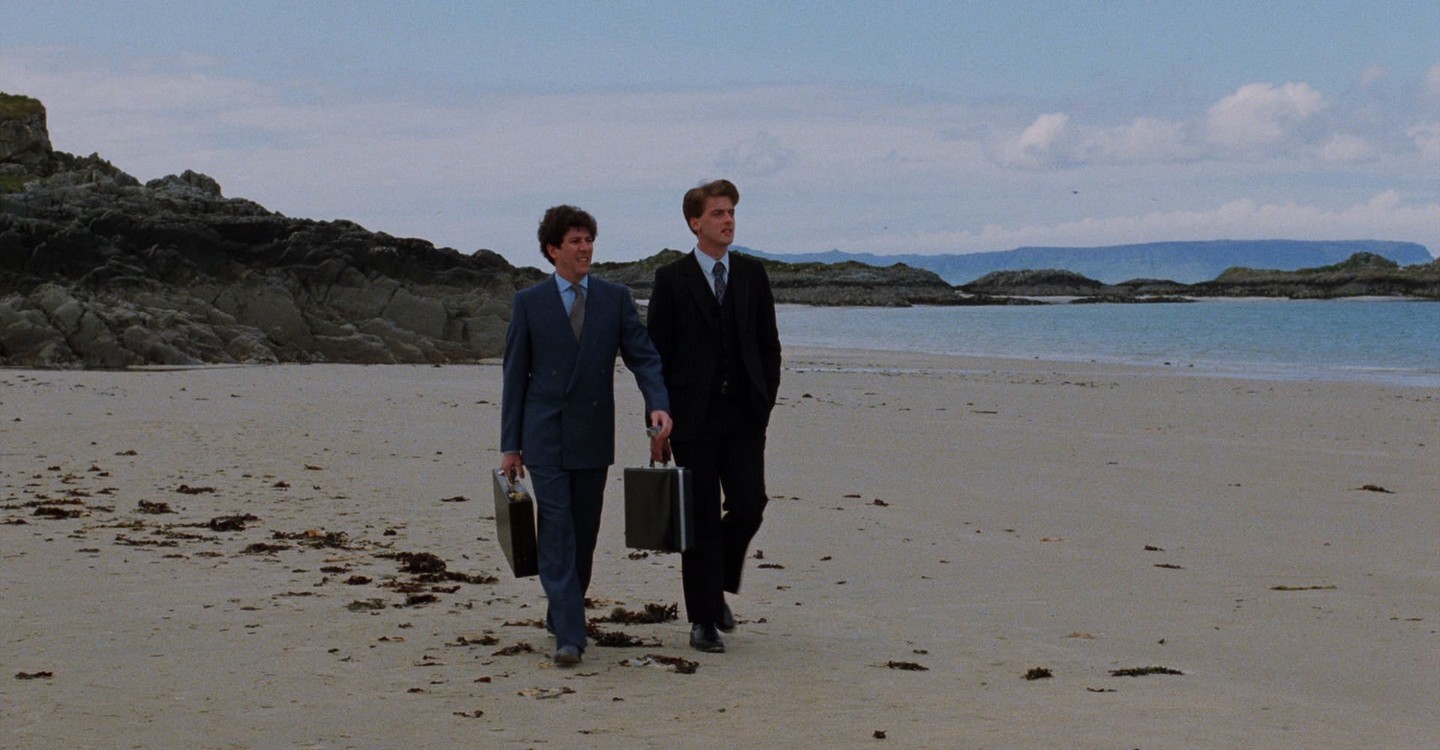
That Sinking Feeling (1979) – Sort of a Scottish version of Big Deal on Madonna Street, this was the 1979 debut from writer-director Bill Forsyth (Local Hero, Comfort & Joy). An impoverished Glasgow teenager, tired of eating cornflakes for breakfast, lunch and dinner, comes up with a scheme that will make him and his underemployed pals rich beyond their wildest dreams-knocking over a plumbing supply warehouse full of stainless steel sinks.

Funny as hell, but with a wee touch of working class weltschmerz; this subtext makes it a precursor to films like The Full Monty, Waking Ned Devine and Brassed Off. Nearly all of the same principal cast would return in Forsyth’s 1982 charmer, Gregory’s Girl.

https://i0.wp.com/digbysblog.net/wp-content/uploads/2024/10/slade-1970s-glam-rock-band.webp?w=474&quality=80&ssl=1

Slade in Flame (1974) – Akin to Mott the Hoople, it may be arguable among music geeks as to whether Slade was truly “glam” (they were a bit on the “blokey” side- as the Brits would say), but they are nonetheless considered so in some circles, and this 1974 film was released during the heyday of space boots and glitter, so there you go.

The directorial debut for Richard Loncraine (Brimstone and Treacle, The Missionary, Richard III) the film is a gritty, semi-biographical “behind the music” drama (don’t expect A Hard Day’s Night) about a working-class band called Flame (suspiciously resembling the four members of Slade, wink-wink) who get chewed up and spit out of the star-making machine (this just in: managers and A & R people are back-stabbing weasels).

While not a genre masterpiece, the film is bolstered by a great soundtrack (all Slade originals) and the casting of Tom Conti (who plays a soulless record exec with great aplomb). An amusing scene where lead singer Noddy Holder’s character gets locked into a stage coffin presages a similar hardware malfunction depicted in This Is Spinal Tap. Another memorable scene has the band risking life and limb to access the broadcast booth for an on-air interview at an offshore pirate radio station (the story is set in the late 1960s).

https://i0.wp.com/digbysblog.net/wp-content/uploads/2024/10/image-31.webp?w=1024&quality=80&ssl=1

Sorcerer (1977) – The time is ripe for a re-appraisal of William Friedkin’s 1977 action-adventure, which was greeted with indifference by audiences and critics at the time. Maybe it was the incongruous title, which likely led many to assume it would be in the vein of his previous film (and huge box-office hit), The Exorcist. Then again, it was tough for any other film to garner attention in the immediate wake of Star Wars.

At any rate, it’s an expertly directed, terrifically acted update of Henri-Georges Clouzot’s classic 1953 nail-biter, The Wages of Fear (I say “update” in deference to Friedkin, who bristles at the term “remake” in a “letter from the director” included with the Blu-ray I own).

Roy Scheider heads a superb international cast as a desperate American on the lam in South America, who signs up for a job transporting a truckload of nitroglycerin through rough terrain. Walon Green wrote the screenplay, and Tangerine Dream provides a memorable soundtrack.

https://i0.wp.com/digbysblog.net/wp-content/uploads/2024/10/Stardust-Performing-768x408-1.png?w=768&quality=80&ssl=1

Stardust (1974) – Michael Apted directed this 1974 sequel to Claude Whatham’s 1973 film That’ll Be the Day. David Essex reprises his role as restless seeker Jim MacLaine, who has finally found his true passion: music.

The first third traces MacLaine’s  Beatle-like rise to fame with his beat combo “The Stray Cats” (it’s a safe bet Brian Setzer and band mates saw this film back in the day and “re-appropriated” the name).

With massive success comes the inevitable backstage squabbles and jealousies; eventually MacLaine is surrounded by music company weasels and yes-men whispering in his ear to dump his “backup” band and pursue a solo career as a rock god (who can say “no” to that?). Then comes the inevitable decline: too much drugs, sex and rock ‘n’ roll excess.

One of the best (and most realistic) films ever made about the music business. Clever casting of a number of veteran UK rockers like Adam Faith, Dave Edmunds, Keith Moon, Marty Wylde and Paul Nicholas adds greatly to the authenticity.

https://i0.wp.com/digbysblog.net/wp-content/uploads/2024/10/image-128.webp?w=1024&quality=80&ssl=1

The Seven Per Cent Solution (1977) – Sir Arthur Conan Doyle’s super sleuth Sherlock Holmes has weathered an infinite number of movie incarnations over the decades, but none as fascinating as Nicol Williamson’s tightly wound coke fiend in this wonderful 1977 Herbert Ross film.

Intrepid sidekick Dr. Watson (Robert Duvall), concerned over his friend’s addiction, decides to do an intervention, engineering a meeting between the great detective and Dr. Sigmund Freud (Alan Arkin). Naturally, there is a mystery afoot as well, but it’s secondary to the entertaining interplay between Williamson and Arkin.

Screenwriter Nicholas Meyer (who adapted from his own novel) would repeat the gimmick two years later in his directing debut Time After Time, when he placed similarly odd bedfellows together in one story by pitting H.G. Wells against Jack the Ripper.

https://i0.wp.com/digbysblog.net/wp-content/uploads/2024/10/image-w1280.webp?w=800&quality=80&ssl=1

The Shout (1978) – This unsettling 1978 sleeper was adapted from a Robert Graves story by Michal Austin and its director, Jerzy Skolimowski. The late John Hurt is excellent as a mild-mannered avant-garde musician who lives in a sleepy English hamlet with his wife (Susannah York). When an enigmatic vagabond (Alan Bates) blows into town, their quiet country life begins to go…elsewhere. This is a genre-defying film; somewhere between psychological horror and culture clash drama. I’ll put it this way-if you like Peter Weir’s The Last Wave (which would make a great double-bill) this one is in your wheelhouse.

https://i0.wp.com/digbysblog.net/wp-content/uploads/2024/10/965_image_01_wide-428fe2a3c6668bd43746921d585ccf42bd2030b9.webp?w=1024&quality=80&ssl=1

Wanda (1970) – This 1970 character study/road movie/crime drama is an under-seen indie gem written and directed by its star Barbara Loden. Wanda (Loden) is an unemployed working-class housewife. It’s clear that her life is the pits…and not just figuratively. She’s recently left her husband and two infants and has been crashing at her sister’s house, which is within spitting distance of a yawning mining pit, nestled in the heart of Pennsylvania’s coal country.

When the judge scolds her for being late to a child custody hearing, the oddly detached Wanda shrugs it off, telling His Honor that if her husband wants a divorce, that’s OK by her; adding their kids are probably “better off” being taken care of by their father. Shortly afterward, Wanda splits her sister’s house and hits the road (hair still in curlers), carrying no more than her purse. Her long, strange road trip is only beginning.

Wanda is Terrance Malick’s Badlands meets Barbara Kopple’s Harlan County, USA; like Malick’s film it was inspired by a true crime story and features a strangely passive female protagonist with no discernible identity of her own, and like Koppel’s documentary it offers a gritty portrait of rural working-class America using unadorned 16 mm photography. A unique, unforgettable, and groundbreaking film. (Full review).

https://i0.wp.com/digbysblog.net/wp-content/uploads/2024/10/FC9AB2F0-3FC4-4A39-AD7C-C2CF287493BB.webp?w=802&quality=80&ssl=1

The Wild Rovers (1971) – Blake Edwards made a western? Yes, he did, and not a half-bad one at that. A world-weary cowhand (William Holden) convinces a younger (and somewhat dim) co-worker (Ryan O’Neal) that since it’s obvious that they’ll never really get ahead in their present profession, they should give bank robbery a shot. They get away with it, but then find themselves on the run, oddly, not so much from the law, but from their former employer (Karl Malden), who is mightily offended that anyone who worked for him would do such a thing. Episodic and leisurely paced, but ambles along quite agreeably, thanks to the charms of the two leads, and the beautiful, expansive photography by Philip Lathrop. Ripe for rediscovery.

https://i0.wp.com/digbysblog.net/wp-content/uploads/2024/10/wizards-avatar-bob-holt-elinor-jesse-welles-and-the-president-james-connell-e1470460367872.png?w=1315&quality=80&ssl=1

Wizards (1977) – Within the realm of animated films, Ralph Bakshi’s name may not be as universally recognizable (or revered) as Walt Disney or Studio Ghibli, but I would consider him no less of an important figure in the history of the genre. During his heyday (1972-1983) the director pumped out 8 full-length features (including Fritz the Cat, The Lord of the Rings and American Pop) using his signature blend of live-action, rotoscoping, and  traditional cel animation.

While I grant it is not for all tastes, I’ve always had a particular soft spot for his 1977 film, Wizards. Tanking  at the box office during its original theatrical run due to a combination of lackluster promotion by 20th Century Fox and an unfortunate proximity to the release of that same studio’s Star Wars (much to Bakshi’s chagrin, as he bitterly recounts on the commentary track of the Blu-ray I own) the film has nonetheless picked up a devoted cult following over the decades, thanks to home video.

It’s an elemental tale of two warring brothers, one good and one evil, who are both endowed with the magical powers of natural-born wizards. A familiar trope, to be sure, but Bakshi renders the story with originality, verve, and a fair amount of dark (and adult) humor.

Tribeca 2026: Dear Upstairs Neighbors (***1/2)

By Dennis Hartley

https://storage.googleapis.com/gweb-uniblog-publish-prod/original_images/Figure05_700_6_1080p.png

I’ve never experienced the trauma of war firsthand, but I have lived with upstairs neighbors for 8 years now, which has to be the next worst thing (they’re thundering back and forth as I write this!). In fact, I’ve been suffering from what could only be described as P.T.S.D. ever since the new owners of my apartment building did a gut renovation of the unit directly above me 2 years ago. It was 5 months of a non-stop, cacophonous din; it’s the closest I’ve come in my life to feeling like I was truly going to lose my goddam mind.

I think that’s why this animated short had me rolling for six minutes straight…it was so close to home that I felt like I was looking at something projected directly from my id (“fuck are they doing up there, dropping bowling balls at midnight?!”). Writer-director Connie Qin He takes a simple premise (a sleep-deprived young woman’s imagination runs wild as she tries to visualize what fresh hell her upstairs neighbors have cooked up to keep her tossing and turning) and turns it into comedy gold.

SIFF 2026: Lady (***)

By Dennis Hartley

https://i0.wp.com/digbysblog.net/wp-content/uploads/2026/05/image-152.png?resize=768%2C384&quality=80&ssl=1

“The Aristocrats!” Samuel Abrahams’ mockumentary (co-written by the director with Miranda Campbell Bowling) is the latest entry in that distinctively British sub-genre of cringe comedy seeded by the likes of Absolutely Fabulous, I’m Alan Partridge, and The Office.

Ambitious young documentary filmmaker Sam (Laurie Kyanston) is invited to meet with twitchy Lady Isabella (Sian Clifford) at her ostentatious (and curiously unkempt) country estate. After pompously claiming that she is “the aristocracy’s answer to the Kardashians”, she pitches her idea: a film that documents her creation of a multimedia project for an upcoming local youth talent show that happens to be hosted on the grounds of her estate every year.

Clearly, this woman is completely out of her mind; this should be Sam’s cue to politely bow out before getting in deeper. Judging from his facial expressions, Sam is thinking likewise. On the other hand, Sam is also thinking: this woman is completely out of her mind…what a great angle for a Netflix documentary (not to mention a chance to ridicule the ruling class). Twisty, over-the-top fun. Clifford is a riot.

SIFF 2026: Assets and Liabilities (**)

By Dennis Hartley

https://www.siff.net/images/FESTIVAL/2026/Films/Film%20Detail%20Hero%20Images%20-%20Features/Assets%26Liabilities.jpg

If you’ve been lamenting the lack of a midlife crisis horror comedy tailored for the skate punk crowd, you’ve got one now. Whether that is an asset or a liability is, I suppose, in the eye of the beholder.

Writer-director Zach Weintraub casts himself as a harried middle-age suburban Seattle dad with a corporate gig and a thousand-yard stare that suggests midlife ennui. When  his wife and toddler daughter go off on a day trip, he decides to take a mental health day from work. He smokes a blunt, dons jeans, a tee and a faded flannel shirt, digs his old board out of the garage and heads for the skate park to see if he still has the moves.

At the park, he meets and bonds with a neophyte skater who obviously reminds him of his own halcyon days. He offers the young man a ride home; however once he learns the address of the house, things get weird. Then things proceed to get even…weirder.

The first half of the film (which is an amusing suburban satire) doesn’t prepare you for the second half (gross-out body horror). I was fine with the twists and turns, but Weintraub’s particular fixation with various excretory functions was a deal-breaker for me.

SIFF 2026: Murder in the Building (***1/2)

By Dennis Hartley

https://iffr.com/en/wp-content/uploads/sites/2/2025/12/0c5f6212-ec41-4a77-9bab-fd01d02f664d-1296x729.jpg?image-crop-positioner-ts=1765850398

Rémi Bezanço’s comedy-mystery is a winking homage to Rear Window  (reminiscent of Woody Allen’s Manhattan Murder Mystery). A Parisian couple-an agoraphobic mystery writer and his wife (a film professor specializing in…Hitchcock) fear they may have witnessed a neighbor doing away with his wife following a spat. A well-trod course of amateur sleuthing hi-jinks ensues; but it’s bolstered by a clever construct, lots of laughs, genuine suspense, and the charming performances by the two lead actors.

Living through another Cuba: A filmography

By Dennis Hartley

(Originally posted on Digby’s Hullabaloo on March 7, 2026)

https://occ-0-8407-2218.1.nflxso.net/dnm/api/v6/6AYY37jfdO6hpXcMjf9Yu5cnmO0/AAAABSlVIh-rBIyV7QRKDlHAiFnBqZi6HYY7ZLEgBGrY1NmbRMiXdHnWtC553raXLZOwWIG0kwhwpgHFqXqNavc9x4ja0YNssXGxywvM.jpg?r=f6e

There’s just something about (Castro’s) Cuba that affects (U.S. presidential) administrations like the full moon affects a werewolf. There’s no real logic at work here.

-an interviewee from the documentary 638 Ways to Kill Castro

If I could only live to see it, to be there with you. What I wouldn’t give for twenty more years! Here we are, protected, free to make our profits without Kefauver, the goddamn Justice Department and the F.B.I. ninety miles away, in partnership with a friendly government. Ninety miles! It’s nothing! Just one small step, looking for a man who wants to be President of the United States, and having the cash to make it possible. Michael, we’re bigger than U.S. Steel. – From The Godfather, Pt. II, screenplay by Francis Ford Coppola and Mario Puzo

Which reminds me of a funny story…

Trump: "We're looking forward to the great change that will soon be coming to Cuba. Cuba is at the end of the line. They're very much at the end of the line."

Aaron Rupar (@atrupar.com) 2026-03-07T15:15:23.566Z

“End of the line”? Would you care to…elaborate on that, Mr. Preznit?

Trump: "Cuba is in its last moments of life … but our focus right now is on Iran. Marco will take one hour off and finish up a deal on Cuba. That'll be an easy one."

Aaron Rupar (@atrupar.com) 2026-03-07T15:17:03.149Z

Kinda like one-hour Martinizing? Bish, bash,bosh?

During his second term, President Donald Trump has authorized military action in a string of countries, including Iran, Venezuela, Ecuador, Nigeria, Somalia, and Yemen. Now, he’s hinted that Cuba could be next, declaring that the Caribbean island nation is “in its last moments of life.”

Trump delivered his stark warning during a Saturday speech in Florida, where leaders from several Latin American nations were gathered at his Doral resort.

There, he unveiled a new coalition called “The Shield of the Americas,” aimed at bolstering security across the Western Hemisphere. Kristi Noem has been tapped as a special envoy for the initiative, following her dismissal as Homeland Security secretary.

Upon taking the podium, the president said he is “looking forward to the great change that will soon be coming to Cuba.” He described the nation as “at the end of the line” and experiencing its “last moments of life.”

The country, which has been under communist rule since the 1959 Cuban revolution, has no money, no oil, and a “bad philosophy,” he continued.

While his administration is currently focused on Iran, Trump said that Secretary of State Marco Rubio will “take one hour off and finish up a deal on Cuba,” adding, “That’ll be an easy one.”

Since returning to office, Trump has taken an aggressive posture towards Cuba. He’s slapped steep tariffs on the island nation and threatened to impose duties on goods from countries that export oil to Cuba. He’s also urged the communist state to “make a deal” or face unspecified repercussions.

The country’s president, Miguel Diaz-Canel, has frequently criticized the Trump administration’s hostile rhetoric.

“Cuba is a free, independent and sovereign nation. No one tells us what to do,” he wrote on X in January, adding that his government was “ready to defend the homeland to the last drop of blood.”

For all you youngsters in the audience, the cigar-chomping dictator who once inspired a documentary entitled 638 Ways to Kill Castro (more on that below) was finally taken out in 2016 by method #639: Old age. Regardless of who is in charge of the island nation now, it’s been a long, strange trip for U.S.-Cuban relations since Castro seized power in 1959.

But I’m sure Secretary Rubio will get it straightened out in an hour or so.

While we’re holding our breath, here are 10 Cuba-themed films worth a peek:

This image has an empty alt attribute; its file name is bananas.jpg

Bananas– Yes, I know. This 1971 Woody Allen film takes place in the fictional banana republic of “San Marcos”, but the mise en scene is an obvious stand-in for Cuba. There are also numerous allusions to the Cuban revolution, not the least of which is the ridiculously fake beard donned at one point by hapless New Yawker Fielding Mellish (Allen) after he finds himself swept up in Third World revolutionary politics. Naturally, it all starts with Allen’s moon-eyed desire for a woman completely out of his league, an attractive activist (Louise Lasser). The whole setup is utterly absurd…and an absolute riot. This is pure comic genius at work. Howard Cosell’s (straight-faced) contribution is priceless. Allen co-wrote with his Take the Money and Run collaborator, Mickey Rose.

This image has an empty alt attribute; its file name is image-63.png

Buena Vista Social Club- This engaging 1999 music documentary was the brainchild of musician Ry Cooder, director Wim Wenders, and the film’s music producer Nick Gold. Guitarist/world music aficionado Cooder coaxes a number of venerable Cuban players out of retirement (most of whom had their careers rudely interrupted by the Revolution and its aftermath) to cut a collaborative album, and Wenders is there to capture what ensues (as well as ever-cinematic Havana) in his inimitable style. He weaves in footage of some of the artists as they make their belated return to the stage, playing to enthusiastic fans in Europe and the U.S.

This image has an empty alt attribute; its file name is image-64.png

Che– Let’s get this out of the way. Ernesto “Che” Guevara was no martyr. By the time he was captured and executed by CIA-directed Bolivian Special Forces in 1967, he had put his own fair share of people up against the wall in the name of the Revolution. Some historians have called him “Castro’s brain”.

That said, there is no denying that he was a complex, undeniably charismatic and fascinating individual. By no means your average revolutionary guerrilla leader, he was well-educated, a physician, a prolific writer (from speeches and essays on politics and social theory to articles, books and poetry), a shrewd diplomat and had a formidable intellect. He was also a brilliant military tactician.

Steven Soderbergh and his screenwriters (Peter Buchman and Benjamin A. Van Der Veen) adapted their 4 ½ hour opus from Guevara’s autobiographical accounts. Whereas Part 1 (aka The Argentine) is a fairly straightforward biopic, Part 2 (aka Guerilla) reminded me of two fictional films with an existential bent, both  also set in torpid South American locales-Clouzot’s The Wages of Fear and Herzog’s Aguirre, the Wrath of God. Like the doomed protagonists in those films, Guevara is fully committed to his journey into the heart of darkness, and has no choice but to cast his fate to the wind and let it all play out. Benicio del Toro shines in the lead role. Full review

This image has an empty alt attribute; its file name is image-65.png

The Godfather, Part II– While Cuba may not be the primary setting for Francis Ford Coppola’s superb 1974 sequel to The Godfather, it is the location for a key section of the narrative where powerful mob boss Michael Corleone (Al Pacino) travels to pre-Castro Havana to consider a possible business investment. He has second thoughts after witnessing a disturbing incident involving an anti-Batista rebel. And don’t forget that the infamous “kiss of death” scene takes place at Batista’s opulent New Year’s Eve party…just as the guests learn Castro and his merry band of revolutionaries have reached the outskirts of the city and are duly informed by their host…that they are on their own! And remember, if you want to order a banana daiquiri in Spanish, it’s “banana daiquiri”.

This image has an empty alt attribute; its file name is image-67.png

Harold and Kumar Escape from Guantanamo Bay– Picking up where they left off in their surprise stoner comedy hit Harold and Kumar Go to White Castle, roomies Harold (John Cho) and Kumar (Kal Penn) excitedly pack their bags for a dream European vacation in weed-friendly Amsterdam. Unbeknownst to Harold, Kumar has smuggled his new invention, a “smokeless” bong, on board.

When a “vigilant” passenger, already eyeballing Kumar with suspicion due to his ethnic appearance, catches a glimpse of him attempting to fire up his homemade contraption in the bathroom, all hell breaks loose. Before they know it, Harold and Kumar have been handcuffed by on-board air marshals, given the third degree back on the ground by a jingoistic government spook and issued orange jumpsuits, courtesy of the Gitmo quartermaster.

Through circumstances that could only occur in Harold and Kumar’s resin-encrusted alternate universe, they break out of Cuba, and hitch a boat ride to Florida. This sets off a series of cross-country misadventures. As in the first film, the more ridiculously over-the-top their predicament, the funnier it gets. It’s crass, even vulgar; but it’s somehow endearingly crass and vulgar, in a South Park kind of way (i.e. the goofiness is embedded with sharp political barbs). (Full review)

This image has an empty alt attribute; its file name is image-68.png

I Am Cuba – There is a tendency to dismiss this 1964 film about the Cuban revolution as Communist propaganda. Granted, it was produced with the full blessing of Castro’s regime, who partnered with the Soviet government to provide the funding for director Mikhail Kalatozov’s sprawling epic. Despite the dubious backers, the director was given a surprising amount of creative freedom.

On the surface, Kalatozov’s film is in point of fact a propagandist polemic; the narrative is divided into a quartet of rhetoric-infused vignettes about exploited workers, dirt-poor farmers, student activists, and rebel guerrilla fighters.

However it is also happens to be a visually intoxicating masterpiece that, despite accolades from critics over the decades, remains relatively obscure. The real stars of the film are the director and his technical crew, who will leave you pondering how they produced some of those jaw-dropping set pieces and logic-defying tracking shots.

This image has an empty alt attribute; its file name is image-69.png

The Mambo Kings– Arme Glimcher’s underrated 1992 melodrama concerns two musician brothers (Armand Assante and Antonio Banderas) who flee Cuba in the mid-1950s to seek fame and fortune in America. Hugely entertaining, with fiery performances by the two leads, great support from Cathy Moriarty and Maruschka Detmers, topped off by a fabulous soundtrack. Tito Puente gives a rousing cameo performance, and in a bit of stunt casting Desi Arnaz, Jr. is on hand to play (wait for it) Desi Arnaz, Sr. (who helps the brothers get their career going). Cynthia Cidre adapted her screenplay from Oscar Hijuelos’ novel.

This image has an empty alt attribute; its file name is image-70.png

Our Man in Havana– A decade after their collaboration on the 1949 classic, The Third Man, director Carol Reed and writer Graham Greene reunited for this wonderfully droll 1960 screen adaptation of Greene’s seriocomic novel. Alec Guinness gives one of his more memorable performances as an English vacuum cleaner shop owner living in pre-revolution Havana. Strapped for cash, he accepts an offer from Her Majesty’s government to do a little moonlighting for the British Secret Service. Finding himself with nothing to report, he starts making things up so he can stay on the payroll. Naturally, this gets him into a pickle as he keeps digging himself into a deeper hole. Reed filmed on location, which provides an interesting snapshot of Havana on the cusp of the Castro era.

This image has an empty alt attribute; its file name is image-71.png

Scarface (1983)– Make way for the bad guy. Bad guy comin’ through. Tony Montana (Al Pacino) is a bad, bad, bad, bad man, a Cuban immigrant who comes to America as part of the 1980 Mariel boat lift. A self-proclaimed “political refugee”, Tony, like the millions of immigrants before him who made this country great, aims to secure his piece of the American Dream. However, he’s a bit impatient. He espies a lucrative shortcut via Miami’s thriving cocaine trade, which he proves very adept at (because he’s very ruthless). Everything about this film is waaay over the top; Pacino’s performance, Brian De Palma’s direction, Oliver Stone’s screenplay, the mountains of coke and the carnage. Yet…it remains a guilty pleasure.

This image has an empty alt attribute; its file name is image-72.png

638 Ways to Kill Castro- History buffs (and conspiracy-a-go-go enthusiasts) will definitely want a peek at British director Dolan Cannell’s documentary. Mixing archival footage with talking heads (including a surprising number of would-be assassins), Cannell highlights some of the attempts by the U.S. government to knock off Fidel over the years. The number (638) of “ways” is derived from a list compiled by former members of Castro’s security team.

Although Cannell initially plays for laughs (many of the schemes sound like they were hatched by Wile E. Coyote) the tone becomes more sobering. The most chilling revelation concerns the 1976 downing of a commercial Cuban airliner off Barbados (73 people killed). One of the alleged masterminds was Orlando Bosch, an anti-Castro Cuban exile living in Florida (he had participated in CIA-backed actions in the past).

When Bosch was threatened with deportation in the late 80s, many Republicans rallied to have him pardoned, including Florida congresswoman Ileana Ros-Lehtinen, who used her involvement with the “Free Orlando Bosch” campaign as part of her running platform. Her campaign manager was a young up and coming politician named (wait for it) Jeb Bush. Long story short? Jeb’s Pappy then-president George Bush Sr. granted Bosch a pardon in 1990. Oh, what a tangled web, Jeb! BTW, Bosch was publicly referred to as an “unrepentant terrorist” by Richard Thornburgh, President Bush the First’s Attorney General. (Full review)

UPDATE: I dug up this pic froma 2011 post on then-Senator Rubio’s Facebook account :

This image has an empty alt attribute; its file name is image-73.png

“Sen. Marco Rubio, with Rep. Ileana Ros-Lehtinen, addressing the Bay of Pigs veterans.”

A tangled web, indeed.

Here are a few more recommendations:

Memories of Underdevelopment
Honey for Oshun
Chico and Rita
The Perez Family
Popi

Never let me down: Midwinter cinema therapy

By Dennis Hartley

It seems like a good time to re-post this one. Ocean waves, Bob. -D.H.

(Originally posted on Digby’s Hullabaloo on February 4, 2023)

https://i0.wp.com/localist-images.azureedge.net/photos/779142/original/fdd26e107abf4ea7626e5fb98b61b17c14ebb00f.png?resize=615%2C410&quality=80&ssl=1

Dee: Jane, do you ever feel like you are just this far from being completely hysterical twenty-four hours a day?

Jane:  Half the people I know feel that way. The lucky ones feel that way. The rest of the people ARE hysterical twenty-four hours a day.

— from Grand Canyon, screenplay by Lawrence and Meg Kasdan

HAL 9000: Look Dave, I can see you’re really upset about this. I honestly think you ought to sit down calmly, take a stress pill, and think things over.

— from 2001: A Space Odyssey, screenplay by Stanley Kubrick and Arthur C. Clarke

George Fields: [to Dorothy/Michael] I BEGGED you to get therapy!

— from Tootsie, screenplay by Murray Schisgal

As if the mid-winter blues weren’t enough, there’s been an odd confluence of celestial events recently – a close encounter with a hurtling asteroid, an eerie green comet lighting up the night skies, and the mysterious appearance of a high altitude “spy balloon” the size of three metro buses that has the conspiracy nuts twisting themselves into pretzels. Not that I believe in heavenly portents, but I am feeling the need for some “cinema therapy” right about now.

With that in mind, here are 12 films I’ve watched an unhealthy number of times; the ones I’m most likely to reach for when I’m depressed, anxious, uncertain about the future…or all the above. These films, like my oldest and dearest friends, have never, ever let me down. Take one or two before bedtime; cocktail optional.

https://i0.wp.com/blog.laemmle.com/wp-content/uploads/2019/02/ac-black-orpheus-b-e1549559052137.jpg?quality=89&ssl=1

Black Orpheus – Marcel Camus directed this mesmerizing 1959 film, a modern spin on a classic Greek myth. Fueled by the pulsing rhythms of Rio’s Carnaval and tempered by the gentle sway of Luiz Bonfa and Antonio Carlos Jobim’s samba soundtrack, Black Orpheus fully engages the senses. Camus and Jacques Viot adapted the screenplay from the play by Vinicius de Moraes.

Handsome tram operator Orfeo (Breno Mello) is engaged to vivacious Mira (Lourdes de Olivera) but gets hit by the thunderbolt when he meets sweet, innocent Eurydice (Marpessa Dawn). As in most romantic triangles, things get complicated, especially when Mr. Death (Ademar da Silva) starts lurking about the place.

You may be scratching your head as to why I’m “comforted” by a story based on a Greek tragedy; but Black Orpheus is graced by one of the most beautiful, life-affirming denouements in cinema; which always assures me that everything is going to be alright.

https://i0.wp.com/compote.slate.com/images/d6f03cb6-8f97-4d63-9472-4409c8b8cc48.jpeg?ssl=1

The Dish  – This 2000 Australian sleeper dramatizes the story behind the live televised images of Neil Armstrong setting foot on the moon in 1969. The worldwide broadcast was facilitated by a tracking station located on a sheep farm in New South Wales.

Quirky characters abound in Rob Sitch’s culture-clash comedy (reminiscent of Bill Forsyth’s Local Hero). It’s not all played for yucks; the re-enactment of the telecast is genuinely stirring. Sam Neill heads a fine cast. Director Sitch and co-writers Santo Cilauro, Tom Gleisner, and Jane Kennedy also collaborated on the charming 1997 dramedy The Castle (recommended!).

https://m.media-amazon.com/images/M/MV5BMjExMzQxNDEwNF5BMl5BanBnXkFtZTgwMzY4MTg3NTE@._V1_.jpg

Diva – Jean-Jacques Beineix’s 1981 cult fave kicked off a sub-genre labelled Cinéma du look (e.g. Beineix’s Betty Blue, and Luc Besson’s Subway, La Femme Nikita, and Leon the Professional).

Our unlikely antihero is mild-mannered postman Jules (Frédéric Andréi), a 20-something opera fan obsessed with a Garbo-like diva (American soprano Wilhelmenia Wiggins Fernandez). She has never recorded a studio album and stipulates that her live performances are never to be taped and/or reproduced in any medium.

An enraptured Jules attends one of her concerts and makes a high-quality recording, for his own edification. By pure chance, a pair of nefarious underworld characters witness Jules bootlegging the concert, sparking a chain of events that turns his life upside down.

Diva is an entertaining pop-art mélange of neo-noir, action-thriller, and comic-book fantasy. Chockablock with quirky characters, from a pair of hipster hit men (Gérard Darmon and Dominique Pinon) to a Zen-like international man of mystery named Gorodish (Richard Bohringer) who is currently “going through his cool period” as his girlfriend (Thuy Ann Luu) confides to Jules. Slick, stylish and thoroughly engaging.

https://i0.wp.com/cdn.britannica.com/50/23150-050-A823EED9/The-Beatles-A-Hard-Days-Night.jpg?resize=615%2C477&quality=89&ssl=1

A Hard Day’s Night – This 1964 masterpiece has been often copied, but never equaled. Shot in a semi-documentary style, the film follows a “day in the life” of John, Paul, George and Ringo at the height of their youthful exuberance and charismatic powers. Thanks to the wonderfully inventive direction of Richard Lester and Alun Owen’s clever script, the essence of what made the Beatles “the Beatles” has been captured for posterity.

Although it’s meticulously constructed, Lester’s film has an improvisational feel; and feels as fresh and innovative as when it first hit theaters all those years ago. I still catch subtle gags that surprise me (like John snorting the Coke bottle). Music highlights: “I Should Have Known Better”, “All My Loving”, “Don’t Bother Me”, “Can’t Buy Me Love”, and the fab title song.

https://i0.wp.com/theartsdesk.com/sites/default/files/styles/mast_image_landscape/public/mastimages/harold%20and%20maude_header.jpg?ssl=1

Harold and Maude – Harold loves Maude. And Maude loves Harold. It’s a match made in heaven-if only society would agree. Because Harold (Bud Cort) is a teenager, and Maude (Ruth Gordon) is just shy of 80. Falling in love with a woman old enough to be his great-grandmother is the least of Harold’s quirks. He’s a chronically depressed trustafarian who amuses himself by staging fake suicides to freak out his patrician mother (wonderfully droll Vivian Pickles). He also “enjoys” funerals-which is where Harold and Maude Meet Cute.

The effervescent Maude is Harold’s polar opposite; while he wallows in morbid speculation how any day could be your last, she seizes each day as if it actually were. Obviously, she has something to teach him. Despite dark undertones, this is one “midnight movie” that manages to be life-affirming. Hal Ashby directed, and Colin Higgins (who would later write and direct Foul Play and 9 to 5) wrote the screenplay. Outstanding soundtrack by Cat Stevens.

https://images.justwatch.com/backdrop/133833962/s1440/local-hero

Local Hero – This low-key, observant 1983 social satire from Scottish writer-director Bill Forsyth stars Peter Reigert as Macintyre, a Texas-based executive who is assigned by the head of “Knox Oil & Gas” (Burt Lancaster) to scope out a sleepy Scottish hamlet that sits on an oil-rich bay. He is to negotiate with local property owners and essentially buy out the town so that the company can build a huge refinery.

While he considers himself “more of a Telex man”, who would prefer to knock out such an assignment “in an afternoon”, Mac sees the overseas trip as a possible fast track for a promotion within the corporation. As this quintessential 80s Yuppie works to ingratiate himself with the unhurried locals, a “fish out of water” transformation ensues. It’s the kindest and gentlest Ugly American tale you’ll ever see.

https://pics.filmaffinity.com/Man_on_the_Train-495405654-large.jpg

Man on the Train – There are a only a handful of films I have become  emotionally attached to, usually for reasons I can’t completely fathom. This 2002 drama is one of them. Best described as an “existential noir”, Patrice LeConte’s relatively simple tale of two men in their twilight years with disparate life paths (a retired poetry teacher and a career felon) forming an unexpected deep bond turns into a transcendent film experience. French pop star Johnny Hallyday and screen veteran Jean Rochefort deliver mesmerizing performances. I feel an urge to watch it right now.

https://i0.wp.com/cdna.artstation.com/p/assets/images/images/024/683/844/4k/alice-marshall-my-neighbor-totoro2.jpg?ssl=1

My Neighbor Totoro  – While this 1988 film was anime master’s Hayao Miyazaki’s fourth feature, it was one of his (and Studio Ghibli’s) first international hits.

It’s a lovely tale about a young professor and his two daughters settling into their new country house while Mom convalesces at a nearby hospital. The rambunctious 4 year-old goes exploring and stumbles into the verdant court of a “king” nestled within the roots of a gargantuan camphor tree. This king rules with a gentle hand; a benign forest spirit named Totoro (an amalgam of every plush toy you ever cuddled with as a child).

Granted, it’s Miyazaki’s most simplistic and kid-friendly tale…but that’s not a put down. Miyazaki’s usual themes remain intact; the animation is breathtaking, the fantasy elements magical, yet the human characters are down-to-earth and universally relatable. A charmer.

https://i0.wp.com/denofcinema.com/wp-content/uploads/2022/01/shermans-march-1024x576.jpg?resize=1024%2C576&quality=89&ssl=1

Sherman’s March – Filmmaker Ross McElwee is one of America’s hidden treasures. McElwee, a genteel Southern neurotic (Woody Allen meets Tennessee Williams) has been compulsively documenting his personal life since the mid 70’s and managed to turn the footage into some of the most hilarious, moving and thought-provoking films most people have never seen.

Audiences weaned on “reality TV” may wonder “what’s the big deal about one more schmuck making glorified home movies?” but they would be missing an enriching glimpse into the human condition. Sherman’s March began as a project to retrace the Union general’s path of destruction through the South, but ended up as rumination on the eternal human quest for love and acceptance, filtered through McElwee’s search for the perfect mate.

Despite its 3 hour length, I’ve found myself returning to this film for repeat viewings, and enjoying it just as much as the first time. The unofficial “sequel”, Time Indefinite, is also worth a peek.

https://i0.wp.com/digbysblog.net/wp-content/uploads/2023/02/image-123.png?resize=1024%2C576&quality=80&ssl=1

The Thin Man – W.S. Van Dyke’s delightful mix of screwball comedy and murder mystery (adapted from Dashiell Hammett’s novel by Albert Hackett and Frances Goodrich) never gets old for me. Story takes a backseat to the repartee between private investigator (and perpetually tipsy socialite) Nick Charles (William Powell) and his wisecracking wife Nora (sexy Myrna Loy). Top it off with a scene-stealing wire fox terrier (Asta!) and you’ve got a winning formula that has spawned countless imitations; particularly a bevy of sleuthing TV couples (Hart to Hart, McMillan and Wife, Moonlighting, Remington Steele, et.al.).

https://i.ytimg.com/vi/AuUgRaBc4og/maxresdefault.jpg

True Stories – Musician/raconteur David Byrne enters the Lone Star state of mind with his subtly satirical Texas travelogue from 1986. Not easy to pigeonhole; part social satire, long-form music video, and mockumentary. The vignettes about the quirky but generally likable inhabitants of sleepy Virgil, Texas should hold your fascination once you buy into “tour-guide” Byrne’s bemused anthropological detachment. Among the town’s residents: John Goodman, “Pops” Staples, Swoosie Kurtz and the late Spalding Gray. The outstanding cinematography is by Edward Lachman. Byrne’s fellow Heads have cameos performing “Wild Wild Life”.

https://cinemaaxis.com/wp-content/uploads/2013/12/wings-of-desire-2.jpg?w=770

Wings of Desire – I’ve never attempted to compile a Top 10 list of my all-time favorite films (I’ve just seen too many damn movies…I’d be staring at an empty page for weeks, if my head didn’t explode first) but I’m certain Wim Wenders’ 1987 stunner would be a shoo-in. Now, attempting to describe this film is something else altogether.

If I told you it’s about an angel (Bruno Ganz) who hovers over Berlin in a trench coat, monitoring people’s thoughts and taking notes, who spots a beautiful trapeze artist (Solveig Dommartin) and follows her home, wallows in her deepest longings, watches her undress, then falls in love and decides to chuck the mantle of immortality and become human…you’d probably say “That sounds like a story about a creepy stalker.” And if I told you it features Peter Falk, playing himself, you’d laugh nervously and say, “Oh, look at the time.” Of course, there is more to it-about life, the universe, and everything.

BONUS!

If you really want to go all out for movie night (which is pretty much every night for me), you have to watch a cartoon before the movie, right? Here’s my 2011 review of a Blu-ray box set always guaranteed to lift your spirits. Keep it handy, right next to the first aid kit.

https://i0.wp.com/digbysblog.net/wp-content/uploads/2023/02/image-122.png?w=945&quality=80&ssl=1

The Looney Tunes Platinum Collection, Vol. 1  – During those long, dark nights of my soul, when all seems hopeless and futile, there’s one thought that never fails to bring me back to the light. It’s that feeling that somewhere, out there in the ether, there’s a frog, with a top hat and a cane, waiting for his chance to pop out of a box and sing:

Hello my baby, hello my honey, hello my ragtime gal

Send me a kiss by wire, baby my heart’s on fire…

If you don’t know what I’m talking about, just go ahead and skip to the next review now.

The rest of you might want to check out this fabulous 3-disc collection, which features 50 classic animated shorts (and 18 rarities) from the Warner Brothers vaults. Deep catalog Looney Tunes geeks may quibble until the cows come home about what’s not here (Warner has previously released six similar DVD collections in standard definition), but for the casual fans (like yours truly) there is plenty to please. I’m just happy to have “One Froggy Evening”, “I Love to Singa”, “Rabbit of Seville”, “Duck Amuck”, “Leghorn Lovelorn”, “Three Little Bops” and “What’s Opera Doc?” in one place. The selections cover all eras, from the 1940s onward.

One thing that does become clear, as you watch these restored gems in gorgeous hi-def (especially those from the pre-TV era) is that these are not “cartoons”, they are 7 ½ minute films, every bit as artful as anything else cinema has to offer. Extras include a trio of excellent documentaries about the studio’s star director, the legendary Chuck Jones. The real diamond among the rarities is The Dot and the Line: A Romance in Lower Mathematics (directed by Jones for MGM), which won the 1965 Oscar for Best Animated Short Film.

More medicine:

Book of Saturday

Book of Saturday II

Book of Saturday III

Book of Saturday IV

Blu-ray reissue: Withnail & I (****)

By Dennis Hartley

(Originally posted on Digby’s Hullabaloo on July 26, 2025)

https://i0.wp.com/digbysblog.net/wp-content/uploads/2025/07/withnail_and_i.jpg?fit=900%2C450&quality=89&ssl=1&resize=640%2C320&_jb=custom

Withnail & I (Criterion Collection)

Writer-director Bruce Robinson’s 1987 study of two impoverished actors slogging through 1969 London with high hopes and low squalor has earned a devoted cult following (guilty as charged). Richard E. Grant excels as the decadently wasted Withnail, ably supported by Paul McGann (he would be the “I”).

The two flat mates, desperate for a break from their cramped, freezing apartment and mutual descent into creeping fear and paranoia, take a trip to the country, where Withnail’s rich eccentric uncle (Richard Griffiths) keeps a cottage. There are so many quotable lines (“We want the finest wines available to humanity. And we want them here, and we want them now!” or “We’ve gone on holiday by mistake.”). Ralph Brown nearly steals the film as Danny the drug dealer.

Previous DVD and Blu-ray editions have been frustratingly problematic in terms of image and/or sound quality (I think I’ve owned them all), but the 2025 Criterion edition finally puts those issues to rest with a proper 4K restoration (granted, the film was purposely shot in low light and muted brown and grey tones to match the characters’ melancholic mood; still, this is the best print I’ve seen to date). Extras include two audio commentaries, a new short with Robinson and Grant, and Withnail and Us (1999), a documentary on the making of the film.

Lazy, hazy, crazy: Top 10 Summer Idyll Films

By Dennis Hartley

(Originally posted on Digby’s Hullabaloo on July 12, 2025)

https://upload.wikimedia.org/wikipedia/commons/thumb/7/7d/A_Sunday_on_La_Grande_Jatte%2C_Georges_Seurat%2C_1884.jpg/960px-A_Sunday_on_La_Grande_Jatte%2C_Georges_Seurat%2C_1884.jpg

Since it’s now officially summer, I thought it would be a good excuse to cull a list of my 10 seasonal favorites for your consideration. These would be films that I feel capture the essence of these “lazy, hazy, crazy” days; stories infused with the sights, the sounds, the smells, of summer. So, here you go…as per usual, in alphabetical order:

https://i0.wp.com/digbysblog.net/wp-content/uploads/2023/06/image-130.png?resize=1024%2C576&ssl=1

Jazz on a Summer’s Day– Bert Stern’s groundbreaking documentary about the 1958 Newport Jazz Festival is not so much a “concert film” as it is a fascinating and colorful time capsule of late 50s American life. Don’t get me wrong, there are plenty of gorgeously filmed numbers spotlighting the artistry of Thelonius Monk, Anita O’Day, Dinah Washington, Louis Armstrong, etc. and the performances are outstanding.

The effect is like “being there” in 1958 Newport on a languid summer’s day. If you’ve ever attended an outdoor music festival, you know half the fun is people-watching, and Stern obliges. Stern breaks with film making conventions of the era; this is the genesis of the cinema verite music documentary, which wouldn’t come to full flower until a decade later with films like Don’t Look Back, Monterey Pop, Woodstock and Gimme Shelter.

https://i0.wp.com/digbysblog.net/wp-content/uploads/2023/06/image-131.png?w=600&ssl=1

Last Summer–This underrated 1969 gem is from the husband-and-wife film making team of director Frank Perry and writer Eleanor Perry (who adapted from Evan Hunter’s novel).

On the surface, it’s a character study about three friends on the cusp of adulthood (Bruce Davison, Barbara Hershey and Richard Thomas) who develop a Jules and Jim-style relationship during a summer idyll on Fire Island. When a socially awkward stranger (Catherine Burns, in a Best Supporting Actress-nominated performance) bumbles into this simmering cauldron of raging hormones and burgeoning sexuality, it blows the lid off the pressure cooker, leading to shocking twists (don’t expect Beach Blanket Bingo). Think Summer of ’42 meets Lord of the Flies; this isn’t so much about the exuberance of youth as it is about the cruelty of youth (a precursor to films like River’s Edge). Beautifully acted and directed.

https://i0.wp.com/digbysblog.net/wp-content/uploads/2023/06/image-132.png?w=750&ssl=1

Mid-August Lunch– This slice-of-life charmer from Italy, set during the mid-August Italian public holiday known as Ferragosto, was written and directed by Gianni Di Gregorio (who also co-scripted the 2009 gangster drama Gomorra).

Di Gregorio casts himself as Giovanni, an easy-going middle-aged bachelor living in Rome with his elderly mother. He doesn’t work, because as he tells a friend, taking care of mama is his “job”.

One day, his landlord drops in. He wants to take a weekend excursion with his mistress and asks for a “small” favor. In exchange for forgiveness on back rent, he requests Giovanni take a house guest for the weekend-his elderly mother. Giovanni agrees, but is chagrined when the landlord turns up with two little old ladies (he hadn’t mentioned his aunt). Soon after, Giovanni’s doctor makes a house call; in lieu of a service charge he asks Giovanni if he doesn’t mind taking on his dear old mama as well (Ferragosto is a popular “getaway” holiday in Italy).

It’s the small moments that make this film such a delight. Giovanni reading Dumas aloud to his mother, until she quietly nods off in her chair. Two friends, sitting in the midday sun, enjoying white wine and watching the world go by. In a scene that reminded me of a classic sequence in Fellini’s Roma, Giovanni and his pal glide us through the streets of Rome on a sunny motorcycle ride. This mid-August lunch might offer you a limited menu, but you’ll find every morsel worth savoring.

https://i0.wp.com/digbysblog.net/wp-content/uploads/2023/06/image-133.png?w=1000&ssl=1

Mommy is at the Hairdresser’s- Set at the beginning of an idyllic Quebec summer, circa 1966, Lea Pool’s beautifully photographed drama centers around the suburban Gauvin family. A teenager (Marianne Fortier) and her little brothers are thrilled that school’s out for summer. Their loving parents appear to be the ideal couple; Mom (Celine Bonnier) is a TV journalist and Dad (Laurent Lucas) is a medical microbiologist. A marital infidelity precipitates a separation, leaving the kids in the care of their well-meaning but now titular father, and young Elise finds herself the de facto head of the family. This is a perfect film about an imperfect family; a bittersweet paean to the endless summers of childhood lost.

https://i0.wp.com/digbysblog.net/wp-content/uploads/2023/06/image-134.png?resize=1024%2C576&ssl=1

Smiles of a Summer Night– “Lighthearted romp” and “Ingmar Bergman” are not normally synonymous, but it applies to this wise, drolly amusing morality tale from the director whose name is synonymous with somber dramas. Bergman regular Gunnar Bjornstrand heads a fine ensemble, as an amorous middle-aged attorney with a young wife (whose “virtue” remains intact) and a free-spirited mistress, who juggles a few lovers herself. As you may guess, this leads to amusing complications.

Love in all its guises is represented by a bevy of richly drawn characters, who converge in a third act set on a sultry summer’s eve at a country estate (the inspiration for Woody Allen’s A Midsummer Night’s Sex Comedy). Fast-paced, literate, and sensuous, it has a muted cry here and a whisper there of that patented Bergman “darkness”, but compared to most of his oeuvre, this one is a veritable screwball comedy.

https://i0.wp.com/digbysblog.net/wp-content/uploads/2023/06/image-135.png?w=828&ssl=1

Stand By Me– Director Rob Reiner was on a roll in the mid-to late 80s, delivering five exceptional films, book-ended by This is Spinal Tap in 1984 and When Harry Met Sally in 1989. This 1986 dramedy was in the middle of the cycle. Based on a Stephen King novella (adapted by Raynold Gideon and Bruce A. Evans) it’s a bittersweet “end of summer” tale about four pals (Wil Wheaton, River Phoenix, Corey Feldman and Jerry O’Connell) who embark on a search for the body of a missing teenager, during the course of which they learn hard life lessons. Reiner coaxes extraordinary performances from the young leads, and Richard Dreyfus provides the narration.

https://i0.wp.com/digbysblog.net/wp-content/uploads/2023/06/image-136.png?resize=1024%2C563&ssl=1

Summer Wars– Don’t be misled by the cartoon title of Mamoru Hosoda’s eye-popping movie-this could be the Gone with the Wind of Japanese anime. OK…that’s a tad hyperbolic. But it does have drama, romance, comedy, and war-centering around a summer gathering at a bucolic family estate. Tokyo Story meets War Games? At any rate, it’s one of the finer animes of recent years. While some narrative devices in Satoko Ohuder’s screenplay will feel familiar to anime fans (particularly the “cyber-punk” elements), it’s the humanist touches and subtle social observations (reminiscent of Yasujiro Ozu’s films) that makes it unique and worthwhile.

https://i0.wp.com/digbysblog.net/wp-content/uploads/2023/06/image-137.png?resize=1024%2C576&ssl=1

A Summer’s Tale– It’s nearly 8 minutes into Eric Rohmer’s romantic comedy before anyone utters a word; and it’s a man calling a waitress over to order a chocolate crepe. But not to worry, because things are about to get much more interesting.

In fact, our young man, an introverted maths grad named Gaspar (Melvil Poupaud), who is killing time in sunny Dinard until his “sort of” girlfriend arrives to join him on summer holiday, will soon find himself in a dizzying girl whirl. It begins when he meets bubbly and outgoing Margo (Amanda Langlet) an ethnologist major who is spending her summer break waitressing at her aunt’s seaside creperie. Margo is also (sort of) spoken for, with a boyfriend (currently overseas). A friendship blooms. But will they stay “just friends”?

Originally released in France in 1996, this film (which didn’t make its official U.S. debut until 2014) rates among the late director’s best work (strongly recalling Pauline at the Beach, which starred a then teenage Langlet, who is wonderful here as the charming Margo).

In a way, this is a textbook “Rohmer film”, which I define as “a movie where the characters spend more screen time dissecting the complexities of male-female relationships than actually experiencing them”. Don’t despair; it won’t (as Gene Hackman’s character in Night Moves states regarding a Rohmer film) be akin to “watching paint dry”. Even a neophyte will glean the director’s ongoing influence (particularly if you’ve seen Once, When Harry Met Sally, or Richard Linklater’s “Before” trilogy).

https://i0.wp.com/digbysblog.net/wp-content/uploads/2023/06/image-138.png?w=700&ssl=1

Tempest– “Show me the magic.” Nothing says “idyllic” like a Mediterranean getaway, which provides the backdrop for Paul Mazursky’s seriocomic 1982 update of Shakespeare’s classic play.

His Prospero is a harried Manhattan architect (John Cassavetes) who spontaneously quits his firm, abandons his wife (Gena Rowlands), packs up his teen daughter (Molly Ringwald) and retreats to a Greek island for an open-ended sabbatical. He soon adds a young lover (Susan Sarandon) and a Man Friday (Raul Julia) to his entourage. But will this idyll inevitably be steamrolled by the adage: “Wherever you go…there you are”?

The pacing lags a little bit on occasion, but superb performances, gorgeous scenery and bits of inspired lunacy (like a choreographed number featuring Julia and his sheep dancing to “New York, New York”) make up for it.

https://i0.wp.com/digbysblog.net/wp-content/uploads/2023/06/image-139.png?resize=1024%2C704&ssl=1

3 Women– If Robert Altman’s haunting 1977 character study plays like a languid, sun-baked California fever dream…it’s because it was (the late director claimed that the story came to him in his sleep). What ended up on the screen not only represents Altman’s best, but one of the best American art films of the 1970s.

The women are Millie (Shelly Duvall), a chatty physical therapist, considered a needy bore by everyone except her childlike roommate/co-worker Pinky (Sissy Spacek), who worships the ground she walks on, and enigmatic Willie (Janice Rule), a pregnant artist who only paints anthropomorphic lizard figures (empty swimming pools as her canvas). As the three personas slowly merge (bolstered by fearless performances from the three leads), there’s little doubt that Millie, Pinky and Willie hail from the land of Wynken, Blynken and Nod.

SIFF 2025: Scarecrow in a Garden of Cucumbers (**1/2)

By Dennis Hartley

https://tlt-events.s3.amazonaws.com/2934535d-5613-46e7-9bd5-877b74dad80a_resize.png

Robert J. Kaplan’s long-“lost” 1972 cult indie starring the legendary Holly Woodlawn (immortalized in Lou Reed’s “Walk on the Wild Side”) has been restored in all of its…glory, by the Academy Film Archive. This was Warhol Factory alum Woodlawn’s third film (she had previously appeared in two of Paul Morrissey’s features).

Woodlawn plays “Eve Harrington” (first in a series of references), a naive Kansas farm gal who hits the Big Apple with ambitions of becoming a huge, huge star. She encounters a bevy of fellow wannabes and low-rung show-biz hustlers. While this suggests a dark and depressing tale (there’s a nod to Midnight Cowboy with a character named “Joe Buck”), no worries-because this is a musical (sort of).

This campy wallow in some of NYC’s seediest neighborhoods is pretty over-the-top (reminiscent of Ralph Bakshi’s 1973 animated feature Heavy Traffic) and anyone looking for a cohesive narrative need not apply, but there are some genuine laughs and a couple of decent songs (one sung by Bette Midler). Not for all tastes; I’d wager that fans of directors John Waters and/or Paul Bartel will fare best.