Category Archives: Politics

Conspiracy a go-go (slight return)

By Dennis Hartley

(Originally posted on Digby’s Hullabaloo on November 23, 2024)

https://denofcinema.com/wp-content/uploads/2024/11/131030-jfk-jackie-dallas-1963-03.jpg

“Strength takes many forms, and the most obvious forms are not always the most significant. The men who create power make an indispensable contribution to the Nation’s greatness, but the men who question power make a contribution just as indispensable, especially when that questioning is disinterested, for they determine whether we use power or power uses us. […] 

If sometimes our great artists have been the most critical of our society, it is because their sensitivity and their concern for justice, which must motivate any true artist, makes him aware that our Nation falls short of its highest potential. […]

We must never forget that art is not a form of propaganda; it is a form of truth […] But democratic society — in it, the highest duty of the writer, the composer, the artist is to remain true to himself and to let the chips fall where they may. In serving his vision of the truth, the artist best serves his nation.” President John F. Kennedy, from his Robert Frost tribute address (October 23, 1963)

61 years ago this past Friday, President John F. Kennedy and First Lady Jacqueline Kennedy landed in Dallas, Texas at 11:38am. They were accompanied by Texas Governor John Connally and his wife. The two couples were greeted by Vice-President Lyndon B. Johnson and Lady Bird Johnson. After about 15 minutes of schmoozing with the friendly crowd of admirers gathered on the tarmac, the Kennedys, Johnsons, and Connallys were whisked to their waiting motorcade, which would take them through downtown Dallas. Thousands of locals already lined the route, eager for a glimpse of the charismatic President and First Lady.

As we are all now painfully aware, President Kennedy had only 35 minutes left to live.

“Where were you when Kennedy got shot?” has been a meme for anyone old enough to remember what happened that day in Dallas on November 22, 1963.

I was but a wee military brat, attending my second-grade class at a public school in Columbus, Ohio (my dad was stationed at nearby Fort Hayes). Our class was herded into the gym for an all-school assembly. Someone (probably the principal) gave a brief address. It gets fuzzy from there; we either sang “My Country ‘Tis of Thee” or recited the Pledge of Allegiance (or we possibly did both), and were sent home early.

My 7-year-old mind could not grasp the profound sociopolitical impact of this tragedy; naturally I have come to understand it in the fullness of time. From my 2016 review of Jackie

Understandably, the question of “why now?” could arise, to which I would reply (paraphrasing JFK) …why not? To be sure, Jacqueline Kennedy’s story has been well-covered in a myriad of documentaries and feature films; like The Beatles, there are very few (if any) mysteries about her life and legacy to uncover at this point. And not to mention that horrible, horrible day in Dallas…do we really need to pay $15 just to see the nightmare reenacted for the umpteenth time? (Spoiler alert: the President dies at the end). 

I think that “we” do need to see this film, even if we know going in that there was no “happy ever-aftering” in this Camelot. It reminds us of a “brief, shining moment” when all seemed possible, opportunities were limitless, and everything was going to be all right, because Jack was our king and Jackie was our queen. So what if it was all kabuki, as the film implies; merely a dream, invented by “a great, tragic actress” to unite us in our sadness. Then it was a good dream, and I think we’ll find our Camelot again…someday.

If we can just get through these next four years, maybe then (I can dream, can’t I?).

https://i.ytimg.com/vi/s-cb5iDPjlw/maxresdefault.jpg

They will run you dizzy. They will pile falsehood on top of falsehood, until you can’t tell a lie from the truth – and you won’t even want to. That’s how the powerful keep their power. Don’t you read the papers? From Winter Kills (screenplay by William Richert)

The Kennedy assassination precipitated a cottage industry of independent investigations, papers, articles, non-fiction books, novels, documentaries and feature films that riff on myriad conspiracy theories.

Then of course there was that Warren Commission report released in 1964; an 888-page summation concluding JFK’s alleged murderer Lee Harvey Oswald acted alone. This “conclusive” statement, of course only fueled more speculation that our government was not being completely …forthcoming.

2024 marks the 45th anniversary of one of the more oddball conspiracy thrillers based on the JFK assassination…Winter Kills. Director William Richert adapted his screenplay from Richard Condon’s book (Condon also wrote The Manchurian Candidate, which was adapted for the screen twice).

Jeff Bridges stars as the (apolitical) half-brother of an assassinated president. After witnessing the deathbed confession of a man claiming to be a “second gunman”, he reluctantly gets drawn into a new investigation of his brother’s murder nearly 20 years after the matter was allegedly put to rest by the findings of the “Pickering Commission”.

John Huston chews the scenery as Bridges’ father (a larger-than-life character said to be loosely based on Joseph Kennedy Sr.). The cast includes Anthony Perkins, Eli Wallach, Sterling Hayden, Ralph Meeker, Toshiro Mifune, Richard Boone, and Elizabeth Taylor.

The film vacillates between byzantine conspiracy thriller and a broad satire of other byzantine conspiracy thrillersbut is eminently watchable, thanks to an interesting cast and a screenplay that, despite ominous undercurrents, delivers a great deal of dark comedy.

Is Winter Kills essential viewing? It depends. If you like quirky 60s and 70s cinema, it’s one of the last hurrahs in a film cycle of arch, lightly political and broadly satirical all-star psychedelic train wrecks like The Loved One, The President’s Analyst, Skidoo, Candy and The Magic Christian. For “conspiracy-a-go-go” completists, it is a must-see.

Here are 9 more films that either deal directly with or have a notable link with the JFK conspiracy cult. And while you’re watching, keep President Kennedy’s observation in the back of your mind: “In serving his vision of the truth, the artist best serves his nation.” https://i.pinimg.com/originals/c0/c8/b1/c0c8b1d48149687b70248be7ee877748.jpg

Suddenly – Lewis Allen’s taut 1954 hostage drama/film noir stars a surprisingly effective Frank Sinatra as John Baron, the cold-blooded leader of a three-man hit team who are hired to assassinate the (unnamed) President during a scheduled whistle-stop at a sleepy California town (interestingly, the role of John Baron was originally offered to Montgomery Clift).

The film is essentially a chamber piece; the assassins commandeer a family’s home that affords them a clear shot at their intended target. In this case, the shooter’s motives are financial, not political (“Don’t give me that politics jazz-it’s not my racket!” Sinatra snarls after he’s accused of being “an enemy agent” by one of his hostages). Richard Sale’s script also drops in a perfunctory nod or two to the then-contemporaneous McCarthy era (one hostage speculates that the hit men are “commies”).

Also in the cast: Sterling Hayden, James Gleason, Nancy Gates, Christopher Dark, and Paul Frees (Frees would later become known as “the man of a thousand voices” for his voice-over work with Disney, Jay Ward Productions, Rankin/Bass and other animation studios).

Some aspects of the film are eerily prescient of President Kennedy’s assassination 9 years later; Sinatra’s character is an ex-military sharpshooter, zeroes down on his target from a high window, and utilizes a rifle of a European make. Most significantly, there have been more than a few claims over the years in JFK conspiracy circles suggesting that Lee Harvey Oswald had watched this film with a keen interest.

There have been conflicting stories over the years whether Sinatra had Suddenly pulled from circulation following Kennedy’s death; the definitive answer may lie in remarks made by Frank Sinatra, Jr., in a commentary track he did for a 2012 Blu-ray reissue of the film:

[Approximately 2 weeks] after the assassination of President Kennedy, a minor network official at ABC television decided he was going to run “Suddenly” on network television. This, while the people were still grieving and numbed from the horror of the death of President Kennedy. When word of this reached Sinatra, he was absolutely incensed…one of the very few times had I ever seen him that angry. He got off a letter to the head of broadcasting at ABC, telling them that they should be jailed; it was in such bad taste to do that after the death of President Kennedy.

Sinatra, Jr. does not elaborate any further, so I interpret that to mean that Frank, Sr. fired off an angry letter, and the fact that the film remains in circulation to this day would indicate that it was never actually “pulled” (of course, you are free to concoct your own conspiracy theory).

https://i0.wp.com/unaffiliatedcritic.com/wp-content/uploads/2018/07/THE-MANCHURIAN-CANDIDATE-1962.png?ssl=1

The Manchurian Candidate – There’s certainly more than just a perfunctory nod to Red hysteria in John Frankenheimer’s 1962 cold war paranoia fest, which was the last assassination thriller of note released prior to the zeitgeist-shattering horror of President Kennedy’s murder. Oddly enough, Frank Sinatra was involved in this project as well. Sinatra plays a Korean War vet who reaches out to help a buddy he served with (Laurence Harvey). Harvey is on the verge of a meltdown, triggered by recurring war nightmares.

Sinatra has been suffering the same malady (both men had been held as POWs by the North Koreans). Once it dawns on Sinatra that they both may have been brainwashed during their captivity for very sinister purposes, all hell breaks loose.

In this narrative (based on Richard Condon’s novel) the assassin is posited as an unwitting dupe of a decidedly “un-American” political ideology; a domestic terrorist programmed by his Communist puppet masters to kill on command. Some of the Cold War references have dated; others (as it turns out) are evergreen.

https://i2.wp.com/denofcinema.com/wp-content/uploads/2021/11/image-w1280-1024x576.webp?resize=1024%2C576&ssl=1

Seven Days in May – This 1964 “conspiracy a-go go” thriller was director John Frankenheimer’s follow-up to The Manchurian Candidate. Picture if you will: a screenplay by Rod Serling, adapted from a novel by Fletcher Knebel and Charles W. Bailey II.

Kirk Douglas plays a Marine colonel who is the adjutant to a hawkish, hard right-leaning general (Burt Lancaster) who heads the Joint Chiefs of Staff.  The general is at loggerheads with the dovish President (Fredric March), who is perceived by the general and some of the other joint chiefs as a “weak sister” for his strident support of nuclear disarmament.

When Douglas begins to suspect that an imminent, unusually secretive military “exercise” may in fact portend more sinister intentions, he is torn between his loyalty to the general and his loyalty to the country as to whether he should raise the alarm. Or is he just being paranoid?

An intelligently scripted and well-acted nail-biter, right to the end. Also with Ava Gardner, Edmund O’Brien, and Martin Balsam.

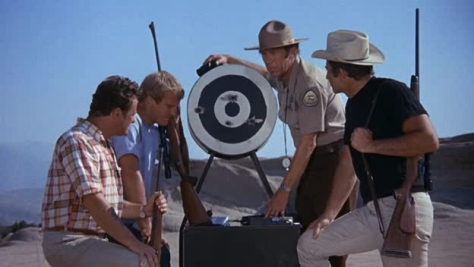
https://wolfmanscultfilmclub.files.wordpress.com/2017/01/executive-action-1973-target-pactice.jpg

Executive Action – After the events of November 22, 1963, Hollywood took a decade-long hiatus from the genre; it seemed nobody wanted to “go there”. But after Americans had mulled a few years in the sociopolitical turbulence of the mid-to-late 1960s (including the double whammy of losing Robert F. Kennedy and Martin Luther King to bullets in 1968), a new cycle of more cynical and byzantine conspiracy thrillers began to crop up (surely exacerbated by Watergate).

The most significant shift in the meme was to move away from the concept of the assassin as a dupe or an operative of a “foreign” (i.e., “anti-American”) ideology; some films postulated that shadowy cabals of businessmen and/or members of the government were capable of such machinations. The rise of the JFK conspiracy cult (and the cottage industry it created) was probably a factor as well.

One of the earliest examples was this 1973 film, directed by David Miller, and starring Burt Lancaster and Robert Ryan. Dalton Trumbo (famously blacklisted back in the 50s) adapted the screenplay from a story by Donald Freed and Mark Lane.

A speculative thriller about the JFK assassination, it offers a scenario that a consortium comprised of hard right pols, powerful businessmen and disgruntled members of the clandestine community were responsible.

Frankly, the premise is more intriguing than the film (which is flat and talky), but the filmmakers deserve credit for being the first ones to “go there”. The film was a flop at the time, but has become a cult item; as such, it is more of a curio than a classic. Still, it’s worth a watch.

https://i1.wp.com/denofcinema.com/wp-content/uploads/2021/11/the-parallax-view-1024x768.jpg?resize=1024%2C768&ssl=1

The Parallax View – Alan J. Pakula’s 1974 thriller takes the concept of the dark corporate cabal one step further, positing political assassination as a sustainable capitalist venture, if you can perfect a discreet and reliable algorithm for screening and recruiting the right “employees”.

Warren Beatty delivers an excellent performance as a maverick print journalist investigating a suspicious string of untimely demises that befall witnesses to a U.S. senator’s assassination in a restaurant atop the Space Needle. This puts him on a trail that leads to an enigmatic agency called the Parallax Corporation. irror while the film was in production).

The supporting cast includes Hume Cronyn, William Daniels and Paula Prentiss. Nice work by cinematographer Gordon Willis (aka “the prince of darkness”), who sustains the foreboding, claustrophobic mood of the piece with his masterful use of light and shadow.

The screenplay is by David Giler and Lorenzo Semple Jr. (based on the 1970 novel by Loren Singer, with a non-credited rewrite by Robert Towne). The narrative contains obvious allusions to the JFK assassination, and (in retrospect) reflects the political paranoia of the Nixon era (perhaps this was serendipity, as the full implications of the Watergate scandal were not yet in the rear view mirror while the film was in production).

https://i1.wp.com/images.squarespace-cdn.com/content/v1/50a8e2dde4b089e056eebec7/1476084542625-M2X1HGW6NXBO58IRD182/ke17ZwdGBToddI8pDm48kO3agmuenxEiKUqx4vWgN1B7gQa3H78H3Y0txjaiv_0fDoOvxcdMmMKkDsyUqMSsMWxHk725yiiHCCLfrh8O1z4YTzHvnKhyp6Da-NYroOW3ZGjoBKy3azqku80C789l0sofvP-RiTb638-KOMjny0vZqo_CDvLrpom-mRi8pK5ovAmGk7wYwPyNIiMMUIKApg/image-asset.jpeg?ssl=1

The Conversation – Written and directed by Francis Ford Coppola, this 1974 thriller does not involve a “political” assassination, but does share crucial themes with other films here. It was also an obvious influence on Brian De Palma’s 1981 thriller, Blow Out (see my review below).

Gene Hackman leads a fine cast as a free-lance surveillance expert who begins to obsess that a conversation he captured between a man and a woman in San Francisco’s Union Square for one of his clients is going to directly lead to the untimely deaths of his subjects.

Although the story is essentially an intimate character study, set against a backdrop of corporate intrigue, the dark atmosphere of paranoia, mistrust and betrayal that permeates the film mirrors the political climate of the era (particularly in regards to its timely proximity to the breaking of the Watergate scandal).

24 years later Hackman played a similar character in Tony Scott’s 1998 political thriller Enemy of the State. Some have postulated “he” is the same character (you’ve gotta love the fact that there’s a conspiracy theory about a fictional character). I don’t see that myself; although there is obvious homage with a brief shot of a photograph of Hackman’s character in his younger days that is actually a production still from …The Conversation!

https://i1.wp.com/lwlies.com/wp-content/uploads/2016/07/blow-out-john-travolta-1981-1108x0-c-default.jpg?ssl=1

Blowout -This 1981 thriller is one of Brian De Palma’s finest efforts. John Travolta stars as a sound man who works on schlocky horror films. While making a field recording of ambient nature sounds, he unexpectedly captures audio of a fatal car crash involving a political candidate, which may not have been an “accident”. The proof lies buried somewhere in his recording-which naturally becomes a coveted item by some dubious characters. His life begins to unravel synchronously with the secrets on his tape.

The director employs an arsenal of influences (from Antonioni to Hitchcock), but succeeds in making this one of his most “De Palma-esque” with some of the deftest set-pieces he’s ever done (particularly in the climax).

https://stanleyrogouski.files.wordpress.com/2020/01/condor.jpg

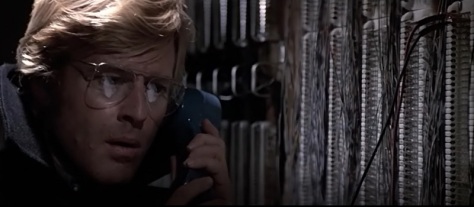
Three Days of the Condor – One of seven collaborations between star Robert Redford and director Sydney Pollack, and one of the seminal “conspiracy-a-go-go” films. With a screenplay adapted by Lorenzo Semple, Jr. and David Rayfiel from James Grady’s novel “Six Days of the Condor”, this 1975 film offers a twist on the idea of a government-sanctioned assassination.

Here, you have members of the U.S. clandestine community burning up your tax dollars to scheme against other members of the U.S. clandestine community (no honor among conspirators, apparently). Also with Faye Dunaway, Cliff Robertson and Max von Sydow.

Pollack’s film conveys the same atmosphere of dread and paranoia that infuses The Conversation and The Parallax View. The final scene plays like an eerily prescient prologue for All the President’s Men, which wasn’t released until the following year. An absolutely first-rate political thriller with more twists and turns than you can shake a dossier at.

https://assets.mubicdn.net/images/artworks/656502/images-original.png?1703395334

JFK – The obvious bookend to this cycle is Oliver Stone’s controversial 1991 film, in which Gary Oldman gives a suitably twitchy performance as Lee Harvey Oswald. However, within the context of Stone’s film, to say that we have a definitive portrait of JFK’s assassin (or “assassins”, plural) is difficult, because, not unlike Agatha Christie’s fictional detective Hercule Poirot, Stone suspects no one…and everyone.

The most misunderstood aspect of the film, I think, is that Stone is not favoring any prevalent narrative; and that it is by the director’s definition a “speculative” political thriller. Those who have criticized the approach seem to have missed that Stone himself has stated from the get-go that his goal was to provide a “counter myth” to the “official” conclusion of the Warren Commission (usually referred to as the “lone gunman theory”). 

Stone’s narrative is so seamless and dynamic, many viewers didn’t get that he was mashing up at least a dozen *possible* scenarios. The message is right there in the script, when “Mr. X” (Donald Sutherland) advises New Orleans D.A. Jim Garrison (Kevin Costner), “Don’t believe me. Do your own work…your own thinking.”

JICYMI- This 2023 episode of “The Commonwealth Club” features Mark Shaw, best-selling author of 6 books related to the Kennedy assassination, reflecting on the 60th anniversary of the tragedy:

Related posts:

The Irishman

On mad kings, Mueller’s report and Altman’s Secret Honor

State of Play

Wormwood

Kleptocracy Now: A Top 1% List (redux)

By Dennis Hartley

(Originally posted on Digby’s Hullabaloo on November 16, 2024)

History never repeats (I tell myself before I go to sleep)

– Split Enz

These past 10 days have felt…like a bad dream:

But alas, as Mia Farrow famously exclaimed in Rosemary’s Baby:

Speaking of bad dreams…in an excellent piece published this week entitled “Alexander Hamilton’s Nightmare Realized: How the Billionaires Hijacked America”, Thom Hartmann writes:

Alexander Hamilton thought he (and the others who wrote the Constitution) had it all figured out.

He and his colleagues never imagined that a group of billionaires would spend 43 years and billions of dollars to seize the US Supreme Court, which would then legalize political bribery.

They never conceived of a foreign billionaire family coming to American and building a nationwide media ecosystem that was capable of convincing Americans that up was down, wrong was right, and a convicted fraudster and rapist would be a noble president.

They would’ve laughed at you if you told them that the richest man in the world would come from apartheid South Africa to hook up with a grifter billionaire to become co-president.

In Federalist 68, Hamilton wrote:

“The process of election affords a moral certainty, that the office of President will never fall to the lot of any man who is not in an eminent degree endowed with the requisite qualifications.”

Indeed, while a knave or rogue or traitor may fool enough people to even ascend to the office of mayor of a major city or governor of a state, Hamilton told us, the people would ferret out such a con man or traitor and Congress and the Supreme Court would put a brake on such a man even if he were to slip past the voters and the Electoral College:

“Talents for low intrigue, and the little arts of popularity, may alone suffice to elevate a man to the first honors in a single State; but it will require other talents, and a different kind of merit, to establish him in the esteem and confidence of the whole Union, or of so considerable a portion of it as would be necessary to make him a successful candidate for the distinguished office of President of the United States.”

Hamilton’s pride in the system that he himself had helped create was hard for him to suppress.

He wrote, “It will not be too strong to say, that there will be a constant probability of seeing the station filled by characters preeminent for ability and virtue.”

He even bragged in Federalist 71 that presidents would be of such high character that they could easily avoid being seduced “by the wiles of parasites and sycophants, by the snares of the ambitious, the avaricious, the desperate, by the artifices of men who possess their confidence more than they deserve it, and of those who seek to possess rather than to deserve it.”

He also believed that good elected officials in Congress, dependent on the voters for their own political futures, would serve as a check against a corrupt president bent on exploiting his position for his own enrichment, the demands of special interest groups (like billionaires), or the interests of a hostile foreign government:

“But however inclined we might be to insist upon an unbounded complaisance in the Executive [President] to the inclinations of the people, we can with no propriety contend for a like complaisance to the humors of the legislature.”

Turns out, Hamilton was wrong. His nightmare scenario tracks back to five corrupt Republicans on the Supreme Court, starting with Lewis Powell authoring the 1978 Bellotti decision that says money is “free speech” and corporations are “persons.” It reached its fetid bottom with John Roberts’ and Clarence Thomas’ Citizens United blowing up almost all campaign contribution limits.

Without billionaire-controlled media (including billionaire-owned social media) and billions spent to carpet-bomb America with extraordinarily deceptive advertising, Donald Trump would never have had a chance. […]

This is America becoming a Mafia State; with Trump and the corrupt toadies he’s inserting into our government, we’re all now stuck living in Alexander Hamilton’s nightmare.

With that happy thought in mind (pleasant dreams!), I thought I’d revisit a “top 10 list” I originally posted on the eve of Inauguration Day 2017, which contains bellwethers that may need to be heeded once again (perhaps more now than the first time around). With my childlike grasp of investment strategies, the best tip I can give is: go long on Hope.

(The following was originally published on Hullabaloo on January 14, 2017)

https://i0.wp.com/digbysblog.net/wp-content/uploads/2024/01/drumpf-christmas.webp?resize=1024%2C691&quality=80&ssl=1

“To assess the ‘personality’ of the corporate ‘person’ a checklist is employed, using diagnostic criteria of the World Health Organization and the standard diagnostic tool of psychiatrists and psychologists. The operational principles of the corporation give it a highly anti-social ‘personality’: it is self-interested, inherently amoral, callous and deceitful; it breaches social and legal standards to get its way; it does not suffer from guilt, yet it can mimic the human qualities of empathy, caring and altruism.”

– from the official website for the film, The Corporation

I don’t know about you, but my jaw is getting pretty sore from repeatedly dropping to the floor with each successive cabinet nomination by our incoming CEO-in-chief of the United States of Blind Trust. It seems that candidate Trump, who ran on an oft-bleated promise to “drain the swamp” in Washington D.C. bears little resemblance to President-elect Trump, who is currently hell-bent on loading the place up with even more alligators.

When I heard the name “Rex Tillerson” bandied about as Trump’s pick for Secretary of State, it rang a bell. I knew he was the former head of Exxon, so it wasn’t that. Then I remembered. Mr. Tillerson was one of the “stars” of a documentary I reviewed several years back, called Greedy Lying Bastards (conversely, if I hear the words “greedy lying bastards,” bandied about, “Trump’s cabinet picks” is the first phrase that comes to mind).

So with that in mind, and in keeping with my occasional unifying theme, “Hollywood saw this coming”, I was inspired to comb my review archives of the last 10 years to see if any bellwethers were emerging that may have been dropping hints that the planets were aligning in such a manner as to set up a path to the White House for an orange TV clown (the “self-interested, inherently amoral, callous and deceitful” kind of orange TV clown).

All 10 of these films were released within the last 10 years. I’ll let you be the judge:

https://i0.wp.com/digbysblog.net/wp-content/uploads/2024/01/AR-AL617_FILM_G_P_20151210130412.jpg?w=749&quality=89&ssl=1

The Big Short Want the good news first? Writer-director Adam McKay and co-scripter Charles Randolph’s adaptation of Michael Lewis’ eponymous 2010 non-fiction book is an outstanding comedy-drama; an incisive parsing of what led to the crash of the global financial system in 2008. The bad news is…it made me pissed off about it all over again.

Yes, it’s a bitter pill to swallow, this ever-maddening tale of how we stood by, blissfully unaware, as unchecked colonies of greedy, lying Wall Street investment bankers were eventually able to morph into the parasitic gestalt monster journalist Matt Taibbi famously compared to a “…great vampire squid wrapped around the face of humanity, relentlessly jamming its blood funnel into anything that smells like money.” Good times!  (Full review)

https://i0.wp.com/digbysblog.net/wp-content/uploads/2024/01/mmoore-96f53b67912ec50544bd93c386db5ac336922db8-s1100-c50.gif?resize=1000%2C750&ssl=1

Capitalism: A Love Story – Back in 2009, Digby and I did a double post on this film, which was Michael Moore’s reaction to the 2008 crash. Here’s how I viewed his intent:

So how did we arrive to this sorry state of our Union, where the number of banks being robbed by desperate people is running neck and neck with the number of desperate banks ostensibly robbing We The People? What paved the way for the near-total collapse of our financial system and its subsequent government bailout, which Moore provocatively refers to as nothing less than a “financial coup d’etat”? The enabler, Moore suggests, may very well be our sacred capitalist system itself-and proceeds to build a case (in his inimitable fashion) that results in his most engaging and thought-provoking film since Roger and Me […] at the end of the day I didn’t really find his message to be so much “down with capitalism” as it is “up with people”.

Digby gleaned something else from the film that did a flyover on me at the time:

But this movie, as Dennis notes, isn’t really about saviors or criminals, although it features some of both. It’s a call for citizens to focus their minds on what’s actually gone wrong and take to the streets or man the barricades or do whatever defines political engagement in this day and age and demand that the people who brought us to this place are identified and that the system is reformed. Indeed, I would guess that if it didn’t feature the stuff about capitalism being evil he could have shown this to audiences of all political stripes and most of the latent teabaggers would have given him a standing ovation.

If the film manages to focus the citizenry on the most important story of our time then it will be tremendously important. If it gets lost in a cacophony of commie bashing and primitive tribalism then it will probably not be recognized for what it is until sometime later. As with all of his films, he’s ahead of the zeitgeist, so I am hopeful that this epic call to leftwing populist engagement is at the very least a hopeful sign of things to come.

She called it. “Someone” did tap into that populist sentiment; but sadly, it wasn’t the Left. (Full review)

https://i0.wp.com/digbysblog.net/wp-content/uploads/2024/01/image-w1280.webp?w=800&quality=80&ssl=1

The Corporation – While it’s not news to any thinking person that corporate greed and manipulation affects everyone’s life on this planet, co-directors Mark Achbar and Jennifer Abbott deliver the message in a unique and engrossing fashion. By applying a psychological profile to the rudiments of corporate think, Achbar and Abbott build a solid case; proving that if the “corporation” were corporeal, then “he” would be Norman Bates.

Mixing archival footage with observations from some of the expected talking heads (Michael Moore, Noam Chomsky, etc.) the unexpected (CEOs actually sympathetic with the filmmakers’ point of view) along with the colorful (like a “corporate spy”), the film offers perspective not only from the watchdogs, but from the belly of the beast itself. Be warned: there are enough exposes trotted out here to keep conspiracy theorists, environmentalists and human rights activists tossing and turning in bed for nights on end.

https://i0.wp.com/digbysblog.net/wp-content/uploads/2024/01/the_forecaster_still-1.webp?resize=1024%2C577&quality=80&ssl=1

The Forecaster – There’s a conspiracy nut axiom that “everything is rigged”. Turns out it’s not just paranoia…it’s a fact. At least that’s according to this absorbing documentary from German filmmaker Marcus Vetter, profiling economic “forecaster” Martin Armstrong. In the late 70s, Armstrong formulated a predictive algorithm (“The Economic Confidence Model”) that proved so accurate at prophesying global financial crashes and armed conflicts, that a shadowy cabal of everyone from his Wall Street competitors to the CIA made Wile E. Coyote-worthy attempts for years to get their hands on that formula.

And once Armstrong told the CIA to “fuck off”, he put himself on a path that culminated in serving a 12-year prison sentence for what the FBI called a “3 billion dollar Ponzi scheme”. Funny thing, no evidence was ever produced, nor was any judgement passed (most of the time he served was for “civil contempt”…for not giving up that coveted formula, which the FBI eventually snagged when they seized his assets). Another funny thing…Armstrong’s formula solidly backs up his contention that it’s the world’s governments running the biggest Ponzi schemes…again and again, all throughout history.

And something tells me that we ain’t seen nuthin’ yet…

https://i0.wp.com/digbysblog.net/wp-content/uploads/2024/01/greedylyingbastards.webp?resize=1024%2C511&quality=80&ssl=1

Greedy Lying Bastards – I know it’s cliché to quote Joseph Goebbels, but: “If you repeat a lie often enough, it becomes the truth.” That’s the theme of Craig Rosebraugh’s 2013 documentary. As one interviewee offers: “On one side you have all the facts. On the other side, you have none. But the folks without the facts are far more effective at convincing the public that this is not a problem, than scientists are about convincing them that we need to do something about this.” What is the debate in question here? Global warming.

Using simple but damning flow charts, Rosebraugh follows the money and connects dots between high-profile deniers (“career skeptics…in the business of selling doubt”) and their special interest sugar daddies. Shills range from media pundits (with no background in hard science) to members of Congress, presidential candidates and Supreme Court justices. Think tanks and other organizations are exposed as mouthpieces for Big Money.

Sadly, the villains outnumber the heroes-which is not reassuring. What does reassure are suggested action steps in the film’s coda…which might come in handy after January 20th. (Full review)

https://i0.wp.com/digbysblog.net/wp-content/uploads/2024/01/v2-5iemn-bi77s.jpg?resize=1024%2C585&quality=89&ssl=1

Inside Job I have good news and bad news about documentary filmmaker Charles Ferguson’s incisive parsing of what led to the crash of the global financial system in 2008. The good news is that I believe I finally grok what “derivatives” and “toxic loans” are. The bad news is…that doesn’t make me feel any better about how fucked we are.

Ferguson starts where the seeds were sown-rampant financial deregulation during the Reagan administration (“morning in America”-remember?). The film illustrates, point by point, how every subsequent administration, Democratic and Republican alike, did their “part” to enable the 2008 crisis- through political cronyism and legislative manipulation. The result of this decades long circle jerk involving Wall Street, the mortgage industry, Congress, the White House and lobbyists (with Ivy League professors as pivot men) is what we are still living with today…and I suspect it is about to get unimaginably worse.  (Full review)

https://i0.wp.com/digbysblog.net/wp-content/uploads/2024/01/13international_600.jpg?w=600&quality=89&ssl=1

The International Get this. In the Bizarro World of Tom Tykwer’s conspiracy thriller, people don’t rob banks…. banks rob people. That’s crazy! And if you think that’s weird, check this out: at one point in the film, one of the characters puts forth the proposition that true power belongs to he who controls the debt. Are you swallowing this malarkey? The filmmakers even go so far as to suggest that some Third World military coups are seeded by powerful financial groups and directed from shadowy corporate boardrooms…

What a fantasy! (Not.)

The international bank in question is under investigation by an Interpol agent (Clive Owen), who is following a trail of shady arms deals all over Europe and the Near East that appear to be linked to the organization. Whenever anyone gets close to exposing the truth about the bank’s Machiavellian schemes, they die under mysterious circumstances. Once the agent teams up with an American D.A. (Naomi Watts), much more complexity ensues, with tastefully-attired assassins lurking behind every silver-tongued bank exec.

The timing of the film’s release (in 2010) was interesting, in light of the then-current banking crisis and plethora of financial scandals. Screenwriter Eric Singer (no relation to the KISS drummer) based certain elements of the story on the real-life B.C.C.I. scandal.   (Full review)

https://i0.wp.com/digbysblog.net/wp-content/uploads/2024/01/20120624-VERSAILLES-slide-QOP6-superJumbo.jpg?resize=1024%2C683&quality=89&ssl=1

The Queen of Versailles In Lauren Greenfield’s 2012 doc, billionaire David Siegel shares an anecdote about his 52-story luxury timeshare complex in Vegas. In 2010, Donald Trump called him and said, “Congratulations on your new tower! I’ve got one problem with it. When I stay in my penthouse suite, I look out the window and all I see is ‘WESTGATE’. Could you turn your sign down a little bit?” (how he must have suffered).

While Greenfield’s portrait of Siegal, his wife Jackie, their eight kids, nanny, cook, maids, chauffeur and (unknown) quantity of yippy, prolifically turd-laying teacup dogs is chock full of wacky “you couldn’t make this shit up” reality TV moments, there is an elephant in the room…the family’s unfinished Orlando, Florida mansion, the infamous “largest home in America”, a 90,000 square foot behemoth inspired by the palace at Versailles. Drama arises when the bank threatens to foreclose on it, along with the PH Towers Westgate. So does the family end up living in cardboard boxes? I’m not telling.

However, there is a more chilling message, buried near the end of the film. When Siegel boasts he was “personally responsible” for the election of George W. Bush in 2000, the director asks him to elaborate. “I’d rather not say,” he replies, “…because it may not necessarily have been legal.” Any further thoughts? “Had I not stuck my big nose into it, there probably would not have been an Iraqi War, and maybe we would have been better off…I don’t know.” Gosh, imagine a billionaire having the power to “buy” the POTUS of their choice. Worse yet, imagine a similarly odious billionaire becoming the POTUS. Oh.   (Full review)

https://i0.wp.com/digbysblog.net/wp-content/uploads/2024/01/welcome-to-new-york-2435339.webp?w=680&quality=80&ssl=1

Welcome to New York While it is not a “action thriller” per se, Abel Ferrara’s film is likewise “ripped from the headlines”, involves an evil banker, and agog with backroom deals and secret handshakes. More specifically, the film is based on the Dominique Strauss-Kahn scandal. In case you need a refresher, he was the fine fellow who was accused and indicted for an alleged sexual assault and attempted rape of a maid employed by the ritzy NYC hotel he was staying at during a 2011 business trip. The case was dismissed after the maid’s credibility was brought into question (Strauss-Kahn later admitted in a TV interview that a liaison did occur, but denied any criminal wrongdoing).

I’m sure that the fact that Strauss-Kahn was head of the International Monetary Fund at the time (and a front-runner in France’s 2012 presidential race) had absolutely nothing to do with him traipsing out from the sordid affair smelling like a rose (2024 sidebar: Umm…)

It is interesting watching the hulking Gerard Depardieu wrestle with the motivations (and what passes as the “conscience”) of his Dostoevskian character. It doesn’t make this creep any more sympathetic, but it is a fearless late-career performance, as naked (literally and emotionally) as Marlon Brando was playing a similarly loathsome study in Last Tango in Paris. Jacqueline Bisset gives a good supporting turn as the long-suffering wife.   (Full review)

https://i0.wp.com/digbysblog.net/wp-content/uploads/2024/01/ems.jpg?w=652&quality=89&ssl=1

The Yes Men Fix the World – Anti-corporate activist/pranksters Andy Bichlbaum and Mike Bonanno (aka “The Yes Men”) and co-director Kurt Engfehr come out swinging, vowing to do a take-down of a powerful nemesis…an Idea. If money makes the world go ‘round, then this particular Idea is the one that oils the crank on the money-go-round, regardless of the human cost. It is the free market cosmology of economist Milton Friedman, which the Yes Men posit as the root of much evil in the world.

Once this springboard is established, the fun begins. Perhaps “fun” isn’t the right term, but there are hijinks afoot, and you’ll find yourself chuckling through most of the film (when you’re not crying). However, the filmmakers have a loftier goal than mining laughs: corporate accountability; and ideally, atonement. “Corporate accountability” is an oxymoron, but one has to admire the dogged determination (and boundless creativity) of the Yes Men and their co-conspirators, despite the odds. It’s a call to activism that is as timely as ever.   (Full review)

It’s My Party: 10 films for election season

By Dennis Hartley

(Originally posted on Digby’s Hullabaloo on August 24, 2024)

https://i0.wp.com/digbysblog.net/wp-content/uploads/2024/08/image-w1280-2.webp?w=800&quality=80&ssl=1

In my 2011 review of George Clooney’s political drama The Ides of March, I wrote:

The art of seduction and the art of politicking are one and the same; not exactly a new revelation (a narrative that goes back at least as far as, I don’t know, Shakespeare’s Julius Caesar). Politicians are seduced by power. However, a politician first must seduce the voter. A pleasing narrative is spun and polished, promises are made, sweet nothings whispered in the ear, and the voter caves.

But once your candidate is ensconced in their shiny new office, well…about that diamond ring? It turns out to be cubic zirconium. Then it’s all about the complacency, the lying, the psychodramas, and the traumas. While a lot of folks do end up getting ‘screwed’, it is not necessarily in the most desirable and fun way.

Once again, we are ensconced in a political season chockablock with pleasing narratives, promises, and sweet nothings. For those of us who have been around the block a few times (this November will mark my 13th  presidential election), those are all best taken with a grain of salt (I’ve learned a thing or two since casting my ballot for Jimmy Carter back in 1976).

Full disclosure, I am no poly sci major; rather, I am (to paraphrase William Holden in Network) “television generation”, so I “learned life from Bugs Bunny”. Well, Bugs Bunny and I, Claudius:

For about a three-month period in the fall of 1977, every Sunday at 9pm, [my housemates and I] would abruptly drop whatever we were doing (sfx: guitars, bongs, Frisbees, empty Heineken bottles and dog-eared Hunter Thompson paperbacks hitting the floor) and gather round a 13-inch color TV (replete with Reynolds Wrap-reinforced rabbit ears) to rapturously watch I, Claudius on Masterpiece Theatre.

While an opening line of “I, Tiberius Claudius Drusus Nero Germanicus…” could portend more of a snooze-inducing history lecture, rather than 11 hours of must-see-TV, the 1976 BBC series, adapted from Robert Graves’ 1934 historical novel about ancient Rome’s Julio-Claudian dynasty, was indeed the latter, holding U.S. viewers in thrall for its 12-week run.

While it is quite possible that at the time, my friends and I were slightly more in thrall with the occasional teasing glimpses of semi-nudity than we were with, say, the beauty of Jac Pulman’s writing, the wonder of the performances and historical complexity of the narrative, over the years I have come to realize that I think I learned everything I needed to know about politics from watching (and re-watching) I, Claudius.

It’s all there…the systemic greed and corruption of the ruling plutocracy, the raging hypocrisy, the grandstanding, glad-handing and the backstabbing (in this case, both figurative and literal). Seriously, over the last 2000 years, not much has changed in the political arena.

So…is your media player of choice fired up, and ready to go? Excellent!  Here are 10 politically themed films I officially endorse for the 2024 race.

https://i0.wp.com/digbysblog.net/wp-content/uploads/2024/08/being-there-shot.webp?w=851&quality=80&ssl=1

Being There – Filmmaker Hal Ashby was an essential contributor to the new American cinema movement of the 1970s. He spanned the decade with an astonishing seven film streak: The Landlord (1970), Harold and Maude (1971), The Last Detail (1973), Shampoo (1975), Bound for Glory (1976), Coming Home (1978), and this 1979 masterpiece.

Like Sidney Lumet’s Network, Ashby’s Being There becomes more vital in the fullness of time.  Adapted from Jerzy Kosinki’s novel by frequent  Ashby collaborator Robert C. Jones, it is a wry political fable about a simpleton (Peter Sellers, in one of his greatest performances) who stumbles his way into becoming a Washington D.C. power player within an alarmingly short period of time (it suffices to say that stranger things have happened in recent memory).

Superbly acted; from the leading players (Sellers, Melvyn Douglas, Shirley MacLaine, Jack Warden, Richard Dysart) to the supporting roles (especially the wonderful Ruth Attaway).

https://i0.wp.com/digbysblog.net/wp-content/uploads/2024/08/MV5BMzUwNTUxNzItMDEwYy00MzVjLThiNmItMWIyMjEwYWFhNzAxXkEyXkFqcGdeQXVyOTc5MDI5NjE@._V1_.jpg?w=630&quality=89&ssl=1

The Candidate -This 1972 gem from Michael Ritchie (Downhill Racer, Prime Cut, Smile) centers on an activist lawyer named Bill McKay (Robert Redford) wooed by a slick Democratic political consultant (Peter Boyle) into challenging a three-term Republican California Senator for his congressional seat.

The idealistic and progressive McKay is initially reticent, as he does not want to be perceived as trading in on his family name (his father is a former governor). Assured that he can set his own agenda, say whatever he wants, and is almost guaranteed a victory due to the lack of Democratic challengers, McKay accepts the offer to run.

But you know what they say…if it sounds too good to be true, there’s usually a catch. In this case, it’s McKay’s realization that in the rough and tumble world of politics, the true path to victory is inevitably littered with a discarded ideal or two (compromise, compromise, compromise).

The perceptive, wryly satirical screenplay earned an Oscar for Jeremy Larner (his experience as a speechwriter for Eugene J. McCarthy on the Senator’s 1968 campaign undoubtedly contributed to the film’s air of authenticity). Redford and Boyle are outstanding, and ably supported by a wonderful ensemble that includes Melvyn Douglas, Don Porter, Allen Garfield, and Karen Carlson.

https://i0.wp.com/digbysblog.net/wp-content/uploads/2024/08/donsparty.jpg?w=620&quality=89&ssl=1

Don’s Party – Director Bruce Beresford (Breaker Morant) sets his story on Australia’s election night, 1969. Outgoing host Don and his uptight wife are hosting an “election party” for old college chums at their middle-class suburban home.

Most of the guests range from the recently divorced to the unhappily married. Ostensibly a gathering to watch election results, talk politics and socialize, Don’s party deteriorates into a primer on bad human behavior as the booze kicks in. By the end of the night, marriages are on the rocks, friendships nearly broken and guests are skinny dipping in the vacationing neighbor’s pool.

Yet, this is not just another wacky party film. David Williamson’s script (which he adapted from his own play) offers many keen observations about elitism, politics, and adult relationships. Savagely funny, brilliantly written and splendidly acted.

https://i0.wp.com/digbysblog.net/wp-content/uploads/2024/08/election-1999-thoughts-on-this-film-v0-qzlckwgjd85d1.webp?resize=1024%2C754&quality=80&ssl=1

Election – Writer-director Alexander Payne and creative partner Jim Taylor (Sideways, About Schmidt) followed up their 1995 feature film debut, Citizen Ruth, with this biting 1999 sociopolitical allegory, thinly cloaked as a teen comedy (which it decidedly is not).

Reese Witherspoon delivers a pitch perfect performance as the psychotically perky, overachieving Tracy Flick, who makes life a special hell for her brooding civics teacher, Mr. McAllister (Matthew Broderick). Much to Mr. McAllister’s chagrin, Tracy is running a meticulously organized and targeted campaign for school president. Her opponent is a more popular, but politically and strategically clueless jock (why does that sound so familiar?).

Payne’s film is very funny at times, yet it never pulls its punches; there are some painful truths about the dark underbelly of suburbia bubbling beneath the veneer (quite similar to American Beauty, which interestingly came out the same year).

https://i0.wp.com/digbysblog.net/wp-content/uploads/2024/08/2021-05-19-democracy_1920-1.jpg?resize=1024%2C576&quality=89&ssl=1

The Edge of Democracy– Latin American countries have a long history as ever-simmering cauldrons of violent coups, brutal dictatorships, revolving door regimes and social unrest. In The Edge of Democracy, Brazilian actress and filmmaker Petra Costa suggests there is something even more insidious at play in her country these days than a cyclical left-to-right shift. Costa’s film delves into the circumstances that led to the impeachment of former President Dilma Rousseff, and the imprisonment of her predecessor, the wildly popular progressive reformer Luis Inacio Lula da Silva.

The real coup for Costa (no pun intended) is the amazing accessibility she was given to President Rousseff and ex-President Lula during these events. This is the most powerful documentary about South American politics since Patricio Guzman’s The Battle of Chile. It is also a cautionary tale; “we” have more in common with Brazil than you might think.  (Full review)

https://i0.wp.com/digbysblog.net/wp-content/uploads/2024/08/MV5BMjAzMTQ0NDc0Ml5BMl5BanBnXkFtZTcwMzcwNDg2Nw@@._V1_QL75_UX500_CR047500281_.jpg?w=500&quality=89&ssl=1

Grassroots – There aren’t many political biopics that open with the candidate-to-be dressed in a bear suit and screaming at traffic. But then again, there aren’t many cities I have lived in that have a political climate quite like Seattle. A case in point would be the brief but colorful political career of Grant Cogswell, which provided fodder for this film from director Stephen Gyellenhaal.

Cogswell (Joel David Moore) was an unemployed music critic (a polite term for “slacker”) with no prior political experience, who made a run for a city council seat back in 2001. His unconventional grassroots campaign was managed by his friend and fellow political neophyte Phil Campbell (Jason Biggs).

While political junkies may take umbrage that Gyllenhaal’s screenplay (co-written with Justin Rhodes and based on Campbell’s campaign memoir Zioncheck for President) takes a broad approach by favoring the kookier elements of the story, I think most viewers will find his film engaging.

I think it was wise for Gyllenhaal to eschew the political minutiae; otherwise he may have ended up with something of little interest to anyone besides Seattleites. In fact, the best thing about this film is that it (dare I say it?) renews your faith in the democratic process. In these cynical times, that is a good thing. (Full review)

https://i0.wp.com/digbysblog.net/wp-content/uploads/2024/08/mediumcool1969_83188_1201x784_06072019094627.jpg?resize=1024%2C668&quality=89&ssl=1

Medium Cool – What Haskell Wexler’s unique 1969 drama may lack in narrative cohesion is more than made up for by its importance as a sociopolitical document. Robert Forster stars as a TV news cameraman who is fired after he complains to station brass about their willingness to help the FBI build files on political agitators via access to raw news film footage and reporter’s notes.

He drifts into a relationship with a Vietnam War widow (Verna Bloom) and her 12 year-old son. They eventually find themselves embroiled in the mayhem surrounding the 1968 Democratic Convention (in the film’s most memorable scene, the actors were actually sent in to improvise amidst one of the infamous “police riots” as it was happening). Many of the issues Wexler touches on (especially regarding media integrity and journalistic responsibility) would be extrapolated further in films like Network and Broadcast News.

https://i0.wp.com/digbysblog.net/wp-content/uploads/2024/08/post_591b6c2f06f6c.jpg?resize=1024%2C462&quality=89&ssl=1

Milk – On November 27th, 1978, San Francisco mayor George Moscone and District Supervisor Harvey Milk were murdered  in their respective offices at City Hall; both men shot repeatedly at point blank range. Even more shocking (and bordering on the downright bizarre) was the fact that their killer was a fellow San Francisco politician-former District Supervisor Dan White. Gus Van Sant’s 2008 biopic focuses on the life and work of Milk.

Sean Penn plays Milk; the film enters his life journey at age 40, which was when he experienced the epiphany that led to him to dedicate the rest of his life to public service. Using his tiny camera shop in San Francisco’s Castro neighborhood as HQ, Milk quickly garnered a reputation as the city’s leading gay activist, thanks to his relentless drive and a natural gift for community organizing.

The excellent script (by Dustin Lance Black, one of the writers on HBO’s Big Love) is engaging, yet never strays too far from Milk’s own words and deeds. Most crucial to the success of this film is the powerhouse performance by Penn, who never falls into caricature; opting instead to essentially channel the wit, passion and genuine humanity of this remarkable individual. (Full review)

https://i0.wp.com/digbysblog.net/wp-content/uploads/2024/08/William-Castle_Julie-Christie_Warren-Beatty_Rose-Michton.jpg?resize=1024%2C568&quality=89&ssl=1

Shampoo – Sex, politics, and the shallow SoCal lifestyle are mercilessly skewered in Hal Ashby’s classic 1975 satire. Warren Beatty (who co-scripted with Robert Towne) plays a restless, over-sexed hairdresser with commitment issues regarding the three major women in his life (excellent performances from Lee Grant, Goldie Hawn and Julie Christie).

Beatty allegedly based his character of “George” on his close friend, celebrity hairdresser Jay Sebring (one of the victims of the infamous 1969 Tate-LaBianca slayings).

This was one of the first films to satirize the 1960s zeitgeist with some degree of historical detachment. The late great cinematographer Laszlo Kovacs infuses the L.A. backdrop with a gauziness that appropriately mirrors the protagonist’s fuzzy way of dealing with adult responsibilities.

https://i0.wp.com/digbysblog.net/wp-content/uploads/2024/08/ba9136b0a4e921080adef2cca171bb19.jpeg?resize=1024%2C576&quality=89&ssl=1

Z -This 1969 film was a breakthrough for director Costa-Gavras, and a high-watermark for the “radical chic” cinema that flourished at the time. Yves Montand plays a leftist politician who is assassinated after giving a speech at a pro-Peace rally. What at first appears to be an open and shut case of a violent action by an isolated group of right wing extremists unfolds as a suspenseful conspiracy thriller.

The story (set in an unspecified Balkan nation, but based on the real-life assassination of a Greek political figure back in 1963) is told from the perspective of two characters-a photojournalist (a young Jacques Perrin, future director of Winged Migration) and an investigating magistrate (Jean-Louis Trintignant). The great Irene Papas is also on board as Montand’s wife.

The film is a bit of a stagey talk-fest for a political “thriller” but it is still essential viewing. It’s part Kafka, part Rashomon, but ultimately a cautionary tale about what happens when corrupt officialdom, unchecked police oppression and partisan-sanctioned extremism get into bed together.


Blu-ray reissue: The President’s Analyst (***1/2)

By Dennis Hartley

(Originally posted on Digby’s Hullabaloo on August 10, 2024)

https://i0.wp.com/digbysblog.net/wp-content/uploads/2024/08/Presidents_Analyst_1967_trimmed.jpg?resize=1024%2C668&quality=89&ssl=1

The President’s Analyst (KL Studio Classics)

Beware the Phone Company! Unlike the empty-headed 60’s spy spoofs James Coburn’s name usually evokes, writer-director Theodore J. Flicker’s 1967 film is one with substance. Coburn plays a psychoanalyst recruited to be the President’s personal shrink by one of his patients (Godfrey Cambridge, in a wonderful performance).  Cambridge is an operative for the “C.I.E.” The ensuing intrigue and conspiracy paranoia plays like Three Days of the Condor on acid (literally, in one memorable sequence).

Granted, it’s a tad silly and “slapstick-y” at times, but the socio-political satire is consistently on point (at times recalling Dr. Strangelove, particularly in one scene where a character is desperately trying to reach the White House on a pay phone). “Summer of Love” trappings aside, the film is quite prescient and bold for its time (e.g. consider Cambridge’s stark monologue recalling his first encounter with racism, played directly to the camera; nothing “ha-ha” funny going on there.)

Also with Joan Delaney, Severn Darden, Pat Harrington, Jr., Walter Burke (stealing all his scenes as an officious “F.B.R.” agent), Will Geer, William Daniels, and Arte Johnson. Look for Barry Maguire (who sang the 60s classic “Eve of Destruction”) as the leader of a band of hippies Coburn hooks up with while he’s on the run from an assortment of nefarious parties.

Kino’s Blu-ray is light on extras (just two commentary tracks), but the 4K scan is a definite step up from the previous Paramount DVD. A must-have for “Conspiracy a Go-go” fans!

Tribeca 2024: Under the Grey Sky (***)

By Dennis Hartley

(Originally posted on Digby’s Hullabaloo on June 22, 2024)

https://i0.wp.com/digbysblog.net/wp-content/uploads/2024/06/large_UNDER_THE_GREY_SKY-Clean-16x9-01.png?w=980&quality=80&ssl=1

This “ripped from the headlines” political drama is set during the 2020 Belarusian election. In a genuinely tense and unnerving opening scene, a journalist (Aliaksandra Vaitsekhovich) opposed to the current regime is in a friend’s apartment, livestreaming an aggressive police action against demonstrators on the streets below.

Soon after an ominous pass of a police camera drone, the authorities burst in and arrest her. As her Kafkaesque nightmare ensues in the oppressive government’s court system, her husband (also a journalist) suffers his own travails as he is harassed by the police and eventually arrested on trumped-up charges. Based on a true story, writer-director Mara Tamkovich’s film is a sobering reminder that Orwellian totalitarianism is not dead…hell, it’s never even been resting. And yes…it could happen here.

SIFF 2024: Hitchcock’s Pro-Nazi Film? (***)

By Dennis Hartley

(Originally posted on Digby’s Hullabaloo on May 11, 2024)

https://www.siff.net/images/FESTIVAL/2024/Films/Film%20Detail%20Hero%20Sizes/Features/HitchcocksProNaziFilm.jpg

I’ve always considered Alfred Hitchcock’s1944 war drama Lifeboat (about a small group of passengers who survive the sinking of their vessel by a U-boat) as a sharply observed microcosm of the human condition. However, Daphné Baiwir’s documentary sheds a different light, recalling a critical backlash from some who condemned the film as pro-German (an aspect I had never really considered before). A fascinating look at Hollywood in the 1940s, and the effects of war hysteria.

SIFF 2024: Bonjour Switzerland (***1/2)

By Dennis Hartley

https://www.siff.net/images/FESTIVAL/2024/Films/Film%20Detail%20Hero%20Sizes/Features/BonjourSwitzerland.jpg

Bananas meets The Mouse That Roared in this refreshingly old-school political satire directed by Peter Luisi. Beat Schlatter (who co-wrote the screenplay with the director) stars as a mild-mannered German-speaking federal agent who gets tasked with overseeing implementation of a controversial new Swiss law that mandates French as the country’s official language (in true Peter Sellers fashion, Schlatter also plays the high-profile media demagogue who pushed for the law). Problems quickly pile up for the hapless agent; he can barely speak French, his dear old mom becomes radicalized, and he finds himself falling for an Italian woman who belongs to a separatist group he’s been assigned to infiltrate. OK, I’ll say it: This is a hilarious, good-natured romp.

No shame in love: The Old Oak (****)

By Dennis Hartley

(Originally posted on Digby’s Hullabaloo on April 13, 2024)

https://i0.wp.com/digbysblog.net/wp-content/uploads/2024/04/OldOak_photo_1-scaled-1.jpg?resize=1024%2C683&quality=89&ssl=1

I’m not sure if I can chalk this up to kismet, or to the fact I’ve seen literally thousands of films in my 68 years on this silly planet…but as the Giant says to Agent Cooper in Twin Peaks: “It is happening again.”

Last week, I watched a 2022 Blu-ray reissue of The Limey that I recently ordered (nice 4k restoration). I hadn’t seen the film since its original theatrical release. In case you are unfamiliar, Steven Soderbergh’s taut 1999 neo-noir centers on a British career criminal (Terrence Stamp) who gets out of prison and makes a beeline for America to investigate the suspicious death of his estranged daughter. He learns she had a relationship with an L.A.-based record producer (Peter Fonda), who may be able to shed some light on her untimely demise. It’s fast-moving and intelligently scripted, with an outstanding supporting cast.

There are snippets throughout depicting Stamp’s character as a young man. Contrary to convention, Soderbergh didn’t cast a younger lookalike actor for these flashbacks, but rather used clips obviously taken from one of Stamp’s 1960s UK films. When I first saw The Limey in 1999, I remember thinking how clever this was, but didn’t feel compelled to investigate which film the clips were taken from. As I learned from one of the Blu-ray’s extras, that film was the 1967 kitchen sink drama Poor Cow, directed by Ken Loach. Turns out it was the legendary UK filmmaker’s first theatrical feature (ashamed and driven by the fear of having my critic’s license revoked, I quickly ordered a Blu-ray copy as an act of contrition).

I know what you’re thinking (“Is there a …point to this fascinating anecdote?”). Fast-forward a day or two, and I received a link to screen Ken Loach’s (self-proclaimed) “final” film. See the symmetry there?

 [awkward silence]

Anyway…The bookend of a triptych of working-class dramas set in Northeast England (preceded by I, Daniel Blake in 2016 and Sorry We Missed You! in 2019), The Old Oak marks the 87-year-old director’s 28th film.

The story (scripted by Paul Laverty) is set in 2016, in an unnamed “pit town” on the Northeast coast of England, and centers on TJ (Dave Turner), who is barely making ends meet as the owner and proprietor of The Old Oak pub. He inherited the pub from his late mother, who had invested in the property with the settlement money she had received after TJ’s father died in a mining accident. TJ himself began working in the local mine just before a major strike in the mid-80s. After the mine closed, he threw himself into community organizing. Depressed over a broken marriage, he’s become more withdrawn in recent years.

TJ was born and raised in the village, so he’s known the pub’s hardcore regulars since his school days. Many of them worked alongside TJ in the mine, and are suffering similar economic hardships, living off modest pensions or on the dole. You get the impression daily life for the town’s residents has become predictably drab; a reliable disappointment. In addition to providing a cozy space where they can toss back a pint or two and forget their problems, The Old Oak has become the de facto community center.

The general torpor of the locale is about to receive a goosing. As I mentioned earlier, Laverty and Loach have set their story in 2016, which was 2 years into the implementation of the UK’s Syrian Vulnerable Persons Resettlement Scheme. The program offered safety to 20,000 Syrians who were fleeing the crisis in their home country. A large portion of the refugees ended up getting resettled in economically depressed communities (like the fictional ex-mining town in the film) due to the low cost of housing.

One day, a busload of Syrian refugees appears and disembarks in the center of town. Unfortunately, not all the locals appear willing to roll out the welcome wagon. When xenophobic catcalling escalates into a scuffle that results in a young Syrian woman’s camera getting damaged, TJ intervenes and defuses the situation. TJ learns that Yara (Ebla Mari) has picked up her English skills from working as a volunteer in a refugee camp in Jordan. The camera is her most prized possession, as it was given to her by her father, who is imprisoned back in Syria. TJ and Yara strike up a friendship that fuels the heart of the narrative.

The Old Oak is rife with Loach’s trademarks; not the least of which is giving his cast plenty of room to breathe. The entire ensemble (which ranges from first-time film actors to veteran players) delivers relatable, naturalistic performances. Hovering somewhere between Do the Right Thing and Ikuru, The Old Oak is raw, uncompromising, and genuinely moving (so rare at the multiplex nowadays), with an uplifting message of hope and reconciliation. If this is indeed its director’s swan song-what a lovely, compassionate note to go out on.

Shukran, Mr. Loach.

Tribeca 2023: The Future (**1/2)

By Dennis Hartley

(Originally posted on Digby’s Hullabaloo on June 10, 2023)

https://i0.wp.com/digbysblog.net/wp-content/uploads/2023/06/image-39.png?resize=1024%2C576&ssl=1

A near-future tale about a surrogate mother-daughter relationship between an Israeli scientist (Reymond Amsalem), and a Palestinian college student (Samar Qupty) who has confessed to assassinating Israel’s Minister of Space and Tourism. The scientist heads “The Future Project”, which uses algorithms to predict terrorist attacks (shades of Philip K. Dick). The scientist has asked permission to conduct a psychological study of the young woman to determine why her crime eluded prediction. More “science-fiction” in tone than production design, writer-director Noam Kaplan’s economical film is essentially a chamber drama, bolstered by earnest lead performances but bogged down by its heavy-handed allegory.

Tribeca 2023: Against All Enemies (***)

By Dennis Hartley

(Originally posted on Digby’s Hullabaloo on June 10, 2023)

https://i0.wp.com/digbysblog.net/wp-content/uploads/2023/06/image-37.png?resize=1024%2C576&ssl=1

In a post examining reaction from the Right when news broke this week that ex-president Trump was being indicted by federal prosecutors for alleged mishandling of classified documents, Digby included this disturbing tidbit:

What makes that even more chilling for me was that this all came down mere days after I saw Charlie Sadoff’s (incredibly) timely documentary. Sadoff’s study (which he co-wrote with Sebastian Junger and Kenneth Harbaugh) begins with an unsettling statistic: out of the approximately 1,000 people who have been officially charged for storming the U.S. Capitol building on January 6, 2021, 15% worked as police or military personnel. These are, of course, the folks who take an oath to support the Constitution of the United States.

The film not only delves into how military vets become radicalized but builds a timeline of modern right-wing extremism from the Ku Klux Klan’s public resurgence in the 1920s to current groups like the Proud Boys. The most revelatory “hidden history” aspect for me concerns the mid-70s to mid-80s-a period that saw a surge of Vietnam vets into various anti-government and racist groups, as well as the advent of “Liberty Net”, which holds the dubious distinction of being the first social network engineered by and for members of the neo-Nazi/white power movements.

Sadoff covers so much ground that this engrossing history begs a Ken Burns extended dance mix (occasional narration by Burns stalwart Peter Coyote adds to that flavor). That said, this is enough nightmare fuel for most viewers. You have been warned.