(Originally posted on Digby’s Hullabaloo on June 7, 2025)
Adolescence can be an emotional roller coaster; likewise the grief process. Dealing with both at once is a daunting test of anyone’s mettle. Chilean writer-director Nayra Ilic Garcia’s meditative family drama opens on New Year’s Eve, 1990. Vivacious 15 year-old Celeste (Helen Mrugalski) is enjoying a beach holiday with her loving family and closest friends (I had to remind myself that Chile is below the equator).
This is not only a happy time for Celeste and her entourage, but for Chileans in general. General Pinochet’s brutal Junta is over for good, with democratically-elected Christian Democrat Patricio Aylwin set to take office in March of the new year.
However, just when everything’s looking up, Fate intervenes with a sudden death in the family. Celeste’s double-whammy of having to cope with growing pains along with an emotionally traumatic personal loss gives impetus to this moving and sensitively acted coming-of-age story. Garcia subtly weaves political analogy in the narrative; using the specter of Chile’s “missing” to mirror a nation coming to terms with collective grief, and the growing pains of a revived democracy that has lain dormant for far too long.
While it is set on the eve of the 1968 Prague Spring in Czechoslovakia, in some respects writer-director Jiří Mádl’s riveting political thriller could have been ripped from today’s headlines:
The administration of Donald Trump has terminated nearly 600 contractors at Voice of America (VOA), the US-funded international news network known for delivering independent journalism to countries with restricted press freedom.
The firings, announced on [May 15], appeared to defy a recent court order requiring the government to preserve strong news operations at VOA. The US president has criticized the news network and accused it of spreading “radical” content.
The cuts, announced on Thursday, affected mostly journalists along with some administrative staff and represented more than one-third of VOA’s workforce.
Among those dismissed are journalists from authoritarian countries who now face deportation, as their visas are linked to their jobs at VOA. […]
Kari Lake, a Trump ally and senior adviser at the US Agency for Global Media, which oversees VOA, defended the decision as legally permissible. Lake had previously denounced the agency as “unsalvageable” and accused it of corruption without presenting evidence. […]
Senator Jeanne Shaheen, ranking member of the Senate foreign relations committee, issued a statement in response to the firings:
“The Trump administration’s gutting of Voice of America threatens access to independent media in places where it is needed most,” the statement reads. “It deeply weakens a critical and cost-effective tool of American influence and soft power. If Voice of America is silenced, PRC and Russian propaganda and lies will fill the void. To add more fuel to the fire, Kari Lake’s recent announcement that the Voice of America will now become a conduit for One America News Network is a gift to Russia and propagandists everywhere.”
Reminds me of a funny story (well…not “ha-ha” funny). In 1967 Prague, a young man named Tomás (Vojtěch Vodochodský) lives in a cramped apartment with his younger brother Paja (Ondřej Stupka). Tomás is Paja’s legal guardian. The conservative and apolitical Tomás is concerned about rebellious Paja’s increasing involvement with an anti-regime activist group. One day, he is chagrined to learn that Paja has sneaked off to an open audition for a job as an assistant to a popular but controversial radio journalist. Tomás rushes down to the station to intervene, but stumbles into landing the gig himself.
While he cannot foresee it, Tomás is about to get swept up into the vortex of tumultuous political upheaval in his country, culminating in the August 1968 invasion of Czechoslovakia by Soviet and Warsaw Pact forces (the film is based in part on the rousing story of how Czech Radio managed to keep broadcasting, even after Soviet troops forced their way in and seized control of the main studios).
Waves plays like a mashup of Three Days of the Condor and The Unbearable Lightness of Being, and is a welcome throwback to films that hit that sweet spot between historical sweep and intimate drama. Oh, and don’t forget to support your favorite independent journalists, because democracy dies in…well, you know.
Within a 17-day period in the early fall of 1975, President Gerald R. Ford survived two attempts on his life-both taking place in California. One could argue that the first would-be assassin, Lynette “Squeaky” Fromme is the only one people remember, by virtue of her well-known association with the Manson Family.
The second shooter, Sara Jane Moore, has remained a relative cypher. For one thing, she wasn’t a member of a high-profile death cult, and in stark contrast to Fromme’s psycho daisy couture, Moore looked for all the world like a buttoned-down housewife who had strolled straight out of a John Cheever story (although in this case, a buttoned-down housewife armed with a .38 Special).
Not that she didn’t have a screw loose…which became apparent (to me) as Robinson Devor’s documentary unfolded. Mixing archival materials and a present-day interview with an evasive and truculent Moore (now in her 90s), Devor tries to piece together the jigsaw of her bizarre journey from suburban mother of four to FBI informant, self-proclaimed revolutionary and would-be presidential assassin.
Moore (released from prison in 2007, after serving 32 years) is too cagey to drop any real bombshells here, so her motivations remain foggy. What I found even more interesting than Moore’s story was the adjacent retrospective on a politically tumultuous period in San Francisco (e.g. Moore has a tie-in with the Patty Hearst debacle). Despite leaving a number of questions unanswered, Suburban Fury is nonetheless a worthwhile watch for political junkies and the curious.
Every minute of the next 48 hours of Souleymane’s life counts, because it will determine whether or not he will be granted the asylum he has been seeking in France. He’s barely scraping by, and has to bike around Paris day and night delivering food just to remain flush with his creditors. He has no legal papers, so he has to pay to work, forking over a fee to a fellow Guinean delivery man so he can “borrow” his identity.
Most importantly, he has a looming deadline to pay off the shady fixer who is selling him a new “story” he claims will be more likely to convince the authorities that Souleymane warrants asylum. Adding to his stress level, Soueymane has to memorize the extremely detailed narrative to a tee, or he’ll risk raising red flags for the well-seasoned bureaucrat he has been scheduled to meet with in just two days time.
Driven by a realistic lead performance by non-professional actor Abou Sangaré and imbued with a kinetic energy and sense of urgency recalling Run Lola Run, writer-director Boris Lokjine’s Souleymane’s Story is really the story of millions of émigrés all over the world who dream and strive for a better life.
(Originally posted on Digby’s Hullabaloo on May 17, 2025)
Lionel Baier’s dramedy (adapted from Christophe Boltanski’s novel La Cache) is a child’s-eye view of the political tumult that permeated Paris in May of 1968.
A nine-year-old boy lives in a comically cramped apartment with his parents, his grandparents, a pair of uncles, and his great-grandmother. Everyone in the family is quirky, colorful, and whimsical (despite the near-revolution raging in the streets outside).
If you can get past the initial Wes Anderson vibe (with a zest of Jacques Tati), Baier does occasionally turn down the twee enough to fold in the sociopolitical realities of the era; leading to some profound moments (e.g. the film’s best scene is completely absurd, yet unexpectedly moving).
(Originally posted on Digby’s Hullabaloo on May 17, 2025)
There were many horrors endured by the citizens of Argentina in the course of that country’s “Dirty War” period (1974-1983). Nicolás Gil Lavedra’s documentary primarily focuses on just one them: the methodical, State-sponsored extermination of dissidents (or those accused of being such) wherein people were kidnapped, tortured, drugged, and thrown to their deaths from airplanes.
These “death flights” included the kidnapping and murder of the “twelve of Santa Cruz,” a group of Mothers of Plaza de Mayo, human rights activists and two French nuns captured in December 1977, which Lavedra covers in detail, mixing archival and present-day testimonials from former detainees, eyewitnesses, and journalists.
There is some redemption when you learn how a few (if not enough) of the perpetrators were eventually brought to justice. Interestingly, this was precipitated by the fact that, not unlike the Nazis, they kept meticulous records of their crimes (in this case, vis a vis dated flight logs that notated passenger counts).
Chilling and moving, this relatively understated film brings the human cost to the fore; making it a good companion piece to Luis Puenzo’s 1985 political drama The Official Story.
This is also a cautionary tale. When you consider that the term “Dirty War” was coined by the military junta, which one would assume was its way of self-justifying its atrocities, recent statements by government officials in our own country suggesting that habeas corpus “may” be suspended under the umbrella of “war powers” (what ‘war’?) should raise a red flag.
“Free Leonard Peltier!” has been a rallying cry by Native American rights activists for decades; in fact so many years have passed since his trial, conviction and sentence for the murder of two FBI agents that the circumstances surrounding his case have become obfuscated to the general public. Even those who have lobbied 50 years for his release (predicated on the government’s arguably flimsy evidence and dubious witness testimonies) didn’t see Joe Biden’s January 2025 commutation of Peltier’s life sentence coming. It wasn’t the full pardon his advocates had wished for, but they certainly welcomed it with joy and relief.
It’s been a long road for Peltier (now 80), with many twists and turns, but co-directors Jesse Short Bull (Oglala Sioux) and David France do a yeoman’s job of telling not only his story, but putting it in context with the activities of the American Indian Movement that flourished in the 1970s.
The filmmakers recount the Mt. Rushmore, Alcatraz, and Wounded Knee occupations, takeover of the BIA headquarters in Washington D.C., the Trail of Broken Treaties march, et.al., culminating with the 1975 incident at Pine Ridge Reservation involving the execution-style murders of the two FBI agents.
This is the most comprehensive study I’ve seen on Peltier’s case and the history of the A.I.M. movement. What you learn from this film is by turns enlightening and maddening, but ultimately inspiring and moving.
Never heard about Oscar Wilde Don’t know about Brendan Behan Know anything about Sean O’Casey Or care about George Bernard Shaw Or Samuel Beckett Won’t talk about Eugene O’Neill He won’t talk about Edna O’Brien Or know anything about Lawrence Stern
Being the proud middlebrow that I am, I will freely admit that the only two things I previously knew about Irish writer Edna O’Brien was 1) she was name-checked in my favorite Dexy Midnight Runners song (“Dance Stance”), and 2) that the 1964 UK kitchen sink drama Girl With Green Eyes was adapted from her novel “The Lonely Girl” (which I haven’t read).
However, I’m happy to report that Sinéad O’Shea’s engaging documentary portrait of the outspoken novelist, playwright, poet and short-story writer (who died in 2024 at the ripe age of 93) has set me straight. Now I want to read everything she wrote.
What a life. She was raised by an abusive father; left home and married writer Ernest Gébler when she was 24 (he was 40), and was garnering universal critical acclaim for her debut novel (“The Country Girls”) by age 30.
That book (and several of her subsequent works) were banned in Ireland, due to their sexual frankness (and anti-patriarchal stance, no doubt). Undaunted, she pushed onward with her career, becoming the toast of the town in London, and eventually selling her work to Hollywood (in the film, the nonagenarian O’Brien bemusedly recounts escapades with Robert Mitchum and Marlon Brando). A film as provocative and uncompromising as its subject.
(Originally posted on Digby’s Hullabaloo on April 12, 2025)
You may have missed this tidbit, amongst the ongoing mass firings across numerous government agencies…but back in February, a funny thing happened on the way to the Apocalypse:
National Nuclear Security Administration officials on Friday attempted to notify some employees who had been let go the day before that they are now due to be reinstated — but they struggled to find them because they didn’t have their new contact information.
In an email sent to employees at NNSA and obtained by NBC News, officials wrote, “The termination letters for some NNSA probationary employees are being rescinded, but we do not have a good way to get in touch with those personnel.”
The individuals the letter refers to had been fired on Thursday and lost access to their federal government email accounts. NNSA, which is within the Department of Energy and oversees the nation’s nuclear stockpile, cannot reach these employees directly and is now asking recipients of the email, “Please work with your supervisors to send this information (once you get it) to people’s personal contact emails.”
The Department of Energy did not immediately respond to an NBC News request for comment.
President Donald Trump’s administration has acted with unprecedented speed — and in some cases, questionable legality — in seeking to cut large portions of the federal government, laying off staff and ending contracts. But that speed has resulted in complications, including firing people agencies actually want to keep.
The emails come after multiple staff — all civil servants — at the NNSA received termination notices late Thursday, according to a source with direct knowledge of the notifications. NBC News reviewed the termination notification, which included the subject line: “Notification of Termination During Probationary/Trial Period.”
The NNSA is tasked with designing, building and overseeing the U.S. nuclear weapons stockpile.
The termination notices, which read “effective today,” came within hours of a Russian drone striking the Chernobyl power plant in Ukraine. NNSA tracks nuclear risks in Ukraine, including through sensor systems.
Whoopsie!
Speaking of Europe…and the rest of the world, for that matter:
Would America be safer if more countries had nuclear bombs? We are about to find out. For the first time in 60 years, European nations are considering arming themselves with nuclear weapons.
The urgent talks in March among Europe’s leaders were triggered by what Germany’s next chancellor, Friedrich Merz, termed a “profound change of American geopolitics” under President Donald Trump. “We must brace ourselves for the fact that Donald Trump will no longer unconditionally honor NATO’s mutual defense commitment,” he said. […]
So far, this is just talk. There are formidable technological, political and economic barriers to building nuclear weapons. It could take even an advanced nation 10 years and tens of billions of dollars to build the facilities to produce the highly enriched uranium or plutonium needed for bombs, then to construct, test and deploy even a small arsenal.
But that is why European leaders feel the urgency to begin discussions now. Should they proceed, the spread of nuclear weapons would not be limited to Europe or our allies. The nuclear reaction chain could quickly spread to Asia, where Japan, South Korea and Taiwan face similar worries about the reliability of their defense agreements with America.
We have seen this dynamic before. In the 1950s and 1960s, all these nations and more explored getting their own nuclear weapons. Two initiatives convinced them not to do so.
The first was America’s ironclad commitment to come to their aid if they were attacked. That extended deterrence — enshrined in the NATO treaty signed in Washington on April 4, 1949 — was not, by itself, enough. The United Kingdom got nuclear weapons in 1952 and France in 1960, despite the security assurances.
Another framework was needed: the arms control and disarmament commitments embodied in the Nuclear Non-Proliferation Treaty (NPT), negotiated in 1968 and ratified under President Richard Nixon in 1970.
That treaty and the associated mechanisms provided the diplomatic and legal framework that assured countries that if they choose not to get nuclear weapons, their neighbors would not either, and that the world was moving toward nuclear disarmament. […]
Trump is now tearing down these two pillars of global security. If any of these nations were to leave the NPT (as is their right) and launch a weapons program, others would soon follow. The nuclear dominoes would topple globally.
We would be thrust back into the nuclear anarchy of decades past, when President John F. Kennedy warned of “nuclear weapons in so many hands, in the hands of countries large and small, stable and unstable, responsible and irresponsible, scattered throughout the world.”
This will be the nuclear nightmare Donald Trump has unleashed.
Now, I don’t mean to be alarmist, but I recently posted this on Bluesky:
I know, I know…there is enough happening right now to keep you up nights without adding that old chestnut to the mix. That said…there must be something in the air:
As Netflix hit Adolescence continues to make waves and potentially inspire policy, the team behind it has turned its attention to a new impactful project – a Threads reboot.
Warp Films has confirmed it will be turning the BBC’s pivotal TV film into a series. For those unfamiliar, Threads aired on BBC Two in 1984 and depicted the devastating effects of a fictional nuclear apocalypse.
Mark Herbert, founder and chief exec of Warp, said: “Threads was, and remains, an unflinchingly honest drama that imagines the devastating effects of nuclear conflict on ordinary people. This story aligns perfectly with our ethos of telling powerful, grounded narratives that deeply connect with audiences.
“Re-imagining this classic film as a TV drama gives us a unique opportunity to explore its modern relevance.”
Emily Feller, chief creative officer and exec producer, added: “This adaptation will allow us to uncover fresh interpretations in light of today’s world. We imagine highlighting how resilience and connection can offer hope even in the most challenging of times. […]
Not much else is known about the reboot at this stage, or which, if any, original cast members might make a return.
“The most challenging of times”, indeed. So tonight I thought I’d mosey on over to the war room and do a little “reboot” myself. Oh…and Shug? Don’t forget to say your prayers.
(The following was originally posted on August 3, 2024)
Happy End of the World: Top 15 Anti-Nuke Films
“The atomic bomb made the prospect of future war unendurable. It has led us up those last few steps to the mountain pass; and beyond there is a different country.”
-J. Robert Oppenheimer
[Shame mode] All the times I’ve zipped by the I-82 turn-off to Richland, Washington while driving on I-90 and thought “hey, isn’t that where that Hanford superfund nuclear thingy is?” I’ve never stopped to ponder its historical significance. Adjacent to the Hanford Nuclear Site that was built in the early 1940s to house nuclear government workers at the height of the Manhattan Project, Richland is, in essence, a company town; a true “atomic city” with a problematic legacy.
Then again, according to Irene Lusztig’s absorbing documentary Richland (which I caught at last year’s Tribeca Film Festival), how “problematic” depends on who you talk to. Many current residents don’t see why anyone would fuss over the local high school football team’s “mascot”, which is …a mushroom cloud.
The town manufactured weapons-grade plutonium for decades following the end of WW2-to which they had a direct hand in “ending”, via providing the plutonium for the ”Fat Man” nuclear bomb that was dropped on Nagasaki. Lusztig incorporates archival footage for historical context; these segments reminded me of the 1982 documentary The Atomic Cafe. I wasn’t able to track down whether the film is streaming anywhere; but here’s the trailer:
Speaking of which…we are several days away from the 79th anniversary of the Hiroshima bombing. So what have we learned since 8:15am, August 6, 1945-if anything? Well, we’ve tried to harness the power of the atom for “good”, however, as has been demonstrated repeatedly, that’s not working out so well (Three Mile Island, Chernobyl, Fukushima, et al).
Also, there are enough stockpiled weapons of mass destruction to knock Planet Earth off its axis, and no guarantees that some nut job, whether enabled by the powers vested in him by the state, or the voices in his head (doesn’t matter-end result’s the same) won’t be in a position at some point in the future to let one or two or a hundred rip. Hopefully, cool heads and diplomacy will continue to keep us above ground and rad-free.
After all, if history has taught us anything, it doesn’t take much to trigger a global conflict. Interestingly, just last week TCM ran their premiere showing of Nathan Kroll’s 1964 documentary The Guns of August. The film is based on historian and journalist Barbara W. Tuchman’s eponymous Pulitzer Prize-winning 1963 book, which focuses on the first year of World War I (1914) and the events leading up to it (Kroll’s film covers the entire conflict through 1918).
I hadn’t seen the film in decades; I’d forgotten how straightforward and sobering it was in illustrating how an unfortunate series of blunders, miscalculations, misinterpretations and failed diplomacy among the ruling houses of Europe triggered a conflict that ultimately led to 20 million people dead and 21 million wounded (military and civilian casualties combined).
Most famously, the flashpoint occurred on June 28, 1914 with the assassination of Archduke Franz Ferdinand (presumptive heir to the Austro-Hungarian throne) and his wife Sophie, the Duchess of Hohenberg by a Bosnian Serb revolutionary (and the rest, as they say, is History).
Now we’d like to think that such arcane regional bickering and random acts of political violence half a world away from our comfortable living rooms cannot possibly lead to a horrific global conflict ever again…right? I mean, in this day and age? What are the odds?
The U.S. is adding to its military presence in the Middle East in an effort to help defend Israel from possible attacks by Iran and its proxies in the coming days, as well as to protect U.S. troops, the Pentagon says.
Defense Secretary Lloyd Austin said on Friday that he ordered more ballistic missile defense-capable cruisers and destroyers to the Middle East and Europe. An additional fighter jet squadron will also be sent to the Middle East. Austin added that the U.S. is also taking steps “to increase our readiness to deploy additional land-based ballistic missile defense.”
The USS Abraham Lincoln aircraft carrier strike group will also be moved to the Middle East in order “to maintain a carrier strike group presence.” It will replace the USS Theodore Roosevelt carrier strike group after the end of its deployment.
This week, tensions in the Middle East pushed to a critical point after top leaders from the militant groups Hamasand Hezbollah were killed and Iran and its proxies vowed revenge. Iran’s Revolutionary Guards said Saturday that Tehran’s retaliation will be “severe and (taken) at an appropriate time, place, and manner,” Reuters reported. […]
Austin said in a statement on Friday that while the U.S. is taking additional measures to support Israel, its priority is to prevent a wider war in the Middle East.
Let’s hope so. In such volatile regions of the world, prevention is preferable to escalation.
Speaking of which …in light of the upcoming presidential election in November, one of the most pressing questions (no pun intended) voters should ask themselves before marking their ballots is this:
Whose finger would you rather see hovering over the proverbial “red button”? Which candidate is less likely to fumble the “nuclear football”? The what?
Officially called the “ Presidential Emergency Satchel, ” the “nuclear football” is a bulky briefcase that contains atomic war plans and enables the president to transmit nuclear orders to the Pentagon. The heavy case is carried by a military officer who is never far behind the president, whether the commander-in-chief is boarding a helicopter or exiting meetings with world leaders.
Today, nearly 80 years after the beginning of the nuclear age, the risks posed by nuclear weapons are escalating. U.S. presidential leadership may be the most important factor in whether the risk of nuclear arms racing, proliferation, and war will rise or fall in the years ahead.
As UN Secretary-General António Guterres said in a June 7 statement: “Humanity is on a knife’s edge. The risk of a nuclear weapon being used has reached heights not seen since the Cold War. States are engaged in a qualitative arms race. [W]e need disarmament now. All countries need to step up, but nuclear weapons states must lead the way.”
American voters are increasingly aware and, according to recent polling, deeply concerned about nuclear weapons dangers. A 2024 national opinion survey found that a majority of Americans believe that nuclear weapons make the world more dangerous. Overall, just one in eight Americans (13 percent) think nuclear weapons are making the world a safer place, while 63 percent think the opposite, and 14 percent say neither.
In 2024, the candidates’ approaches to these dangers deserve more scrutiny.
How exactly the winner of the 2024 race will handle the evolving array of nuclear weapons-related challenges is difficult to forecast.
Just something to keep in mind come November. No pressure.
With those happy thoughts in mind, I thought I’d share my picks for the top 15 cautionary films to watch before we all go together (when we go). Uh…enjoy?
The Atomic Café – Whoopee, we’re all gonna die! But along the way, we might as well have a few laughs. That seems to be the impetus behind this 1982 collection of cleverly reassembled footage culled from U.S. government propaganda shorts from the Cold War era (Mk 1), originally designed to educate the public about how to “survive” a nuclear attack (all you need to do is get under a desk…everyone knows that!).
In addition to the Civil Defense campaigns (which include the classic “duck and cover” tutorials) the filmmakers have also drawn from a rich vein of military training films, which reduce the possible effects of a nuclear strike to something akin to a barrage from, oh I don’t know- a really big field howitzer. Harrowing, yet perversely entertaining. Written and directed by Jayne Loader, Pierce Rafferty and Kevin Rafferty (Kevin went on to co-direct the similarly constructed 1999 doc, The Last Cigarette, a take down of the tobacco industry).
Black Rain– For obvious reasons, there have been a fair amount of postwar Japanese films dealing with the subject of nuclear destruction and its aftermath. Some take an oblique approach, like Gojira or I Live inFear. Other films, like the documentary Children of Hiroshima and the anime Barefoot Gen deal directly with survivors (who are referred to in Japan as the hibakusha).
One of the most affecting hibakusha films I’ve seen is Shomei Imamura’s 1989 drama Black Rain (not to be confused with the 1989 Hollywood crime thriller of the same title that is also set in Japan). It’s a simple tale of three Hiroshima survivors: an elderly couple and their niece, whose scars run much deeper than physical. The narrative is sparse, yet contains more layers than an onion (especially considering the complexities of Japanese society). Interestingly, Imamura injects a polemic which points an accusatory finger in an unexpected direction.
The Day after Trinity– This absorbing 1981 film about the Manhattan Project and its subsequent fallout (historical, political and existential) remains one of the best documentaries I have seen on the subject. At its center, it is a profile of project leader J. Robert Oppenheimer, whose moment of professional triumph (the successful test of the world’s first atomic bomb, three weeks before Hiroshima) also brought him an unnerving precognition about the horror that he and his fellow physicists had enabled the military machine to unleash.
Oppenheimer’s journey from “father of the atomic bomb” to anti-nuke activist (and having his life destroyed by the post-war Red hysteria) is a tragic tale of Shakespearean proportion. I think this documentary provides a much more clear-eyed (and ultimately moving) portrait than Christopher Nolan’s well-acted but somewhat overwrought 2023 blockbuster Oppenheimer. Two recommended companion pieces: Roland Joffe’s 1989 drama Fat Man and Little Boy, about the working relationship between Oppenheimer (Dwight Schultz) and military director of the Manhattan Project, General Leslie Groves (Paul Newman); and an outstanding 1980 BBC miniseries called Oppenheimer (starring Sam Waterston).
Dr. Strangelove or How I Learned to Stop Worrying and Love the Bomb- “Mein fuehrer! I can walk!” Although we have yet to experience the global thermonuclear annihilation that ensues following the wheelchair-bound Dr. Strangelove’s joyous (if short-lived) epiphany, so many other depictions in Stanley Kubrick’s seriocomic masterpiece about the tendency for those in power to eventually rise to their own level of incompetence have since come to pass, that you wonder why the filmmakers even bothered to make it all up.
It’s the one about an American military base commander who goes a little funny in the head (you know…”funny”) and sort of launches a nuclear attack on the Soviet Union. Hilarity and oblivion ensues. And what a cast: Peter Sellers (as three characters), George C. Scott, Sterling Hayden, Slim Pickens, Keenan Wynn, James Earl Jones and Peter Bull. There are so many great quotes, that you might as well bracket the entire screenplay (by Kubrick, Terry Southern and Peter George) with quotation marks.
Fail-Safe– Dr. Strangelove…without the laughs. This no-nonsense 1964 thriller from the late great director Sidney Lumet takes a more clinical look at how a wild card scenario (in this case, a simple hardware malfunction) could ultimately trigger a nuclear showdown between the Americans and the Russians.
Talky and a bit stagey; but riveting nonetheless thanks to Lumet’s skillful knack for bringing out the best in his actors. Walter Bernstein’s intelligent screenplay (with uncredited assistance from Peter George, who also co-scripted Dr. Strangelove) and a superb cast that includes Henry Fonda (a commanding performance, literally and figuratively), Walter Matthau, Larry Hagman, and Fritz Weaver.
There’s no fighting in this war room (aside from one minor scuffle), but there is an almost unbearable amount of tension and suspense. The final scene is chilling and unforgettable.
I Live in Fear-This 1955 Akira Kurosawa film is one of the great director’s most overlooked efforts. It’s a melodrama concerning an aging foundry owner (Toshiro Mifune, unrecognizable in Coke-bottle glasses and silver-frosted pomade) who literally “lives in fear” of the H-bomb. Convinced that South America would be the “safest” place on Earth from radioactive fallout, he tries to sway his wife and grown children to pull up stakes and resettle on a farm in Brazil.
His children, who have families of their own and rely on their father’s factory for income, are not so hot on that idea. They take him to family court and have him declared incompetent. This sends Mifune spiraling into madness. Or are his fears really so “crazy”? It is one of Mifune’s most powerful and moving performances. Kurosawa instills shades of Shakespeare’s “King Lear” into the narrative (a well he would draw from again in his 1985 film Ran).
Ladybug, Ladybug– I didn’t have an opportunity to see this chilling 1963 drama until 2017, which is when Turner Classic Movies presented their premiere showing (to my knowledge, it had never been previously available in any home video format). The film marked the second collaboration between husband-and-wife creative team of writer Eleanor Perry and director Frank Perry (The Swimmer, Last Summer,Diary of a Mad Housewife).
Based on an incident that occurred during the 1962 Cuban missile crisis, the story centers on how students and staff of a rural school react to a Civil Defense alert indicating an imminent nuclear strike. While there are indications that it could be a false alarm, the principal sends the children home early. As teachers and students stroll through the relatively peaceful countryside, fears and anxieties come to the fore. Naturalistic performances bring the film’s cautionary message all too close to home.
Miracle Mile- Depending on your worldview, this is either an “end of the world” film for romantics, or the perfect date movie for fatalists. Anthony Edwards and Mare Winningham give winning performances as a musician and a waitress who Meet Cute at L.A.’s La Brea Tar Pits museum. But before they can hook up for their first date, Edwards stumbles onto a fairly reliable tip that L.A. is about to get hosed…in a major way.
The resulting “countdown” scenario is a genuine, edge-of-your seat nail-biter. In fact, this modestly budgeted, 90-minute sleeper offers more heart-pounding excitement (and much more believable characters) than any bloated Hollywood disaster epic from the likes of a Michael Bay or a Roland Emmerich. Writer-director Steve De Jarnatt stopped doing feature films after this 1988 gem (his only other feature was the sci-fi cult favorite Cherry 2000).
One Night Stand –An early effort from filmmaker John Duigan (Winter ofOur Dreams, The Year My Voice Broke, Flirting, Sirens), this 1984 sleeper got lost in the flurry of nuclear paranoia movies that proliferated during the Reagan era (Wargames, The Manhattan Project, Red Dawn, et.al.).
Four young people (three Australians and an American sailor who has jumped ship) get holed up in an empty Sydney Opera House on the eve of escalating nuclear tension between the superpowers in Eastern Europe. In an effort to quell their anxiety over increasingly ominous news bulletins droning from a portable radio, the quartet find creative ways to keep up their spirits.
Uneven, but for the most part Duigan (who scripted) deftly juggles romantic comedy, apocalyptic thriller and anti-war statement. There are several striking set pieces; particularly an affecting scene where the group watches Fritz Langs’s Metropolis as the Easybeats “Friday on My Mind” is juxtaposed over its orchestral score. Midnight Oil performs in a scene where the two young women attend a concert. The bittersweet denouement (in an underground tube station) is quite powerful.
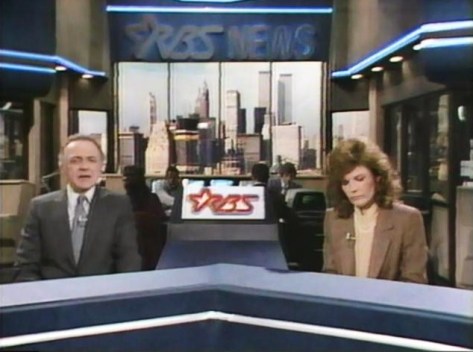
Special Bulletin– This outstanding 1983 made-for-TV movie has been overshadowed by the nuclear nightmare-themed TV movie The Day After, which aired the same year (I’m sure I will be raked over the coals by some readers for not including the aforementioned on this list, but frankly I always thought it was too melodramatic and vastly over-praised).
Directed by Edward Zwick and written by Marshall Herskovitz (the same creative team behind thirtysomething), Special Bulletin is framed as a “live” television broadcast, with local news anchors and reporters interrupting regular programming to cover a breaking story.
A domestic terrorist group has seized a docked tugboat in Charleston Harbor. A reporter relays their demand: If every nuclear triggering device stored at the nearby U.S. Naval base isn’t delivered to them by a specified time, they will detonate their own homemade nuclear device (equal in power to the bomb dropped on Nagasaki). The original airing apparently panicked more than a few South Carolinian viewers (a la Orson Welles’ War of the Worlds radio broadcast in 1938). Riveting and chilling. Nominated for 6 Emmys, it took home 4.
Testament- Originally an American Playhouse presentation, this film (with a screenplay adapted by John Sacred Young from a story by Carol Amen) was released to theaters and garnered a well-deserved Best Actress nomination for Jane Alexander. Director Lynne Littman takes a low key approach, but pulls no punches; I think this is what gives her film’s anti-nuke message more teeth and makes its scenario more relatable than Stanley Kramer’s similarly-framed but more sanitized and preachy 1959 drama On the Beach.
Alexander, her husband (William DeVane) and three kids live in sleepy Hamlin, California, where afternoon cartoons are interrupted by a news flash that nuclear explosions have occurred in New York. Then there is a flash of a different kind when nearby San Francisco (where DeVane has gone on a business trip) receives a direct strike.
There is no exposition on the political climate that precipitates the attacks; this is a wise decision, as it puts the focus on the humanistic message of the film. All of the post-nuke horrors ensue, but they are presented sans the melodrama that informs many entries in the genre. The fact that the nightmarish scenario unfolds so deliberately, and amidst such everyday suburban banality, is what makes it very difficult to shake off.
As the children (and adults) of Hamlin succumb to the inevitable scourge of radiation sickness and steadily “disappear”, like the children of the ‘fairy tale’ Hamlin, you are left haunted by the final line of the school production of “The Pied Piper” glimpsed earlier in the film… “Your children are not dead. They will return when the world deserves them.”
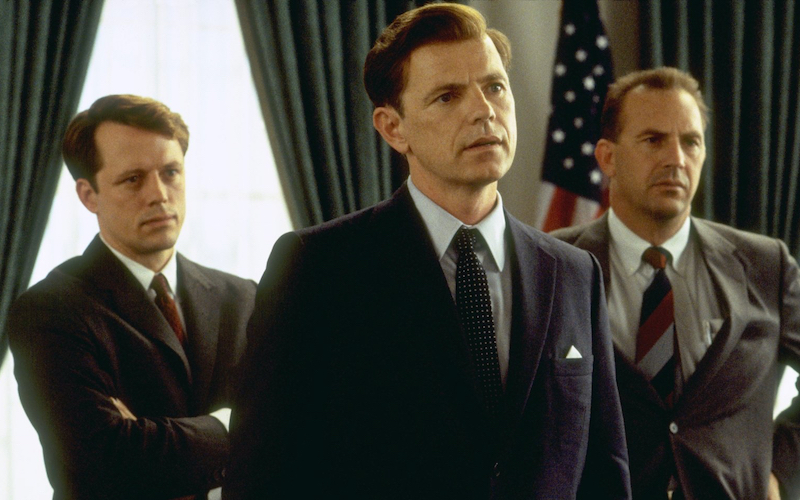
Thirteen Days– I had a block against seeing this 2000 release about the 1962 Cuban missile crisis, for several reasons. For one, director Roger Donaldson’s uneven output (for every Smash Palace or No Way Out, he’s got a Species or a Cocktail). I also couldn’t get past “Kevin Costner? In another movie about JFK?” Also, I felt the outstanding 1974 TV film, The Missiles of October (which I recommend) would be hard to top. But I was pleasantly surprised to find it to be one of Donaldson’s better films.
Bruce Greenwood and Steven Culp make a very credible JFK and RFK, respectively. The film works as a political thriller, yet it is also intimate and moving at times (especially in the scenes between JFK and RFK). Costner provides the “fly on the wall” perspective as Kennedy insider Kenny O’Donnell. Costner gives a compassionate performance; on the downside he has a tin ear for dialects (that Hahvad Yahd brogue comes and goes of its own free will).
According to the Internet Movie Database, this was the first film screened at the White House by George and Laura Bush in 2001. Knowing this now…I don’t know whether to laugh or cry myself to sleep.
The War Game / Threads– Out of all of the selections on this list, these two British TV productions are the grimmest and most sobering “nuclear nightmare” films of them all.
Writer-director Peter Watkins’ 1965 docudrama, The War Game was initially produced for television, but was deemed too shocking and disconcerting for the small screen by the BBC. It was mothballed until picked up for theatrical distribution, which snagged it an Oscar for Best Documentary in 1967. Watkins envisions the aftermath of a nuke attack on London, and pulls no punches. Very ahead of its time, and it still packs quite a wallop.
The similarly stark and affecting nuclear nightmare drama Threads debuted on the BBC in 1984, later airing in the U.S. on TBS. Director Mick Jackson delivers an uncompromising realism that makes The Day After (the U.S. TV film from the previous year) look like a Teletubbies episode. It’s a speculative narrative that takes a medium sized city (Sheffield) and depicts what would likely happen to its populace during and after a nuclear strike, in graphic detail.
Both productions make it clear that, while they are dramatizations, the intent is not to “entertain” you in any sense of the word. The message is simple and direct-nothing good comes out of a nuclear conflict. It’s a living, breathing Hell for all concerned-and anyone “lucky” enough to survive will soon wish they were dead.
When the Wind Blows– This animated 1986 U.K. film was adapted by director Jimmy Murakami from Raymond Brigg’s eponymous graphic novel. It is a simple yet affecting story about an aging couple (wonderfully voiced by venerable British thespians Sir John Mills and Dame Peggy Ashcroft) who live in a cozy cottage nestled in the bucolic English countryside. Unfortunately, an escalating conflict in another part of the world is about to go global and shatter their quiet lives.
Very similar in tone to Testament (another film on this list), in its sense of intimacy amidst slowly unfolding mass horror. Haunting, moving, and beautifully animated, with a combination of traditional cell and stop-motion techniques. The soundtrack features music by David Bowie, Roger Waters, and Squeeze.
(Originally posted on Digby’s Hullabaloo on January 4, 2025)
City of Hope (Sony)
John Sayles’ sprawling 1991 drama about urban decay and political corruption (beautifully shot by Robert Richardson) is set in fictional Hudson City, New Jersey (Cincinnati stands in). Vincent Spano plays the central character, the ne’er-do-well son of a property developer (Tony Lo Bianco) who has dubious ties with local mobsters. Utilizing his patented network narrative structure, Sayles weaves in many of his pet themes, such as family ties, culture clash, tests of faith, class warfare and local politics.
There are similarities with the previous year’s Bonfire of the Vanities; but this is a far superior film. I see City of Hope as a precursor to The Wire. The populous cast (uniformly excellent) includes Chris Cooper, Joe Morton, Angela Bassett, David Straithairn, and Gina Gershon.
Save the commentary track by Sayles, Sony’s Blu-ray edition is bereft of extras, but features a nice high-def transfer. I’m just happy to see this nearly forgotten gem get a long-overdue home video release (to my knowledge, it was never even issued on DVD).