Category Archives: Family Issues

DVD Reissue: El Norte ****

By Dennis Hartley

(Originally posted on Digby’s Hullabaloo on November 28, 2009)

https://quadcinema.com/wp-content/uploads/2017/05/El-Norte-1983-1-e1493598414264.jpg

El Norte – Criterion Collection DVD (2 discs)

 Gregory Nava’s portrait of Guatemalan siblings who make their way to the U.S. after their father is killed by a government death squad will stay with you after credits roll. The two leads deliver naturalistic performances as a brother and sister who maintain optimism, despite fate and circumstance thwarting them at every turn. Claustrophobes be warned: a harrowing scene featuring an encounter with a rat colony during an underground border crossing is nightmare fuel. Do not expect a Hollywood ending; this is an unblinking look at the shameful exploitation of undocumented workers. Criterion’s sparkling transfer is a world of improvement over the previous PAL editions.

DVD Reissue: Dodes’ka-den ***1/2

By Dennis Hartley

(Originally posted on Digby’s Hullabaloo on November 28, 2009)

http://3.bp.blogspot.com/-hYna70psdlo/TjguSuMVc3I/AAAAAAAAALs/WuRnkoxMm-4/s1600/cap146.bmpDodes’ka-den – Criterion Collection DVD

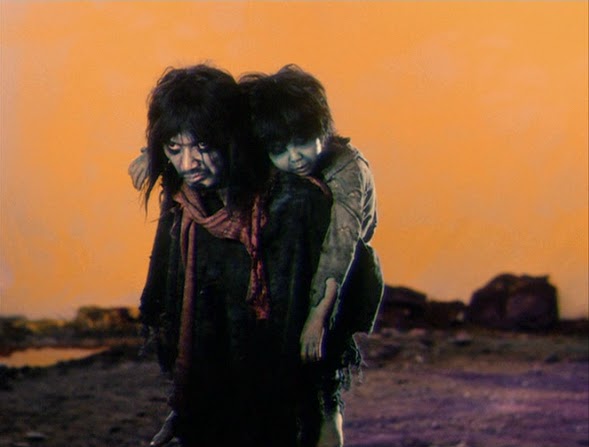
Previously unavailable on Region 1, this 1970 film by Akira Kurosawa rarely gets mentioned in the same breath as The Seven Samurai; nonetheless, it stands out as one of the great director’s most unique efforts.  This was the first film Kurosawa shot in color (27 years into his career, no less)-and it shows; the screen explodes with every imaginable hue you could create from a painter’s palette.

Perversely, the subject matter within this episodic tale of life in a Tokyo slum (mental illness, domestic violence, rape, alcoholism, starvation, etc.) is as dark and bleak as its visuals are bright and colorful. It’s a challenging watch; but the film slowly and deliberately sneaks up on you with its compassion and humanity, packing a real (if hard-won) emotional wallop by the devastating denouement. Criterion’s DVD features a lovely transfer and some nice extras.

SIFF 2009: Mommy is at the Hairdresser’s ****

By Dennis Hartley

(Originally posted on Digby’s Hullabaloo on June 13, 2009)

Mommy Is at the Hairdresser’s is such a perfect film, that I’m almost afraid to review it. It’s a perfect film about an imperfect family; but like the selective recollections of a carefree childhood, no matter what the harsh realities of the big world around you may have been, only the most pleasant parts will forever linger in your mind.

Set on the cusp of an idyllic Quebec summer, circa 1966 (my guess), the story centers on the suburban Gauvin family. Teenaged Elise (Marianne Fortier) and her two young brothers are thrilled that school’s out for the summer. Their loving parents appear to be the ideal couple; the beautiful Simone (Celine Bonnier) works as a TV journalist and her handsome husband Le Pere (Laurent Lucas) is a microbiologist. But alas, there is trouble in River City . When a marital infidelity precipitates a separation, leaving the kids in the care of their well-meaning but now titular father, young Elise suddenly  finds herself as the de facto head of the family.

Thanks to the sensitive direction from Lea Pool, an intelligent and believable screenplay by Isabelle Hebert, and  some of the most extraordinary performances by child actors that I’ve seen in quite some time, I found myself completely transported back to that all-too-fleeting “secret world” of childhood. You know… that singular time of life when worries are few and everything feels possible (before that mental baggage carousel backs up with too many overstuffed suitcases, if you catch my drift).

This is one of the most beautifully photographed films I have seen recently. Daniel Jobin’s DP work should receive some kind of special award from Quebec’s tourist board, because watching this film gave me an urge to take a crash course in Quebecois, pack some fishing gear and move there immediately. This is my personal favorite at this year’s SIFF, and I hope that it finds wider distribution- tres bientot.

SIFF 2009: Mid-August Lunch ***

By Dennis Hartley

(Originally posted on Digby’s Hullabaloo on June 6, 2009)

Eccentric ladyland.

This slice-of-life charmer from Italy, set during the mid-August Italian public holiday known as Ferragosto, was written and directed by Gianni Di Gregorio (who also co-scripted the critically-acclaimed 2009 gangster drama Gomorrah). Light-ish in plot but rich in observational insight, it proves that sometimes, less is more.

The Robert Mitchum-ish Di Gregorio casts himself as Giovanni, a middle-aged bachelor living in Rome with his elderly mother. He doesn’t work, because as he quips to a friend, taking care of mama is his “job”. Although nothing appears to faze the easy-going Giovanni, his nearly saintly countenance is tested when his landlord, who wants to take a little weekend excursion with his mistress, asks for a “small” favor.

In exchange for some forgiveness on back rent, he requests that Giovanni take on a house guest for the weekend-his elderly mother. Giovanni agrees, but is chagrined when the landlord turns up with two little old ladies (he hadn’t mentioned his aunt). Things get more complicated when Giovanni’s doctor makes a house call, then in lieu of a bill asks if he doesn’t mind taking on his dear old mama as well (Ferragosto is a popular “getaway” holiday in Italy).

It’s the small moments that make this film such a delight. Giovanni reading Dumas aloud to his mother, until she quietly nods off in her chair. Two friends, sitting in the midday sun, enjoying white wine and watching the world go by. And in a scene that reminded me of a classic POV sequence in Fellini’s Roma, Giovanni and his pal glide us through the streets of Rome on a sunny motorcycle ride. This mid-August lunch might offer you a somewhat limited menu, but you’ll find that every morsel on it is well worth savoring.


Lighten up, Francis: Tetro **1/2

By Dennis Hartley

(Originally posted on Digby’s Hullabaloo on  June 27, 2009)

http://graphics8.nytimes.com/images/2009/06/11/arts/11tetr600.jpg

ORMAN “Well, you see Willard… Every man has got a breaking point. You and I have. Walter Kurtz has reached his.And very obviously, he has gone insane.” 

WILLARD “Yes sir, very much so sir. Obviously insane.” 

-from Apocalypse Now

It’s official now. With his latest film, Tetro, a mad fever dream of a family angst drama that plays out like a telenovela on acid, Francis Ford Coppola has become Colonel Kurtz.

I don’t really mean to insinuate that the venerable 70-year old director has literally gone completely around the bend in his new film; but as an artist, it signals that he has come full circle-in a sort of insane fashion. Back in 1963, under the auspices of the famously “no-budget” producer Roger Corman, a then 24-year old Coppola wrote and directed a B & W horror cheapie called Dementia 13.

The story revolved around a twisted family with dark secrets. It’s been a while since I’ve screened it, but I seem to remember one of the family members creeping about the estate wielding an axe. While it’s not ostensibly “horror”, one could peg Tetro as a B & W film revolving around a twisted family with dark secrets; and, oddly enough, there is a climactic scene where one of the family members creeps about an estate-wielding an axe.

For the setup of this (possibly) very personal story, Coppola utilizes some of his own emotional leftovers to cook up a Tennessee Williams meets Douglas Sirk-worthy family stew (with just a hint of balletic Powell and Pressburger opera tossed in for flavoring). Tetro (Vincent Gallo) is an ex-pat living in Buenos Aires with his dancer girlfriend Miranda (Mirabel Verdu), who is an Argentine native.

Tetro is a troubled soul; a gifted but unpublished writer-poet with a history of mental breakdowns who has willfully estranged himself from his family (for complex reasons that are unraveled in very sudsy fashion). He is quite chagrined when an unwelcomed boulder comes smashing through this wall of self-imposed exile in the form of his younger brother Bennie (Alden Ehrenreich), who shows up on his doorstep one day. Bennie, a cruise ship worker whose boat “happens” to be in port, has not seen his big brother since he was knee high to a grasshopper, and is eager to reestablish contact.

In fact, Bennie idolizes Tetro; it is that unique mixture of envy and romanticized esteem that younger family members hold for the older siblings who are first in line to declare independence from parental restraints and strike out into the coveted world of adult “freedom” (we all know how soon that illusion gets shattered…heh).

Tetro, however, is not eager to reciprocate. Not only does he make it clear that Bennie is not welcome to stay any longer than necessary, but he refuses to refer to him as a relative when introducing him to the locals. Undaunted, Bennie remains hell-bent to reconnect, and soon fate and circumstance serve to prolong his visit to Buenos Aires, setting off a chain of events that eventually forces both brothers to come to terms with their shared “Daddy issues”. Klaus Maria Brandauer chews major scenery as their narcissistic father, who is a world-famous symphony conductor… and world-class prick.

Coppola’s films have generally vacillated between the Big Theme (The Godfather, The Conversation, Apocalypse Now, Gardens of Stone) and the intimate character study (The Rain People, One From the Heart, Rumble Fish, Peggy Sue Got Married). I have to admit to being more partial to his Big Theme films. As I conjectured earlier, this is “possibly” an extremely personal film; I’m no psychiatrist, but Coppola’s dad, Carmine, is a composer/conductor (I’m just saying).

At any rate, this definitely qualifies as a “personal” work on some level; it virtually screams at you from the passionate, high drama of the piece. It goes without saying that “family” is a recurring theme in his work as well; so in that respect, you could say that Tetro is a return to form. So is that a good thing in this case?

I was with Coppola for the first half or so of the movie. Gallo delivers an explosive performance; I think it’s his finest work to date. The charismatic Verdu is very effective inhabiting a character who is at once earthy, sensuous and saintly. Newcomer Ehrenreich admirably holds his own with his more seasoned co-stars. The problem I have is with the film’s over-the-top third act. Even accounting for Coppola’s (literally) operatic construct that leads up to the jaw-dropping finale, it’s all a bit too…too (if you know what I’m saying). Maybe it’s me; if you enjoy that sort of thing, perhaps you’ll be more forgiving.

One cannot deny the visual artistry on display. Even when he lost me with the story, Coppola’s mastery of the medium kept my eyes riveted to the screen. So he did his job, after all. He’s been doing it for 50 years-so I’ll let him off the hook…for old time’s sake.

Everybody hurts: La Nana ***

By Dennis Hartley

(Originally posted on Digby’s Hullabaloo on December 5, 2009)

Upstairs, creepy stares: Catalina Saavedra in The Maid

Mike Leigh, meet Sebastian Silva. With his second feature, La Nana (aka The Maid) the Chilean writer-director has made a beautifully acted little film that plays like a telenovela, black comedy, intimate character study and social commentary, all rolled into one.

Catalina Saavedra is a revelation as Raquel, a live-in maid employed by an upper-middle class family in Santiago for over 20 years. More than just a housekeeper, she has been the nanny to all the children since birth, and is considered a family member. However, despite her dedicated years of service with the loving clan, who (with the exception of one of the daughters) treat her with the utmost deference and respect, Raquel vibes a glum countenance; she remains emotionally guarded and cryptically aloof much of the time.

When some chronic health issues begin to compromise her efficiency, the mother (Claudia Celedon) decides to hire a second maid to give her a hand. The territorial Raquel is not at all pleased; passive-aggressiveness escalates into open hostility as we watch her transform into a veritable Cruella DeVille.

After manipulatively hastening the departures of two new hires in rapid succession, Raquel suddenly finds herself facing a formidable “opponent”. Her name is Lucy (Mariana Loyola). Her weapons are serenity and compassion. No matter what amount of bad vibes or acts of spite Raquel hurtles in her direction, they all appear to incinerate harmlessly in the aura of Lucy’s perennially sunny disposition before they can reach their target.

Then, something miraculous begins to unfold-Raquel’s seemingly impenetrable defensive shell cracks, and as it does, the emotional repression of 42 years slowly peels away, resulting in unexpectedly delightful and engaging twists and turns.

Initially, I was reminded of Joseph Losey’s dark class struggle allegory, The Servant; but as the film switched gears, I found it closer  to the more recent Happy Go Lucky. Saavedra’s wonderful and fearless performance is the heart of the film. In less sensitive hands, the character of Raquel could have easily been an unsympathetic cartoon villain, but Saavedra never allows her character’s humanity to slip from our view. Raquel is a reminder that everybody deserves a chance to be loved and understood. And that’s a good thing.

Wild child, full of grace: Where the Wild Things Are ***1/2

By Dennis Hartley

(Originally posted on Digby’s Hullabaloo on October 24, 2009)

Pathos, on a cliff by the sea: Where the Wild Things Are

 Shilo, when I was young
I used to call your name
When no one else would come
Shilo, you always came
and we’d play

 -from “Shiloh” by Neil Diamond

Childhood is a magical time. Well, at least until the Death of Innocence…whenever that is supposed to occur. At what point DO we slam the window on Peter Pan’s fingers? When we stop believing in faeries? That seems to be the consensus, in literature and in film.

In Wim Wenders’ Wings of Desire; only children “see” the angels. Even when the fantastical pals are more tangible, the adults in the room keep their blinders on. In Stephen Spielberg’s E.T., Mom doesn’t initially “see” her children’s little alien playmate, even when she’s seemingly gawking right at him. When the protagonist with the “imaginary” friend is an adult, he’s either dismissed as being drunk (Elwood P. Dowd in Harvey), crazy (Ray Kinsella in Field of Dreams), or both (Edward Norton’s character in Fight Club).

These adults, naturally, are acting…“childish”. Why is “childish” such a dirty word, anyway? To paraphrase Robin Williams, what is wrong with retaining a bit of  “mondo bozo” to help keep your perspective? Wavy Gravy once gave similar advice: “Laughter is the valve on the pressure cooker of life. Either you laugh and suffer, or you got your beans or brains on the ceiling.” Basically (in the parlance of psycho-babble) they are advising to “stay in touch with your Inner Child”.

Director Spike Jonze and co-screenwriter Dave Eggars both get their Inner Child on in Where the Wild Things Are, a bold and wildly imaginative film adaptation of the classic children’s book by Maurice Sendak. Blending live action with expressive CGI/Muppet creations, the filmmakers construct a child’s inner fantasy world that lives and breathes, while avoiding the mawkishness that has been the ruin of many a children’s film. In actuality, this arguably may not qualify as such in the strictest sense; perhaps no more so than Lord of the Flies or Pan’s Labyrinth can be labeled as “children’s” films.

Young Max (Max Records) lives with his mother (Catherine Keener) and teenaged sister Claire (Pepita Emmerichs) in suburbia. Max is the type of child who might be described by some as having an “overactive imagination”, by others as a troubled kid). At any rate, we’ll just say that he definitely has some anger management issues stemming from (among other things) feelings of abandonment by his father (whether this situation was precipitated by death or divorce isn’t made quite clear, unless I overlooked something obvious).

He appears to have a loving relationship with his mom, but her job pressures, along with the additional stresses of single parenthood are obviously putting the damper on their quality time. His sister is too sidetracked by the social whirlwind of burgeoning adolescence to take interest in bonding with Kid Brother, and he doesn’t seem to have any peers to hang with. In short, Max is the Lonely Little Boy.

One evening, his mom’s boyfriend (Mark Ruffalo) comes for a visit, triggering an unseemly episode of “acting out” by Max. A defiant standoff with his exasperated mom culminates with Max physically attacking her. Surprised and confused by the ferocity of his own behavior, a spooked Max runs off into the night to wrestle with his demons. Somewhere in the course of this long dark night of his 9 year-old soul, in the midst of a panicky attempt to literally flee from his own actions, Max crosses over from Reality into Fantasy (even children need to bleed the valve on the “pressure cooker of life”).

This pivotal transition is handled beautifully and subtly by the filmmakers; a sequence that I found reminiscent of the unexpectedly lyrical and fable-like interlude in Charles Laughton’s otherwise foreboding noir thriller, The Night of the Hunter, in which the children find respite from trauma via a moonlit, watery escape.

Max washes up on the shore of a mysterious island where he finds that he suddenly has the ability to not only wrestle with his inner demons, but run and jump and laugh and play with them as well. These strange and wondrous manifestations are the literal embodiment of the “wild things” inside of him that drive his complex emotional behaviors; anthropomorphic creatures that also pull double duty as avatars for the people who are closest to him.

At first, the beasts are reflexively territorial, threatening to serve him up for dinner if he doesn’t prove his mettle; Max is quick enough on his feet to figure out that he is going to have to make up in clever invention for what he lacks in physical size to keep himself out of the soup kettle. Somehow he convinces them that he is not only worthy of their trust, but is an excellent candidate to become their “king” as well (I’m no psych major, but if your emotions threaten to consume you, the best way to conquer them is to take control of them, right?)

Max forges an instant bond with the fearsome yet benign Carol (James Gandolfini) who serves as both father figure and soul mate (he also thinks it’s a hoot to rage and howl and break shit to blow off steam). Inversely, Max also is drawn to the calming countenance of Carol’s (Wife? Girlfriend?  Roommate? It’s a little hazy) “KW” (Lauren Ambrose), a morph of a maternal/big sister confidant.

All the voice-over actors (including Forest Whitaker, Chris Cooper and Catherine O’Hara ) do a great job giving the various creatures hearts and souls. The episodic nature of the film’s structure may be trying for some; on the other hand, one must consider that such leaps of faith in logic are, after all, the stuff dreams are made of.

That Jonze and Eggars were able to wring this much compelling narrative and fleshed out back stories from what was essentially a child’s picture book with minimal text and virtually no exposition, and execute it all with such inventive visual flair (lovely work from DP Lance Acord), is quite an amazing accomplishment.

In a way, Jonze was the perfect director for this project. His two previous feature films (both collaborations with the iconoclastic Charlie Kaufman, known for writing densely complex, virtually un-filmable screenplays) were expert cinematic invocations of journeys into “inner space”. In Being John Malkovich, the protagonist literally finds a portal into another person’s psyche; Adaptation dived headlong into the consciousness of a blocked writer.

With his new film, Jonze seems to have drilled a portal both into the mind of Maurice Sendak, and straight into the collective memory of childhood lost. And now, if you will excuse me, I’m going out to the back yard to play for a while. And may your wild rumpus never end.

The accidental tsuris: A Serious Man ***1/2

By Dennis Hartley

(Originally posted on Digby’s Hullabaloo on October 10, 2009)

The noodge-y professor: A Serious Man.

Someone I once worked with in my standup comedy days (my hand to God, I wish I could remember who) had a great bit that he called “Jewish calisthenics”. “OK,” he would exhort the audience, “Here we go…ready? Neck back, and…repeat after me…” (shrug) “Why me? And rest. And again…” (shrug) “Why me?” Well, you had to be there.

Anyway, I thought it was a brilliant distillation of what “Jewish humor” is all about; a rich tradition of comedic expression borne exclusively from a congenital persecution complex and cultural fatalism (trust me on this-I was raised by a Jewish mother).

You know who else was raised by a Jewish mother? Those nice Coen boys-Joel and Ethan. They grew up in a largely Jewish suburban Minneapolis neighborhood (St. Louis Park). But you wouldn’t know it from their films. They nevah call. They nevah write a nice story a mother could love. Instead, it’s always with the corruption, the selfish behavior, and the killing, and the cattle prods…until now.

Well, I don’t know if you would  call it a “nice” story, but A Serious Man is the closest that the Coen Brothers have come to writing something semi-autobiographical . They do set their story in a Minnesotan Jewish suburban enclave, in the summer of 1967 (when Joel was 13 and Ethan was 10). God help them, however, if their family was anything like the Gopniks; although if they were, it would explain a lot about the world view they expound in their films.

Larry Gopnik (Michael Stuhlbarg) is a “serious man”- a buttoned-down physics professor who can map out the paradoxical quantum mysteries of Schrodinger’s cat, but is stymied as to why his wife Judith (Sari Lennick) suddenly announces to him one day out of the blue that she wants a divorce. To add insult to injury, she wants him to move out of the house as soon as possible, so that the man she wishes to spend the rest of her life with, a smarmy neighborhood widower named Sy Abelman (Fred Melamed) can settle in.

This situation alone would give any self-respecting mensch such tsuris, nu? Yes, it gets worse. Larry gets no sympathy or support from his snotty, self-absorbed daughter (Jessica McManus) or his stoner son (Aaron Wolff), who spends more time obsessing on his favorite TV show F Troop than brushing up on his Hebrew for an upcoming Bar Mitzvah.  Larry also has problems at work. And then there is his perennially underemployed brother (Richard Kind) who has become a permanent house guest who spends an inordinate amount of time in the bathroom, draining his, erm, cyst.

Teetering on the verge of an existential meltdown, Larry seeks advice from three rabbis, embarking on a spiritual quest in order to glean, “Why me?” The story takes on the airs of a modern fable from this point onward, neatly telegraphed by the film’s opening ten minutes-a blackly comic, “old school” Yiddish folk tale with semi-mystical overtones,  reminiscent of Woody Allen’s Love and Death.

In the context of the Coen’s oeuvre, the character of Larry Gopnick is not really so far removed from William Macy’s character in Fargo or Billy Bob Thornton’s character in The Man Who Wasn’t There; sans the murder and mayhem, but sharing the plight of the hapless Everyman, ultimately left twisting in the wind by the detached cruelty of Fate…and the Coens themselves.

The cast is excellent, especially Sthulbarg and Kind, very believable as brothers with a complex relationship,  (does their relationship reflect Joel and Ethan’s, I wonder?). I have to mention a wonderful (if brief) performance by Amy Landecker as the sexy neighbor, Mrs. Samsky (channeling Anne Bancroft’s Mrs. Robinson), who has a hilarious seduction scene with the uptight Larry.

I think I need to see this film again, because it  has interesting layers to it that I don’t think can be fully appreciated in just one viewing. It’s smart, it’s funny, it’s made (gasp!) for adults, and it’s one of the most wildly original films I’ve seen this year.

Apparently there’s buzz from some quarters about the film being “too” Jewish, propagating stereotypes and so on and so forth, the Coens are self-loathing, blah blah blah, but I think that’s silly. Hell, I’ve got relatives that are more “Jewish” than the characters in the film. Besides, the Coens are Jews-is there some law against artists incorporating their heritage into their art? One might as well condemn Phillip Roth, Saul Bellow, Jules Feiffer, Mel Brooks, Woody Allen and Neil Simon for the same “crime”. So why do they persecute the Jews, huh? Why? (shrug) Why us? (shrug). And repeat…

John Hughes lives: Post Grad **1/2

By Dennis Hartley

(Originally posted on Digby’s Hullabaloo on August 22, 2009)

Although it “looks” like one of those indie comedies about quirky families (Little Miss Sunshine, Juno), Post Grad is populated by characters who would have felt more at home in a mid-1980s John Hughes vehicle; in an odd way this makes it pleasantly anachronistic.

You could almost picture Molly Ringwald as Ryden Malby (Alexis Bledel), a college lit major whose post-graduation dream is to jump right into the career track at a major L.A. publishing house. You have the male childhood friend (and fellow grad) Adam (Zach Gilford) who secretly pines away for her while gallantly respecting the platonic reality (yes…he is, and will forever be…her Duckman).

You even have the Hated Rival. Her name is Jessica (played to the hilt with amusingly snobby arrogance by Catherine Reitman) and she’s been Ryden’s academic arch-nemesis since high school. Much to Ryden’s chagrin, Jessica (along with her other fellow grads) all manage to breeze into immediate employment (obviously, the film was not made with the current economic realities in mind). Her road to that dream job runs into some bumps; consequently she faces every grad’s worst nightmare: Moving back in with the family.

This brings us to the Batshit Crazy Yet Lovable Family. There’s the D.I.Y. Dad (Michael Keaton, at times recalling his character in Night Shift) who manages a luggage store, but who is always dreaming up quirky money-making schemes on the side (he’s got one word of fatherly advice for his daughter…not “plastics”, but  “buckles”).

Mom (Jane Lynch) divides her time between pinching pennies and reining in Ryden’s weird, sock-puppet wielding little brother (Bobby Coleman) who gets into trouble at school for, uh, licking his classmates; he apparently finds their heads particularly appealing.

And don’t forget Grandma (a scene-stealing Carol Burnett, still an absolute riot at 76) who makes her grand entrance at Ryden’s graduation ceremony replete with clanging portable oxygen bottle and a rather noisy bag of Cheetos (not the only glaring product placement-Eskimo Pies get more screen time than some of the cast).

There’s not a lot of room for character development within the film’s breezy 90-minute running time (don’t expect anything much deeper than a slightly better than average sitcom episode), but the cast is game, there are some genuinely funny scenes and at its heart the film is so amiable  that it’s hard not to like it.

The only misstep of note is a subplot about a flirtation between Ryden and her 30-something neighbor, a wannabe filmmaker who directs TV infomercials (played by Brazilian beefcake Rodrigo Santoro). It doesn’t convince; and the romantic chemistry isn’t there between Bledel and Santoro. Bledel has a charming screen presence, although she is handily upstaged by Keaton, Lynch and Burnett.

This is the first feature-length “live action” film for director Vicky Jenson, who has a background in animation  (she previously co-directed Shark Tale and Shrek). It’s also the feature film debut for screenwriter Kelly Fremon. Ivan Reitman (who directed Ghostbusters and Stripes) produced; which might explain the film’s 80s vibe.

Frankly the chief reason I was intrigued to screen the film was the vague inference in the trailer that it might signal Hollywood’s acknowledgment of our economic woes; it looks like we’ll still have to wait for Michael Moore’s upcoming Capitalism: A Love Story for that. In the meantime, don’t lose any sleep if you miss Post Grad in theaters, although it may be worth a rental on a slow night.

Take me to the river: Sin Nombre ***1/2

By Dennis Hartley

(Originally posted on Digby’s Hullabaloo on April 11, 2009)

Every now and then a debut film comes along that has a voice. And when I say “voice”, I mean that the director’s confidence and clarity of cinematic vision has a tangible presence-from the very first frame to the closing credits. Maybe I’m a little jaded, but it doesn’t happen that much these days. So when I saw Cary Fukunaga’s  assured first feature, Sin Nombre, it “…made my big toe shoot right up in my boot,” (as Little Richard described the first time he ever saw Hendrix live).

Defying all expectations, this modestly budgeted, visually expansive gem hinges on a simple narrative, but is anything but predictable. It’s an adventure, yet it is informed by an almost meditative stillness that makes the occasional frisson that much more gripping and real. It delves into gang culture, but it isn’t a movie about gangs. It has protagonists who are desperately attempting to immigrate to the United States by any means necessary, yet this isn’t yet another earnest message film about “the plight” of illegal immigrants. It’s a “road movie”, but the future’s uncertain-and the end is always near.

The film has two narratives, which eventually merge as one. One story begins in Honduras, concerning a headstrong teenage girl named Sayra (Paulina Gaitan) who joins her long estranged father and uncle as they journey to Mexico, where they plan to ride the rails as far north as possible before making a final dash across the border to America, where dreams of milk and honey await.

Sayra’s father hopes to use their time together to become reacquainted with his daughter. Sayra, who seems to be working through abandonment issues, is polite but keeps a cool distance from his belated attempts at offering fatherly advice and exerting parental authority. Still, Sayra, her father and her uncle begin to form a family unit, precipitated more by necessity than affection.

Another type of extended family unit is examined in the film’s companion narrative, which takes us to the southern Mexico state of Chiapas, and centers on a local chapter of the notorious “MS-13” gang. We witness a brutal initiation rite, a 13-second long “beat down” on a young inductee nicknamed “El Smiley” (Kristian Ferrer).

Punches and kicks are soon replaced by congratulatory hugs, as Smiley is welcomed as a “brother” by his new homies, and anointed a “son” by the leader, “Lil Mago” (Tenoch Huerta Mejia). We also meet Willy, known in the gang as “El Caspar” (Edgar Flores) who is Smiley’s sponsor, and a de facto big brother figure to the young boy.

While he is a dedicated and respected member of the gang, Willy vibes creeping disenchantment; we sense he dreams of a better life. He also has something  lacking in the others-a sense of conscience. This leads to a fateful conflict with Mago, a repugnant sociopath who will accept nothing less than blind obedience . Circumstance puts Willy in the same yard where Sayra and her relatives await to jump a train that will take them north; and thus their paths converge.

While this is a very human story, containing all the elements of classic drama (love, hope, betrayal, revenge, personal sacrifice), it is also about the locales, and the elegiac tone that these backdrops lend to what is otherwise a harrowing tale. As the train whistle stops its way through Mexico, the country’s rugged beauty is captured in gorgeous “golden hour” hues by cinematographer Adriano Goldman.

Goldman’s work  reminds me of Nestor Almendros, who did the magnificent photography for Terence Malick’s Days of Heaven. The Texas prairies used as backdrop in Days of Heaven are in the same neck of the woods, and some story elements (like the protagonist’s point of view) are reminiscent of that film as well. Whether or not Malick was a conscious influence on Fukunaga is a moot point, because his film stands on its own. One could have worse influences.

For an unknown cast (many non-professionals), there are an astonishing number of outstanding performances. This adds to the naturalistic, believable tone. My film going companion, a native of Mexico (she’s from Colima), was impressed by that element, and seconded the motion that the milieu was muy autentico. Sin Nombre is another rarity these days-it’s meant to be seen on the big screen.