Category Archives: Drama

If you really must pry: Top 10 films of 2016

By Dennis Hartley

(Originally posted on Digby’s Hullabaloo on December 31, 2016)

https://s.aolcdn.com/dims-shared/dims3/GLOB/crop/1366x724+0+16/resize/660x350!/format/jpg/quality/85/https:/s.aolcdn.com/hss/storage/midas/b36cfbd7966c4d56de015d29ccb8386d/202780655/hail+caesar+2.jpg

It’s hard to believe it’s been 10 years since my pal Digby graciously offered me a crayon, a sippy cup and a weekly play date on her otherwise grownup site so I can scribble about pop culture. I’d like to take this opportunity to thank everybody who continues to support Hullabaloo and wish you and yours the best in 2017! ‘Tis the season to do a year-end roundup of the best films I reviewed in 2016. Alphabetically, not in order of preference:

The Curve – It’s tempting to synopsize Rifqi Assaf’s road movie as “Little Miss Sunshine in the Arabian Desert” but that would be shortchanging this humanistic, warmly compassionate study of life in the modern Arab world. It’s essentially a three-character chamber piece, set in a VW van as it traverses desolate stretches of Jordan. Fate and circumstance unite a taciturn Palestinian who has been living in his van, with a chatty Palestinian divorcee returning to a Syrian refugee camp and an exiled Lebanese TV director. A beautifully directed and acted treatise on the commonalities that defy borders. (Full review)

Eat That Question – If there’s a missing link between today’s creative types who risk persecution in the (virtual) court of public opinion for the sake of their art, and Lenny Bruce’s battles in the actual courts for the right to even continue practicing his art, I would nominate composer-musician-producer-actor-satirist-provocateur Frank Zappa, who is profiled in Thorsten Schutte’s documentary. Admittedly, the film plays best for members of the choir. If you’ve never been a fan, the largely non-contextualized pastiche of vintage clips will likely do little to win you over. Still, if you’re patient enough to observe, and absorb, the impressionistic approach manages to paint a compelling portrait.  (Full review)

Hail, Caesar! – Truth be told, the narrative is actually a bit thin in this fluffier-than-usual Coen Brothers outing; it’s primarily a skeleton around which they are able to construct a portmanteau of 50s movie parodies. That said, there is another level to the film, one which (similar to the 2015 film Trumbo) depicts the Red Scare-induced fear and paranoia that permeated the movie industry in the 1950s through the eyes of a slightly fictionalized real-life participant (in this case, a Hollywood “fixer” played by Josh Brolin). George Clooney hams it up as a dim-witted leading man who gets snatched off the set of his latest picture (a sword-and-sandal epic bearing a striking resemblance to Spartacus) by an enigmatic organization called The Future (don’t ask). It’s supremely silly, yet enjoyable.  (Full review)

Home Care – The “Kubler-Ross Model” postulates that there are five distinct emotional stages humans experience when brought face-to-face with mortality: denial, anger, bargaining, depression, and acceptance. All five are served up with a side of compassion, a dash of low-key anarchy and a large orange soda in this touching dramedy from Czech director Slavek Horak. An empathic, sunny-side-up Moravian home care nurse (Alena Mihulova) is so oriented to taking care of others that when the time comes to deal with her own health crisis, she’s stymied. A deft blend of family melodrama with gentle social satire. Mihulova and Boleslav Polivka (as her husband) make an endearing screen couple.   (Full review)

Jackie – Who among us (old enough to remember) hasn’t speculated on what it must have been like to be inside Jacqueline Kennedy’s head on November 22, 1963? Pablo Larrain’s film fearlessly wades right inside its protagonist’s psyche, fueled by a precisely measured, career-best performance from Natalie Portman in the titular role, and framed by a (fictional) interview session that the recently widowed Jackie has granted to a probing yet acquiescing journalist (Billy Crudup), which serves as the convenient launching platform for a series of flashbacks and flash-forwards. The narrative (and crucially, Portman’s performance) is largely internalized; resulting in a film that is more meditative, impressionistic and personalized than your standard-issue historical drama. The question of “why now?” might arise, to which I say (paraphrasing JFK)…“why not?”  (Full review)

Mekko – Director Sterlin Harjo’s tough, lean, neorealist character study takes place in Tulsa, Oklahoma. Rod Rondeaux (Meek’s Cutoff) is outstanding as the eponymous character, a Muscogee Indian who gets out of jail after 19 years of hard time. Bereft of funds and family support, he finds tenuous shelter among the rough-and-tumble “street chief” community of homeless Native Americans as he sorts out how he’s going to get back on his feet. Harjo coaxes naturalistic performances from all. There’s more here than meets the eye, with subtexts about Native American identity, assimilation and spirituality.  (Full review)

Older Than Ireland – “They” say with age, comes wisdom. Just don’t ask a centenarian to impart any, because they are likely to smack you. Not that there is any violence in Alex Fegan and Garry Walsh’s doc, but there is a consensus among interviewees (aged from 100-113 years) that the question they find most irksome is: “What’s your secret to living so long?” Once that hurdle is cleared, Fegan and Walsh’s subjects have much to impart in this wonderfully entertaining (and ultimately moving) pastiche of the human experience. Do yourself a favor: turn off your personal devices for 80 minutes, watch this wondrous film and plug into humankind’s forgotten backup system: the Oral Tradition.  (Full review)

Snowden – Oliver Stone had a tough act to follow (Laura Poitras’ Oscar-winning 2014 documentary, Citizenfour) when he tackled his biopic about Edgar Snowden, the former National Security Agency subcontractor who ignited an international political firestorm (and became a wanted fugitive) when he leaked top secret information to The Guardian back in 2013 regarding certain NSA surveillance practices, but he pulls it off quite well. This is actually a surprisingly restrained dramatization by Stone, which is not to say it is a weak one. In fact, quite the contrary-this time out, Stone had no need to take a magical trip to the wrong side of the wardrobe. That’s because the Orwellian machinations (casually conducted on a daily basis by our government) that came to light after Snowden lifted up the rock are beyond the most feverish imaginings of the tin foil hat society. Stylistically speaking, the film recalls cerebral cold war thrillers from the 1960s like The Spy Who Came in From the Cold, with a nuanced performance by Joseph Gordon-Levitt.  (Full review)

The Tunnel– Kim Seong-hun’s film is a (no pun intended) cracking good disaster thriller from South Korea, concerning a harried Everyman (Ha Jung-woo) who gets trapped in his car when a mountain tunnel collapses on top of him. Now, I should make it clear that this is not a Hollywood-style disaster thriller, a la Roland Emmerich. That said, it does have thrills, and spectacle, but not at the expense of its humanity. This, combined with emphasis on characterization, makes it the antithesis of formulaic big-budget disaster flicks (typically agog with CGI yet bereft of IQ). There’s more than meets the eye here; much akin to Billy Wilder’s Ace in the Hole, Seong-hun uses the “big carnival” allusions of the mise-en-scene outside the tunnel to commentate on how members of the media and the political establishment share an alchemist’s knack for turning calamity into capital.  Full review)

Weiner – Co-directors Josh Kriegman and Elyse Steinberg were given remarkable access to Anthony Weiner, his family and campaign staffers during the course of his ill-fated 2013 N.Y.C. mayoral run. Their no-holds-barred film raises many interesting questions prompted in the wake of the former congressman’s “sexting” scandal (which led to his resignation from the U.S. House of Representatives in 2011)…the most obvious one being: should ‘we’ be willing to forgive personal indiscretions (barring actual criminal offenses) of those we have voted into office? After all, if making boneheaded decisions in one’s love life was a crime, there would be barely enough politicians left outside of prison to run the country. Then there’s this chestnut: WTF were you thinking?! If you’re curious to see the film because you think it answers that one, don’t waste your time. However, if you want to see an uncompromising, refreshingly honest documentary about how down and dirty campaigns can get for those in the trenches, this is a must-see.   (Full review)

# # #

And  these were my “top 10” picks for each of the years since I began writing film reviews over at Digby’s Hullabaloo (you may want to bookmark this post as a  handy quick reference for movie night).

[Click on title for full review]

2007

Eastern Promises, The Hoax, In the Shadow of the Moon, Kurt Cobain: About a Son, Michael Clayton, My Best Friend, No Country for Old Men, Pan’s Labyrinth, PaprikaZodiac

2008

Burn After Reading, The Dark Knight, The Gits, Happy Go Lucky, Honeydripper, Man on Wire, Milk, Slumdog Millionaire, Vicky Cristina Barcelona, The Visitor

2009

The Baader Meinhof Complex, Inglourious Basterds, In the Loop, The Limits of Control, The Messenger, A Serious Man, Sin Nombre, Star Trek, Where the Wild Things Are, The Yes Men Fix the World

2010

Creation, Inside Job, Joan Rivers: A Piece of Work, Little Big Soldier, A Matter of Size, My Dog Tulip, Nowhere Boy, Oceans, The Runaways, Son of Babylon

2011

Another Earth, Certified Copy, The Descendants, Drei, Drive, The First Grader, Midnight in Paris, Summer Wars, Tinker/Tailor/Soldier/Spy, The Trip

2012

Applause, Dark Horse, Killer Joe, The Master, Paul Williams: Still Alive, Rampart, Samsara, Skyfall, The Story of Film: an Odyssey, Your Sister’s Sister

2013

The Act of Killing, Big Star: Nothing Can Hurt Me, Computer Chess, 56 Up, The Hunt, Mud, The Rocket, The Silence, The Sweeney, Upstream Color

2014

Birdman, Child’s Pose, A Coffee in Berlin, The Grand Budapest Hotel, Kill the Messenger, The Last Days of Vietnam, Life Itself, A Summer’s Tale, The Wind Rises, The Theory of Everything

2015

Chappie, Fassbinder: Love Without Demands, An Italian Name, Liza the Fox Fairy, Love and Mercy, A Pigeon Sat on a Branch Reflecting on Existence, Song of the Sea, Tangerines, Trumbo, When Marnie Was There

Sour notes: Max Rose **

By Dennis Hartley

(Originally posted on Digby’s Hullabaloo on September 17, 2016)

http://www.indiewire.com/wp-content/uploads/2013/05/jerry-lewis-max-rose.jpg?w=648

“Have you heard about the restaurant on the moon? Great food, no atmosphere.” For better or worse, that’s the best line in Max Rose, Jerry Lewis’ first starring vehicle since Peter Chelsom’s 1995 sleeper Funny Bones.

Not that Max Rose is intended to be a comedy…far from it. Writer-director Daniel Noah’s film has much more gravity (ahem) than that timeworn groaner may infer.

Lewis is the titular character, a retired jazz pianist grieving over the recent death of his wife (Claire Bloom, relegated to flashbacks and the odd hallucination). Understandably, Max is a little morose (endless static shots of a brooding, stone-faced Lewis ensure that we “get” that).

Even his sunny-side up granddaughter Annie (Kerry Bishe) can barely get him to crack a smile. Again, Max did just lose his wife of 60 years; yet some deeply buried injury seems to be tugging at him.

Max’s eulogy at his wife’s funeral turns into an oddly self-deprecating rant, alarming both Annie and his son Christopher (Kevin Pollak). Soon thereafter, Max has a health scare while alone at home that prompts The Talk (the one we all dread…about assisted living).

Max reluctantly acquiesces and checks in to a nursing home, but remains stubbornly aloof toward staff and fellow residents, until he gets liquored up one night with a posse of lively codgers (Mort Sahl, Rance Howard and Lee Weaver).

Defenses down, Max now opens up about his deeper hurt, something he discovered about his wife’s past while sorting through her personal effects after her death. He realizes the only way he’s going to have closure is to go meet face-to-face with an involved party.

Despite the bevy of acting talent on board, this film (an uneven mash-up of The Descendents with The Sunshine Boys) ultimately feels like a squandered opportunity. Lewis has proved himself to be a capable enough dramatic actor in the past (particularly in The King of Comedy, Arizona Dream, and the aforementioned Funny Bones), but here his performance flirts with mawkishness.

To give him the benefit of the doubt, perhaps he was doing his best with the sappy script. There are good moments; a protracted scene between Lewis and the always interesting Dean Stockwell hints at what could have been, but is not enough to raise the film above its steady level of “meh”.

Freudian nightmare: Tunnel ***1/2

By Dennis Hartley

(Originally posted on Digby’s Hullabaloo on August 27, 2016)

https://kaist455.files.wordpress.com/2016/08/tunnel01.jpg?w=640

Herbie Cook: The old man sure looked bad. Did you see his face?

Charles Tatum [thoughtfully]: Yeah.

Herbie Cook: Like the faces of those folks you see outside a coal mine with maybe 84 men trapped inside.

Charles Tatum: One man’s better than 84. Didn’t they teach you that?

Herbie Cook: Teach me what?

Charles Tatum: Human interest. You pick up the paper. You read about 84 men, or 284, or a million men, like in a Chinese famine. You read it, but it doesn’t stay with you. One man’s different, you want to know all about him. That’s human interest.

-from Ace in the Hole (1951), screenplay by Billy Wilder, Lesser Samuels, and Walter Newman.

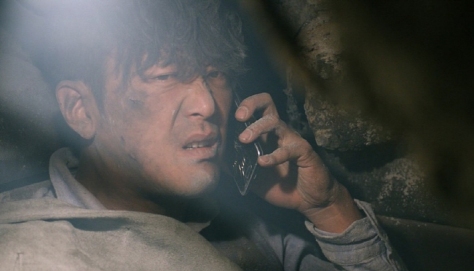
There’s a lot of that “human interest” in Kim Seong-hun’s Tunnel, a (no pun intended) cracking good disaster thriller from South Korea. Now, I should make it clear that this is not a Hollywood-style disaster thriller, a la Roland Emmerich. That said, it does have thrills, and spectacle, but not at the expense of its humanity. This, combined with emphasis on characterization, makes it the antithesis of formulaic big-budget disaster flicks that are typically agog with CGI yet bereft of IQ.

Said to be “based on true events” (which puzzlingly stumps Mr. Google) the story centers on harried Everyman Jung-soo (Ha Jung-woo). Commuting home from his car salesman gig one fine sunny day, Jung-soo pulls into a service station. He asks for $30 worth of gas, but the elderly, hearing-impaired attendant gives him a nearly $100 fill-up instead. Jung-soo is a bit chagrined, but pays his bill and starts to pull away. The attendant runs after him and, by way of apology, insists that he accept two bottles of water. Jung-soo rolls his eyes, but acknowledges the gesture, tossing the bottles on the seat next to the boxed birthday cake he’s bringing home to his daughter.

And yes, it is the director’s intent that we make a special note of the bottled water, and the cake. As I am sure he wishes us to note the irony of the signage over the tunnel Jung-soo is headed for:

Hado Tunnel: Happy and Safe National Construction

As you may surmise (considering you know the premise of the film), Jung-soo’s passage through the Hado Tunnel on this particular fine sunny day will prove to be neither “happy”…nor “safe”.

To be honest, once the inevitable occurred (a harrowing sequence), I began to have doubts whether I could commit to the remaining 2 hours of the film; because I’m claustrophobic, and any story that involves physical entrapment freaks me out (as much as I admire Danny Boyle, I’ve yet to screw up the courage to sit through his 2010 thriller 127 Hours). And since that fear also precipitates white-knuckled parking in garages with low ceilings, driving across lower decks of double-decker bridges, and (wait for it) driving through tunnels…I was all set to just call it a day.

But thanks to Seong-hun’s substantive writing and direction and Jung-woo’s seriocomic performance (recalling Matt Damon’s turn in The Martian), I was absorbed enough by the story to allay my visceral concerns. And, akin to Wilder’s Ace in the Hole, Seong-hun uses the “big carnival” allusions of the mise-en-scene outside the tunnel to commentate on how members of the media and the political establishment share an alchemist’s knack for turning calamity into capital.

Shell-shocker: Disorder **

By Dennis Hartley

(Originally posted on Digby’s Hullabaloo on August 27, 2016)

https://s3.amazonaws.com/content.tiff.net/content/carousel/745c3c2eb0c071113ece136b371686c7.jpg

In my 2009 review of the war drama Waltz With Bashir, I referred to an observation by the late great George Carlin, wherein he analyzes the etymology of the phrase “post-traumatic stress syndrome” and traces it back to WWI (when it was called “shell shock”). To which I appended:

A rose by any other name. Whether you want to call it ‘shell-shock’, ‘battle fatigue’, ‘operational exhaustion’ or ‘PTSD’, there’s one thing for certain: unless you are a complete sociopath and really DO love the smell of napalm in the morning…war will fuck you up.

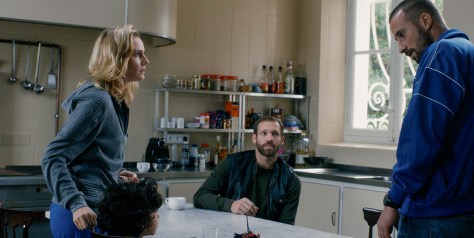
True that. And while Carlin was referring to America’s war veterans through the decades, PTSD knows no borders. Consider Vincent (Matthias Schoenaerts) a French Special Forces Afghan War vet. He is the central character in Disorder, a new psychological thriller from director Alice Winocour (who also co-wrote with Jean-Stephane Bron, Robin Campillo, and Vincent Poymiro).

Insular, taciturn, and more than a little twitchy, Vincent can’t quite get a handle on things since getting back to the world. So much so, in fact, that he actually looks forward to being re-deployed for another tour of combat duty. Due to his condition, perhaps he can only find a sense of order in the chaos of war. His friend and fellow vet Denis (Paul Hami) is also his co-worker at a private security firm; Denis always keeps one concerned eye on him whenever they’re on an assignment.

Indeed, there does seem to be something a bit “off” about Vincent’s behavior one night when he and Denis are providing security for a large soiree taking place at the estate of a wealthy Lebanese businessman. Vincent seems more bent on running surveillance on the client’s activities; his interest is particularly piqued by an apparent heated exchange between the businessman and a couple of his shadier-looking guests, sequestered in a private office well out of earshot from the festivities.

When Vincent is tasked to provide security for the client’s wife (Diane Kruger) and young son while he is out of town on a business trip, Vincent’s inherent paranoia really comes to the fore (while wariness and diligence is something you look for in a bodyguard, any behavior bordering on delusional should raise a red flag). Another red flag: Vincent takes a sudden, uncharacteristic interest in the wife, but it’s hard to read whether his intentions are devious or protective in nature.

So is Vincent the possible threat to the safety and well-being of the clients’ wife and child? Or was he actually on to something the night of the party, with his suspicions that his client’s luxurious lifestyle hinges on potentially dangerous partnerships? Since we know going in that Vincent isn’t quite all there, due to his PTSD condition, the conundrum is all the more unnerving.

Unfortunately, after building up this considerable tension and intrigue (the first act hints at something brewing in the vein of Ridley Scott’s Someone To Watch Over Me), the director doesn’t seem to quite know what to do with it; the narrative fizzles, and by the crucial third act (a tepid knockoff of Sam Peckinpah’s Straw Dogs), the film hits the ground with a resounding thud.

Schoenaerts and Kruger are both fine actors (and easy on the eye), but they can only do so much with the uninspired script they’re working with. The film does sport some nice atmospheric work by cinematographer Georges Lechaptois and a unique (and appropriately unsettling) soundtrack by Mark Levy, but alas, it still can’t make up for a thriller that is curiously devoid of any…thrills.

Love & Death in the 21st Century: Honeyglue **1/2

By Dennis Hartley

(Originally posted on Digby’s Hullabaloo on June 18, 2016)

http://honeygluefilm.com/wp-content/uploads/Morgan-and-Jordan-1024x576.jpg

And maybe love is just letting people be just what they want to be               The door must always be left unlocked

 -from “What is Love”, written by Howard Jones

In the opening of writer-director James Bird’s melodrama Honeyglue, an attractive, gender-fluid young man breaks the ice with an attractive young woman on a dance floor with an original pickup line: “What are you?” To which the young woman replies, “What do you mean, what am I?” The young man counters with “Are you a dragonfly?” “I look like an insect?” she asks, not sure whether she’s being pranked. “Like a dragonfly,” he answers with a smile. Then she turns the tables. “Are you a guy?” she asks. “As opposed to what?” the young man answers with a defensive tone. “As opposed to a girl,” she says. “What do you prefer I be?” he asks. “I mean…are you gay?” she asks this time, hastily  adding  “It’s OK if you are”  as an afterthought. “You ask a lot of questions,” he says, then stalks away into the crowd.

And if you’re thinking that marks the beginning of a beautiful friendship (with benefits), you would be correct (and/or you’ve seen one or two formula mumble core indie flicks). That is not to suggest that Honeyglue is a wholly unoriginal film; as far as formula mumble core indie flicks go, you could do a lot worse. And once you toss a few venerable Disease of the Week Hollywood clichés to the mix, you at least get an interesting hybrid.

The most compelling element of the film is the two romantic leads. Adriana Mather gives a resonant and touching performance as Morgan, a suburban princess who falls in love with streetwise club kid Jordan (Zach Villa, also quite good). Unfortunately, the work by the remainder of the cast is wildly uneven. In fact, one performance is so downright godawful that it becomes a distraction; however as I see that this (hitherto unfamiliar to me) thespian has 99 credits listed on IMDB and is “an award-winning Canadian actor”, I’ll give him the benefit of the doubt and grant that it could be chalked up to miscasting.

Still, despite the screenplay’s clumsy mashup of Now, Voyager with The Crying Game, occasional forays into Love Story-worthy mawkishness and tendency to have its characters spout Hallmark Card platitudes at each other, there remains a stubborn streak of sincerity and goodwill (bolstered by the earnestness of the two young leads), just palpable enough to keep sentimental souls (honey) glued right through to its inevitable four-hanky denouement. And arriving as it does in theaters literally right on the heels of the recent evil mayhem in Orlando, the film’s core message, that Love (gender-defying or otherwise) trumps not only Hate, but perhaps even Death itself, could not be any timelier.

SIFF 2016: Mekko ***1/2

By Dennis Hartley

(Originally posted on Digby’s Hullabaloo on May 21, 2016)

https://s3.amazonaws.com/policymic-images/r9ejjtkqfjk7msdtvezvu7zvgfvhpy0agwcfdmj4tmcir6rc4vbligrvswfjollx.jpg

Director Sterlin Harjo’s tough, lean, neorealist character study takes place in Tulsa, Oklahoma. Rod Rondeaux (Meek’s Cutoff) is outstanding as the eponymous character, a Muscogee Indian who gets out of jail after 19 years of hard time. Bereft of funds and family support, he finds tenuous shelter among the rough-and-tumble “street chief” community of homeless Native Americans as he sorts out how he’s going to get back on his feet. Harjo coaxes naturalistic performances from his entire cast. There’s a lot more going on here than initially meets the eye; namely, a deeper examination of Native American identity, assimilation and spirituality in the modern world.

SIFF 2016: The Curve ***

By Dennis Hartley

(Originally posted on Digby’s Hullabaloo on May 21, 2016)

http://www.siff.net/assets/Images/festival/2016/films/C/Curve.jpg

It’s tempting to describe Rifqi Assaf’s road movie as “Little Miss Sunshine in the Arabian Desert” but that would be shortchanging this humanistic, warmly compassionate study of life in the modern Arab world. It’s essentially a three-character chamber piece, set in a VW van as it traverses desolate stretches of Jordan. Fate and circumstance unite a taciturn Palestinian who has been living in his van, with a chatty Palestinian divorcee returning to a Syrian refugee camp and an exiled Lebanese TV director. A beautifully directed and acted treatise on the commonalities that defy borders.

The empress has no pitch: Marguerite ***

By Dennis Hartley

(Originally posted on Digby’s Hullabaloo on April 9, 2016)

http://www.cineavatar.it/wp-content/uploads/2015/09/marguerite.jpg

It’s been said that many who fancy themselves singers can’t “hear” their own true voice (ever been to a Karaoke bar?). Beauty may be in the eye of the beholder; but in the ears, not so much. Off key is off key, and unfortunately for wealthy arts patron Marguerite Dumont (Catherine Frot) this is Paris in the 20s, and Auto-Tune is many decades hence.

Her heart is in the right place, though. In fact music is her driving passion, and in the opening of writer-director Xavier Giannoli’s eponymous drama, we witness a gathering of aristocrats (and a few party-crashers) that has converged on Marguerite’s sprawling estate for a charity fundraiser. Marguerite has invited a number of accomplished musicians to perform. The biggest buzz surrounds the headliner-Marguerite herself, who has prepared one of her favorite Soprano pieces to regale her guests with. However, she’s holding off until her husband Georges (Andre Marcon) arrives; it seems he has car issues.

It turns out that Georges has frequent trouble with the car; weirdly enough this occurs every time Marguerite gives a recital at their home (although the significance of this “coincidence” has never occurred to the unflappably enthusiastic Marguerite). As the guests are getting impatient, the show must go on…and so Marguerite takes center stage.

When Marguerite begins to sing, erm, how can I put this politely…well, let’s just say she is no Edith Piaf. OK, full disclosure: Her caterwauling could decalcify your spinal column at 100 paces. She’s godawful. But…she’s so enthusiastically godawful that she is at once oddly endearing. We assume this, because nobody has ever told her how utterly horrifying her singing is; neither her guests (who in fact give her a standing O) nor her longtime butler (Denis Mpunga), nor husband (aside from those “problems” with the car).

Two of the “party-crashers” I referred to earlier are an ambitious young journalist and his pal, an avant-garde provocateur, who are intrigued by the inexplicably sycophantic cocoon of “admirers” that enables Marguerite to remain cheerfully oblivious to her atonal warbling. Do they do this out of kindness? Or are they being ironic? Perhaps there’s something the young men are “missing”? The pair decides to conduct a sort of social experiment. If they can coax Marguerite out of her hermetic bubble, into a real public performance, she might prove to be a true phenomenon. Stranger things have happened.

What ensues is a sometimes uneasy cross between The Producers and The Dinner Game. The saving grace is Frot’s brave and moving performance; she’s sweet, funny and heartbreaking all at once. Michel Fau is another standout as a fading opera singer who is reluctantly recruited into playing Henry Higgins to Marguerite’s Eliza Doolittle (his characterization also recalls the exasperated singing coach who is hired to tutor Orson Welles’ tone-deaf wife in Citizen Kane). While there are many amusing moments, this is not a lighthearted romp; the odious, uniquely human capacity to cruelly exploit others for personal gain is on full display. Then again, you know what they say: “That’s show biz!

Enemy to all mankind: A War ***1/2

By Dennis Hartley

(Originally posted on Digby’s Hullabaloo on  February 27, 2016)

https://www.hollywoodreporter.com/wp-content/uploads/2015/08/A_War_Still.jpg?w=1440&h=810&crop=1

Dress me up for battle
When all I want is peace
Those of us who pay the price
Come home with the least

–from “Harvest for the World”, by the Isley Brothers

Remember the Afghanistan War? What do you mean, “which one”? Y’know…the latest one; the one that “ended” in 2014 (or are we just taking a breather? I’ve long lost track). At any rate, while it’s no secret it was/is largely a “we” (as in “American”) problem, it is easy to forget that “we” weren’t the only ones who invested precious blood and treasure in that war; there were coalition forces involved as well. Take Denmark, for example. 43 dead, 211 wounded, and 15 billion kroner spent by the time the Danes pulled out in 2013.

And now, those young men and women who have “paid the price” of the Danish-Afghan conflict may have their generation’s Coming Home (or The Deer Hunter) in the guise of A War, a powerful and sobering Oscar-nominated drama from writer-director Tobias Lindholm.

Pilou Aesbaek stars as a compassionate company commander stationed in the Helmand Province. After one of his units is demoralized by the loss of a man to a Taliban sniper while on recon, the commander bolsters morale by personally leading a patrol, which becomes hopelessly pinned down during an intense firefight. Faced with a split-second decision, the commander requests air support, resulting in a “fog of war” misstep. The commander is ordered back home, facing charges of murdering civilians.

For the first two-thirds of the film Lindholm intersperses the commander’s front line travails with those of his family back home, as his wife (Yuva Novotny) struggles to keep life and soul together while maintaining as much of a sense of “normalcy” as she can muster for the sake their three kids (especially the youngest, who frequently wonders aloud when his dad’s coming home).

The home front and the war front are both played “for real” (aside from the obvious fact that it’s a Danish production, this is a refreshingly un-Hollywoodized war movie; the mundanities of everyday life hold equal import with the odd rush of adrenaline). The only nod to convention comes in a slight tonal shift in the third act; a touch of military courtroom drama recalling Breaker Morant (my review).

Some may be dismayed by the moral and ethical ambivalence of the denouement. Then again, there are few tidy endings in life…particularly in war, which (to quote Bertrand Russell) never determines who is “right”, but who is left. Is that a tired trope? Perhaps; but it’s one that bears repeating…until that very last bullet on Earth gets fired in anger.

Paper ring: The 10 worst date flicks for Valentine’s Day

By Dennis Hartley

(Originally posted on Digby’s Hullabaloo on  February 13, 2016)

https://4.bp.blogspot.com/-5W3VF4b4qhU/Vr-vPIfcmEI/AAAAAAAAeug/ihlhLzVE778/s1600/sid-and-nancy_704_4.jpg

To-morrow is Saint Valentine’s day,
All in the morning betime,
And I a maid at your window,
To be your Valentine.

 –William Shakespeare, Hamlet, Act IV, Scene 5

You’re breakin’ my heart
You’re tearing it apart…so fuck you

-Nilsson, Son of Schmilsson, “You’re Breaking My Heart”

 Alright, I’ve covered the “warm and fuzzy” angle for Valentine’s Day. But there are two sides to every coin. This “holiday” depresses some people. It’s just a corporate invention; a marketing ploy to push overpriced cards and chocolates, right? So I say, embrace your melancholia! I mean, I may be “alone”, but I’m not “lonely”, right? Right? Anyone? Bueller? Hello? (tap, tap) Is this internet working?

Anyway…here you go, alphabetically:

https://s1.dmcdn.net/v/PaaBs1SUoPoxzYi3k/x1080

Baby Doll – In 1956, this deliciously squalid melodrama (directed by Elia Kazan and written by Tennessee Williams) was decried by the “Legion of Decency” for  “carnal suggestiveness”. Granted, there is something suggestive about a sultry, PJ-clad 19 year old (Carroll Baker) curled up in a child’s crib, sucking her thumb. This is our first glimpse of the young woman recently betrothed to creepy old Archie (Karl Malden). Archie is breathlessly counting down to Baby Doll’s imminent birthday. She was 18 on her wedding day, but Archie is beholden to an agreement of  “no consummation” until she’s 20.

In return, Archie has promised to renovate his rundown cotton gin so he can bathe her in luxury, ‘til death do they part. However, Archie is as bereft of coin as he is lustful in loin. This leads to an ill-advised act that  gets him in hot water with his prosperous business rival (Eli Wallach). Instead of getting mad, Wallach decides to get even…by seducing Baby Doll. The seduction scene is a classic; it “shows” little, yet implies much (it is left up to your imagination).

https://www.closeupfilmcentre.com/index.php/download_file/view_inline/2433/

Crazy Love – For the benefit of readers unfamiliar with the Bizarro World “love story” of Burt and Linda Pugach, I won’t risk spoilers regarding this 2007 documentary. Suffice it say, if you think you’ve seen it all when it comes to obsession and dysfunction in romantic relationships, you ain’t seen nuthin’ yet. I will divulge this much- despite the odious nature of the act one of these two people visits upon the other at one point in their relationship, it’s still not cut and dry as to whose “side” you want to be on, because both of these people got off the bus in Crazy Town a long time ago. This film is the antonym for “date movie”. Dan Klores and Fisher Stevens directed.

https://claude101.files.wordpress.com/2011/02/vlcsnap-2011-02-02-00h12m01s1521.png

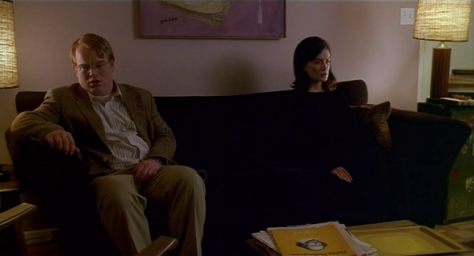
Happiness – If you you’re partial to network narratives populated  by emotionally needy neurotics, this 1998 Todd Solondz film is in your wheelhouse. Bold performances all around in this veritable merry-go-round of modern dysfunction, as you watch a sad parade of completely hapless individuals make desperate, cringe-inducing stabs at establishing meaningful connections sometime before they die (the human condition?). Standouts in the huge cast include the late Philip Seymour Hoffman, Lara Flynn Boyle, Jane Adams, Dylan Baker and Camryn Manheim. Keep a pint of Ben and Jerry’s handy.

https://kultguyskeep.files.wordpress.com/2015/11/honeymoon-killers_1.jpg?w=604

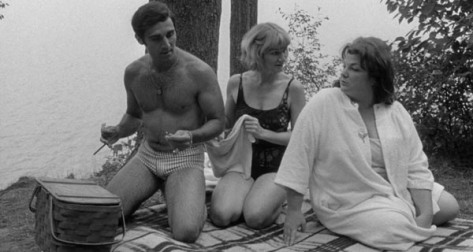
The Honeymoon Killers – Several decades before Natural Born Killers was even a gleam in Oliver Stone’s eye, writer-director Leonard Kastle made this highly effective low-budget exploitation film (based on a true story) about a pair of murderous lovebirds. Martha (Shirley Stoler) and Ray (Tony Lo Bianco) meet via a “lonely hearts” correspondence club and find that they have a lot more in common than the usual love of candlelit dinners and walks on the beach.

Namely, they’re both full-blown sociopaths, who cook up a scheme to lure lonely women into their orbit so they can kill them and take their assets. Stoler and Lo Bianco have a palpable chemistry as the twisted couple. The stark B & W photography and verite approach enhances the unsettling vibe. Martin Scorsese was the original director, but was quickly fired (!). This was Kastle’s only film.

http://2.bp.blogspot.com/-JZJZsztojys/VfbOutYBXVI/AAAAAAAAL1A/tFM0YX6c0iQ/s1600/The%2BNight%2BPorter-Bogarde%2Band%2BRampling%2Breunite.png

The Night Porter – Director Liliana Cavani brilliantly uses a story of a sadomasochistic relationship as both an allusion to the horrors of Hitler’s Germany and a treatise on sexual politics. Dirk Bogarde and Charlotte Rampling deliver intense, brooding performances as a former SS officer and a concentration camp survivor who become entwined in a twisted, doomed relationship years after WW2. Steeped in decadence, deeply disturbing, yet…weirdly compelling.

https://i.ytimg.com/vi/woa5SwAWFHc/maxresdefault.jpg

Sid and Nancy – The ultimate love story…for nihilists. Director Alex Cox has never been accused of subtlety, and there’s certainly a glorious lack of it here in his over-the-top 1986 biopic about the doomed relationship between Sex Pistols bassist Sid Vicious and his girlfriend Nancy Spungen. Gary Oldman and Chloe Webb chew all the available scenery as they shoot up, turn on and check out. Okay, it is a bit of a downer, but the cast is outstanding, and Cox (who co-scripted with Abbe Wool) injects a fair amount of dark comedy (“Eeew, Sid! I look like fuckin’ Stevie Nicks in hippie clothes!”). The movie also benefits from outstanding cinematography by Roger Deakins.

Image result for smash palace 1981

Smash Palace – Dramatic films about  the disintegration of a marriage aren’t a romp in the fields to begin with (and as date movies…it’s safe to say that they are right out), but can be particularly heart-wrenching when children are involved (e.g. Kramer vs Kramer or Shoot the Moon). Few are as raw and emotionally draining as this nearly forgotten 1981 gem from New Zealand.

An early effort from writer-director Roger Donaldson (The Bounty, No Way Out, Thirteen Days), the film features a riveting performance by Bruno Lawrence, as an eccentric race car driver/salvage yard owner who neglects his wife (Anna Maria Monticelli) to the point where she has an affair. The cuckolded hubby (already a walking time bomb) does not react well. Donaldson sustains an incredible sense of tension. Absorbing and unpredictable right up to the end.

https://s-media-cache-ak0.pinimg.com/originals/1e/c1/c1/1ec1c1fc992cc6421604b35a0d1e6ac0.jpg

Swept Away – The time-honored “man and woman stuck on a desert island” scenario is served up with a heaping tablespoon of class struggle and an acidic twist of sexual politics in this controversial 1975 film from Italian director Lena Wertmuller. A shrill and haughty bourgeoisie woman (Mariangela Melato) charters a yacht cruise for herself and her equally obnoxious fascist friends, who all seem to delight in belittling their slovenly deck hand (Giancarlo Giannini), who is a card-carrying communist. Fate and circumstance conspire to strand Melato and Giannini together on a small Mediterranean isle, setting the stage for some interesting role reversal games. BTW, in case you are curious about the Guy Ritchie/Madonna remake? Here’s a two-word review: Stay away!

http://cineplex.media.baselineresearch.com/images/99422/99422_full.jpg

Who’s Afraid of Virginia Woolf? – If words were needles, university history professor George (Richard Burton) and his wife Martha (Elizabeth Taylor) would look like a pair of porcupines, because after years of shrill, shrieking matrimony, these two have become maestros of the barbed insult, and the poster children for the old axiom, “you only hurt the one you love”.   Mike Nichols’ 1966 directing debut (adapted by Ernest Lehman from Edward Albee’s Tony-winning stage play) gives us a peek into one night in the life of this battle-scarred middle-aged couple.

After a faculty party, George and Martha invite a young newlywed couple (George Segal and Sandy Dennis) over for a nightcap. As the ever-flowing alcohol kicks in, the evening becomes a veritable primer in bad human behavior. It’s basically a four-person play, but these are all fine actors, and the writing is the real star of this piece.

Everyone in the cast is fabulous, but Taylor is the particular standout; this was a breakthrough performance for her in the sense that she proved beyond a doubt that she was more than just a pretty face. Don’t forget, the actress behind this blowsy, 50-ish character was only 34 (and, of course, a genuine stunner). When “Martha” says “Look, sweetheart. I can drink you under any goddam table you want…so don’t worry about me,” you don’t doubt that she really can.

http://cineplex.media.baselineresearch.com/images/75651/75651_full.jpg

Your Friends and Neighbors – With friends and neighbors like these…oy. A very dark social satire from the Prince of Darkness himself, playwright-writer-director Neil LaBute (In the Company of Men, Nurse Betty). As in most LaBute narratives, there’s nary a sympathetic character in sight in this study of two unhappy couples and their circle of unhappy friends. Everybody makes bad choices and generally treat each other like shit. Cynical, appalling, and perversely funny. You’ll love it! Aaron Eckart, Jason Patric, Amy Brenneman, Catherine Keener, Nastassja Kinski, and Ben Stiller make a crack ensemble.

…and now here’s the late great Harry Nilsson to sing us out: