Category Archives: Documentary

Blu-ray reissue: Essential Fellini (Box set)

By Dennis Hartley

(Originally posted on Digby’s Hullabaloo on November 28, 2020)

https://ca-times.brightspotcdn.com/dims4/default/efa0515/2147483647/strip/true/crop/2048x1229+0+0/resize/840x504!/quality/90/?url=https%3A%2F%2Fcalifornia-times-brightspot.s3.amazonaws.com%2F32%2F37%2F1b32c9e3a22ae426c4ee2b9af454%2Fla-la-ca-mn-classic-hollywood-felleni-book05-jpg-20151111

Essential Fellini – Criterion Collection box set

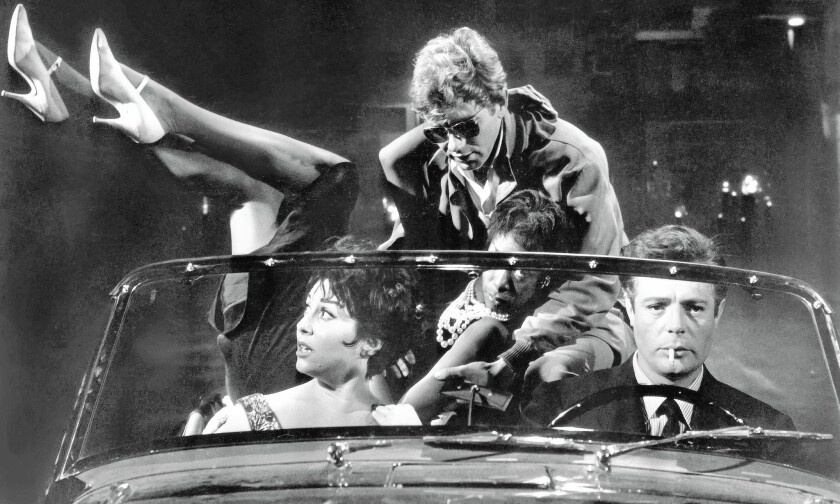
With such a rich oeuvre to cull from, it’s a bit of a head-scratcher that it’s taken this long for someone to curate a decent Federico Fellini collection. That said, Criterion’s 2020 box set proves worth the wait. Predicated on the 100th  anniversary of Fellini’s birth, the collection cherry picks 14 of the “essentials” from his catalog, from obvious choices like La Strada, Nights of Cabiria, La Dolce Vita, , Amarcord and Juliet of the Spirits to previously harder to find early works like Variety Lights and The White Sheik. All the films have been newly restored.

As the set was released only several days ago, I haven’t had a chance to make a huge dent but the two films I have watched are impeccably restored (I started with 1950’s Variety Lights because I’d never seen it, and decided to feast on my favorite Fellini Amarcord on Thanksgiving…wow. Now that is one film the 4K restoration process was made for!).

Extras. Where do I start? Two feature documentaries…Fellini: I’m a Born Liar (great doc) and I’m looking forward to Marcello Mastroianni: I Remember (3 hours!). Also included is a restored version of the curio Toby Dammit. Starring Terrance Stamp, the 40-minute film was Fellini’s contribution to the 1968 horror omnibus/Edgar Allan Poe triptych Spirits of the Dead (Roger Vadim and Louis Malle directed the other two segments). There are numerous commentary tracks, TV interview segments, and more.

There are two books, one is a guide to the films and the other contains essays. It’s all housed in a sturdy album-sized box, with the discs secured in “coin collector” style pockets (similar to Criterion’s lovely Bergman box set released back in 2018).

To serve man: The Social Dilemma (***)

By Dennis Hartley

(Originally posted on Digby’s Hullabaloo on October 10, 2020)

https://i0.wp.com/lovethynerd.com/wp-content/uploads/2020/09/The-Social-Dilemma_2.jpg?ssl=1

“You know, one thing I learned from my patients… they all hate the phone company. It’s interesting; even the stockholders of the phone company hate the phone company!”

― from the 1967 social satire The President’s Analyst

“It’s not about the technology being the existential threat. It’s the technology’s ability to bring out the worst in society…and the worst in society being the existential threat.”

― from the 2020 documentary The Social Dilemma

“You have created a monster, and it will destroy you!”

― from the 1931 horror classic Frankenstein

Just in: From the nanosecond you log in to a social media platform, you are being tracked. Not only are you being tracked, but you are being filed, stamped, indexed, briefed, debriefed, and numbered (YOU are Number 6). In short: you are being bought and sold. That smart phone, laptop, or tablet in your hands is not the “product”. YOU are.

So like, wake UP, sheeple!

As I see you are currently busy checking Twitter notifications on your cell, I’ll cut to the chase. I recently observed a number of my friends on (wait for it) Facebook buzzing about the (relatively) new Netflix documentary The Social Dilemma, so I thought I’d check it out.

“All through my life I’ve had this strange unaccountable feeling that something was going on in the world, something big, even sinister, and no one would tell me what it was.” “No,” said the old man, “that’s just perfectly normal paranoia. Everyone in the Universe has that.”

― from the The Hitchhiker’s Guide to the Galaxy, by Douglas Adams

Never before have a handful of tech designers had such control over the way billions of us think, act, and live our lives.

― the “dilemma”, as posited on the official website for the film The Social Dilemma

Directed by Jeff Orlowski (Chasing Ice) the film operates from the premise that (with all due respect to the late great Douglas Adams) the “strange unaccountable feeling” you may have “that something was going on in the world, something big, even sinister” is in fact not “just perfectly normal paranoia.” This is not a dream…this is really happening.

Sinister terms like “data mining” and “surveillance capitalism” may elicit yawns or shrugs from a generation that assumes laptops, cell phones and the internet are immutable elements of human existence, but Orlowski offers a twist by having the architects of social media utter dire warnings you’d normally only expect to hear coming from the lips of members of the anti-Big Tech conspiracy fringe.

These are not minor players; people like VR guru Jaron Lanier, former head of Pinterest Tim Kendall, Center for Humane Technology co-founders Aza Raskin and Tristan Harris, Facebook “like” button co-creator Justin Rosenstein, et.al. Orlowski also enlists academics, like Harvard University professor/social psychologist Shoshana Zuboff and Stanford Addiction Medicine Dual Diagnosis Clinic Chief/psychiatrist Anna Lembke.

It is not just a cliché that we are “addicted” to our cell phones, to Facebook, to Twitter, to email; scrolling away hours, days, weeks, months of our lives as we circle down the rabbit hole (“There are only two industries that call their customers ‘users’: illegal drugs and software,” observes one talking head in the film). How do we escape this time-sucking alternate reality? Ironically, Virtual Reality pioneer Jaron Lanier offers the most pragmatic advice-in essence saying “Just unplug yourself, stupid.” Easier said than done, grasshopper.

Even some of the people who have helped create “virtual” addiction admit they can’t stop getting high on their own supply. Again, these are the very smart, self-aware men and women “behind the curtain” who have basically distilled all the trickery and mind games that magicians, con artists, used car salesmen and revival tent evangelists have perfected over the centuries into algorithms.

OK…Orlowski’s film is somewhat depressing, especially if you expect light at the end of the tunnel. But it is timely, considering that the November 3rd election looms. You know how people say, “our country has never been more divided”? According to some of the interviewees, the reality may be our country has never been more manipulated. One says:

The manipulation by third parties is not a ‘hack’. The Russians [in the lead-up to the 2016 presidential election] didn’t ‘hack’ Facebook. What they did was they used the tools that Facebook created for legitimate advertisers and for legitimate users. And they applied it to a nefarious purpose.

So what he is saying (if I read him correctly) is that the Russians were merely using the tools of capitalism to do exactly what they are designed to do: reap a profit (in this case, they would gain political capital, one assumes). This is a profound observation, the more I think about it. And it reminds me of this evergreen monologue (delivered by Ned Beatty) from the 1976 film Network (directed by Sidney Lumet and written by Paddy Chayefsky). To wit:

There is no America. There is no democracy. There is only IBM, and ITT, and AT&T, and DuPont, Dow, Union Carbide, and Exxon. Those are the nations of the world today. What do you think the Russians talk about in their councils of state, Karl Marx? They get out their linear programming charts, statistical decision theories, Minimax solutions, and compute the price-cost probabilities of their transactions and investments, just like we do. We no longer live in a world of nations and ideologies, Mr. Beale. The world is a college of corporations, inexorably determined by the immutable bylaws of business. The world is a business, Mr. Beale. It has been since man crawled out of the slime.

Plus ca change.

The Social Dilemma also touches on what has become the greatest bane of social media: fake news. One of the tech insiders offers this less-than-comforting thought:

Algorithms and politicians are becoming so expert at how to trigger us …getting so good at creating fake news that we absorb it as if it were reality and confusing us into believing those lies. It’s as if we have less and less control over who we are and what we believe.

I guess I’ll leave you with that happy thought, because I must go check my email.

(The Social Dilemma is currently streaming on Netflix)

Rescue me: Desert One (***½)

By Dennis Hartley

(Originally posted on Digby’s Hullabaloo on August 22, 2020)

https://i1.wp.com/m.wsj.net/video/20200820/082020desertone/082020desertone_960x540.jpg?ssl=1

I recall my excitement when I was finally eligible to vote in a Presidential election. I was all of 20 and cast my ballot for Jimmy Carter. I confess I was not the political junkie I am now. Entering young adulthood in the Watergate era, I had reflexively teetered Left, and for reasons I could not articulate at the time, identified as a Democrat. I was savvy enough to glean the incumbent candidate’s pardon of Nixon smelled funny and I could not look at Ford without thinking of Chevy Chase’s SNL parodies. My horse won, and I was happy (beginner’s luck-as I have since learned “results may vary”).

Despite shifting appraisals as to whether Carter was a “good”, “bad” or “meh” President, I feel that I backed the right horse in 1976. In hindsight, whoever ended up occupying the Oval Office at that point in time was destined to face formidable challenges: “stagflation” of the American economy, a looming energy crisis, the Cold War…that’s just for starters.

However, the most defining crisis of Carter’s presidency began on November 4, 1979:

[From a 2006 Atlantic article]

In April 1980, President Jimmy Carter sent the Army’s Delta Force to bring back fifty-three American citizens held hostage in Iran. Everything went wrong. The fireball in the Iranian desert took the Carter presidency with it.

Washington, D.C., April 11, 1980, Noon

The meeting began with Jimmy Carter’s announcement: “Gentlemen, I want you to know that I am seriously considering an attempt to rescue the hostages.”

Hamilton Jordan, the White House chief of staff, knew immediately that the president had made a decision. Planning and practice for a rescue mission had been going on in secret for five months, but it had always been regarded as the last resort, and ever since the November 4 embassy takeover, the White House had made every effort to avoid it. As the president launched into a list of detailed questions about how it was to be done, his aides knew he had mentally crossed a line.

Carter had met the takeover in Iran with tremendous restraint, equating the national interest with the well-being of the fifty-three hostages, and his measured response had elicited a great deal of admiration, both at home and abroad. His approval ratings had doubled in the first month of the crisis. But in the following months, restraint had begun to smell like weakness and indecision. Three times in the past five months, carefully negotiated secret settlements had been ditched by the inscrutable Iranian mullahs, and the administration had been made to look more foolish each time. Approval ratings had nose-dived, and even stalwart friends of the administration were demanding action. Jimmy Carter’s formidable patience was badly strained.

And the mission that had originally seemed so preposterous had gradually come to seem feasible. It was a two-day affair with a great many moving parts and very little room for error—one of the most daring thrusts in U.S. military history. It called for a nighttime rendezvous of helicopters and planes at a landing strip in the desert south of Tehran, where the choppers would refuel before carrying the raiding party to hiding places just outside the city. The whole force would then wait through the following day and assault the embassy compound on the second night, spiriting the hostages to a nearby soccer stadium from which the helicopters could take them to a seized airstrip outside the city, to the transport planes that would carry them to safety and freedom. With spring coming on, the hours of darkness, needed to get the first part of this done, were shrinking fast.

Sounds like a Hollywood pitch, but it was a very real plan, and the stakes were high. What could possibly go wrong? Sadly, as painstakingly detailed in Barbara Kopple’s new documentary Desert One everything that could go wrong went horribly wrong.

Using previously inaccessible archival sources (including White House recordings) two-time Academy Award winner Kopple (Harlan County USA, American Dream, Shut Up and Sing) offers a fresh historical perspective, and (most affectingly) an intimate glimpse at the human consequences stemming from what transpired. She achieves the latter with riveting witness testimony by hostages, mission personnel, Iranians, and former President Jimmy Carter.

There are nearly as many moving parts in Kopple’s film as in the original mission plan and she assembles it all beautifully, like a tightly scripted thriller. She also captures the emotional trauma that still haunts many participants some 40 years on.

Kopple maintains a neutral political tone and injects some Rashomon-worthy moments (e.g. hostage and hostage-taker accounts of some events do not reconcile). Still, like any good documentary filmmaker she does not judge but leaves it up to the viewer to parse.

You could say Kopple had her work cut out for her. There is an oft-repeated cliché that “history is written by the winners”. That may be true in many cases, but there do not appear to be any clear “winners” in this instance. At the very least, it begs questions.

Yes, the hostages were eventually freed, and President Reagan certainly did not pass up a politically advantageous opportunity to position it as a “victory” for his new administration. But when you consider the Iranians purposely held off initializing the transfer until literally moments after Reagan was sworn into office, expressly so they could taunt departing President Carter…was it really a “victory” for Reagan?

Likewise, the Iranians have preserved the location of the failed 1980 mission to commemorate what they annually celebrate as their “victory” against a U.S. “invasion”. But considering there was no military engagement nor any awareness of the incursion until after the Americans had skedaddled, and the fact that Delta Force suffered its “defeat” due to bad luck and weather-can Iran claim it as a true “victory”?

It is way above my pay rate to answer such questions; you will have to watch this excellent, thought-provoking documentary and decide for yourself.

“Desert One” is now playing via SIFF’s Virtual Cinema platform.

Stars ‘n’ Bars: Bloody Nose, Empty Pockets (***½) & The Go-Gos (***)

By Dennis Hartley

(Originally posted on Digby’s Hullabaloo on August 1, 2020)

https://i0.wp.com/images.vimooz.com/wp-content/uploads/2020/05/23175700/Bloody-Nose-Empty-Pocket-1024x576.jpg?resize=1024%2C576&ssl=1

“That’s the problem with drinking, I thought, as I poured myself a drink. If something bad happens you drink in an attempt to forget; if something good happens you drink in order to celebrate; and if nothing happens you drink to make something happen.”

— Charles Bukowski, from his novel Women

You have likely heard the cliché that the Inuits have 50 words for “snow”? This is, of course, not 100% true. What we have here, is failure to communicate. What we do have here is a case of “polysynthesis” …which means that you have a base word (in this case, “snow”), which is then attached to many different suffixes which change the meaning. In this context, people of the north have hundreds of ways of describing snow (I know. This sounds like something the drunk at the end of the bar would say…stay with me).

Anyone who has ever spent a few hours down the pub knows there are as many descriptive terms for “drunks” as there are for “snow” . Happy drunks, melancholy drunks, friendly drunks, hostile drunks, sentimental drunks, amorous drunks, philosophical drunks, crazy drunks…et.al. You get all the above (and a large Irish coffee) in the extraordinary, genre-defying Sundance hit Bloody Nose, Empty Pockets.

Co-directed by brothers Turner and Bill Ross, the film vibes the “direct cinema” school popularized in the 60s and 70s by another pair of sibling filmmakers-the Maysles brothers. It centers on the staff and patrons of a Las Vegas dive bar on its final day of business. At least that is the premise I bought into hook, line, sinker, and latest issue of Angling Times. It was only after I saw it that I discovered this little tidbit via IndieWire:

Except that in reality, that bar is still open, it’s in New Orleans, and the patrons gathering for one last hurrah were cast by the filmmakers Turner and Bill Ross.

As Johnny Rotten once said, “Ever feel like you’ve been cheated?” Sheepishly, I read on:

The night before the film premiered to rave reviews at Sundance, the Ross Brothers sat down, at a bar over beers, for a 70-minute interview with to discuss how they made “Bloody Nose, Empty Pockets” and the inevitable questions they knew it would unleash. From the Ross Brothers’ perspective, this, their fifth feature film that has everyone at Sundance talking, is simply the natural evolution of their process as filmmakers.

“With our first film we cast a broad net, we spent 100 hours and a year of life with people until we realized you could fish, how you could wait for these moments, find these moments, and then as we got further and further along, how can you can feed a situation where you create a dynamic situation that might be conducive to what you are looking for,” said Turner. “And we’ve gotten further along into this fifth feature. Well actually can we create a dynamic scenario where we could provoke or create situations where we might elicit these authentic found moments we’re looking for.”

That their work has been embraced and supported by the part of the documentary community that sees nonfiction filmmakers more as artists using form than documentarians practicing journalism, has given the brothers a supportive community and place in the filmmaking world. The flip side is that it’s an association that puts them on one side of the increasingly useless binary of nonfiction vs. fiction that defines most film festivals, and that their latest film confounds.

I hadn’t felt this much like a dunce since the night I happened onto Zak Penn’s Incident at Loch Ness while channel-flipping and got sucked into what I assumed was an obscure Werner Herzog documentary about the Loch Ness monster that I had somehow missed. I had no idea it was a mockumentary until the credits. Hook, line, sinker, and fake Nessie.

My bruised ego aside, I rather enjoyed Bloody Nose, Empty Pockets (whatever the hell it “is”). Populated by characters straight out of a Charles Bukowski novel, the film works as a paean to the neighborhood tavern and a “day in the life” character study. It is also a microcosm of human behavior, infused with all the alcohol-induced bathos you’d expect.

“Bloody Nose, Empty Pockets” is now playing via SIFF’s Virtual Cinema platform.

https://i0.wp.com/media.pitchfork.com/photos/5f2345623e58c8a9937f1e27/16:9/w_2656,h_1494,c_limit/The%20Go-Go%E2%80%99s.jpg?ssl=1

Here are 2 fun facts I learned watching Allison Ellwood’s rock doc The Go-Gos. I never realized they were the first all-female band who wrote their own songs and played their own instruments to have a #1 album (I suppose that says something about the music biz that it took until 1982 for that precedent to be set?). I had also assumed they are inducted in the Rock and Roll Hall of Fame. They are not (WTF?) That shows how much I know.

The band has also been overdue for a feature-length career retrospective; Ellwood’s film offers an absorbing portrait of the groundbreaking quintet’s rise, fall and resurrection(s).

The film begins with their D.I.Y. roots in the burgeoning L.A. punk scene of the late 70s, and goes on to recount the shuffling of various personnel that eventually settled into the now-classic lineup of lead vocalist Belinda Carlisle, rhythm guitarist and vocalist Jane Weidlin (both original co-founders) guitarist-keyboardist and  backing vocalist Charlotte Caffey, bassist Kathy Valentine, and drummer Gina Schock.

The doc does play like a glorified episode of “VH-1’s Behind the Music” at times, with the inevitable tales of bruised egos, backstage squabbles, drug addiction (and don’t forget rehab!)…but hey, that’s rock and roll. It’s nice to see the band recognized for their talent, influence and perseverance (hard to believe they have been around for 40 years). It’s also inspiring to see them together and producing new songs. They’ve still got the beat, baby!

“The Go-Gos” is now playing on Showtime cable and VOD.

Blu-ray Reissue: Salesman (****)

By Dennis Hartley

(Originally posted on Digby’s Hullabaloo on July 11, 2020)

https://i2.wp.com/bostonglobe-prod.cdn.arcpublishing.com/resizer/yqOoMzNk7fifdfY1tGxaUcsL1NA=/1440x0/arc-anglerfish-arc2-prod-bostonglobe.s3.amazonaws.com/public/J7UBF5ZEU5HSZFJOJGHNS2JPT4.jpg?ssl=1

Salesman – Criterion Collection

Anyone can aim a camera, ”capture” a moment, and move on…but there is an art to capturing the truth of that moment; not only knowing when to take the shot, but knowing precisely how long to hold it lest you begin to impose enough to undermine the objectivity.

For my money, there are very few documentary filmmakers of the “direct cinema” school who approach the artistry of David Maysles, Albert Maysles and Charlotte Zwerin. Collectively (if not collaboratively in every case) the trio’s resume includes Monterey Pop, Gimme Shelter, The Grey Gardens, When We Were Kings, and Thelonius Monk: Straight, No Chaser.

In their 1969 documentary Salesman, Zwerin and the brothers Maysles tag along with four door-to-door Bible salesmen as they slog their way up and down the eastern seaboard, from snowy Boston to sunny Florida. It is much more involving than you might surmise from a synopsis. One of the most trenchant, moving portraits of shattered dreams and quiet desperation ever put on film; a real-life Willy Loman tale infused with characters who bring more pathos to the screen than any actor could.

Criterion has done their usual bang-up job here, starting with a new restored 4K digital transfer. There is a commentary track by Albert Maysles and Charlotte Zwerin (from 2001). Extras include an archival 1968 TV interview with both Maysles brothers (sadly, all three directors are no longer with us).

The inclusion of “Globesman”, a spot-on 2016 parody of Salesman from the “mockumentary” IFC series Documentary Now! was a nice surprise (there’s also a short appreciation of Salesman by Documentary Now! co-creator Bill Hader).

Same as it ever was: Capital in the Twenty-First Century (***½)

By Dennis Hartley

(Originally posted at Digby’s Hullabaloo on May 9, 2020)

https://occ-0-92-1722.1.nflxso.net/dnm/api/v6/E8vDc_W8CLv7-yMQu8KMEC7Rrr8/AAAABQWSUE7T2ScNqS7d2Y9nYS9v1eIQvTe04u8nEKWtAqK4q-B3v7Rrg4wI2OjkRdhXYh7ite231evlvWKO95lMEwU255Yy.jpg?r=ca5

“There is no America. There is no democracy. There is only IBM, and ITT, and AT&T, and DuPont, Dow, Union Carbide, and Exxon. Those are the nations of the world today. What do you think the Russians talk about in their councils of state, Karl Marx? They get out their linear programming charts, statistical decision theories, Minimax solutions, and compute the price-cost probabilities of their transactions and investments, just like we do. We no longer live in a world of nations and ideologies, Mr. Beale. The world is a college of corporations, inexorably determined by the immutable bylaws of business. The world is a business, Mr. Beale. It has been since man crawled out of the slime.”

― from Network, screenplay by Paddy Chayefsky

And thus spoke “Arthur Jensen”, CEO of fictional media conglomerate “CCA” in what is for me the most defining scene in director Sidney Lumet’s prescient 1976 satire. Jensen (wonderfully played by Ned Beatty) is calling “mad prophet of the airwaves” Howard Beale (Peter Finch) on the carpet for publicly exposing a potential buyout of CCA by shadowy Arab investors. Cognizant that Beale is crazy as a loon, yet a cash cow for the network, Jensen hands him a new set of stone tablets from which he is to preach (the corporate cosmology of Arthur Jensen). It is screenwriter Chayefsky’s finest monologue.

Recently, we’ve witnessed a President of the United States who is Tweeting and making public statements in TV interviews and press conferences (in a very “mad prophet of the airwaves” manner) that suggest he feels it’s more important right now in the midst of a still-raging pandemic to get everyone back to work than to save their lives. Because the economy. And per usual, Wall Street watches, waits and yawns while it gets a manicure.

You would almost think “someone” has handed the President a set of stone tablets from which he is to preach (akin to the corporate cosmology of Arthur Jensen). Or, at the very least-he opines from the perspective of someone borne of privilege and inherited wealth?

So how did the world become “…a college of corporations, inexorably determined by the immutable bylaws of business”? And come hell, high water, or killer virus, why is it that “Thou shalt rally the unwashed masses to selflessly do their part to protect the interests of the Too Big to Fail” (whether it’s corporations, the dynastic heirs of the 1% or the wealth management industry that feeds off of them) remains the most “immutable bylaw” of all?

It’s not like “the people” haven’t tried through history to level the playing field between the “haves” and the “have-nots”. Take, for example the French Revolution, which ultimately did not change the status quo, despite the initial “victory” of the citizenry over the power-hoarding aristocracy. As pointed out in Justin Pemberton’s documentary Capital in the Twenty-First Century, while there was initial optimism in the wake of the revolution that French society would default to an egalitarian model, it never really took.

Why? Because the architects of the revolution overlooked what is really needed to establish and maintain true equality: strong political institutions, an education system, health care (*sigh*), a transport system, and a tax system that targets the highest incomes.

Same as it ever was.

That, and financial inequality in general are the central themes in Pemberton’s ever-so-timely film, which is based on the eponymous best-seller by economist Thomas Piketty.

Cleverly interweaving pop culture references with insightful observations by Piketty and other economic experts, the film illustrates (in easy-to-digest terms) the cyclical nature of feudalism throughout history. Focusing mostly on the last 200 years or so, it connects the dots between significant events like the aforementioned French Revolution, the Industrial Revolution (which greatly expanded the boundaries of “capital” while driving an even deeper wedge between workers and factory owners), New World expansion (which spawned the slave trade), and the labor movements of the late 19th-to-early 20th Centuries.

While a lot of the historical review is disheartening, it is not all gloom and doom and “the system is rigged”. The film reminds us that there have been periods where egalitarian ideals have taken hold (the Roaring Twenties, FDR’s New Deal, the post-war rise of the middle-class). That said-1% of the world’s population still owns 70% of the land in 2020.

Will there ever come a time when economic equality “takes” for good? Maybe when an asteroid strikes the Earth and puts us all back on equal footing? My personal cynicism aside, Piketty and his fellow commentators do toss out possible scenarios that give you some hope; but frankly they all seem to be predicated on a wee bit of magical thinking.

Naturally, I was being facetious in the previous paragraph when I mentioned an asteroid striking the Earth. But history does indicate it takes some form of Great Equalizer to precipitate a shakeup in the status quo. As pointed out in the film, war is one example (WW 1 begat the Roaring Twenties, WW 2 begat the rise of the middle class, etc.). What about this pandemic? A killer virus doesn’t care whether you’re wearing a Bud-stained T-shirt or a Brioni suit; it’s just looking for the nearest warm body to attach itself to.

As the film was produced before Covid-19 shut down much of the world’s economy, it does not delve into the possibilities of a post-pandemic restructuring. As luck would have it though, a fitting postscript for my review presented itself the day after I screened the film when Thomas Piketty popped up as a guest on The Daily Social Distancing Show with Trevor Noah. Curiously, he was not there to promote the documentary, but did share some interesting thoughts on possible post-pandemic shifts in current economic models:

[Piketty] I think this is one of these crises we see that can really change people’s views about the world and how we should organize the economy. What we see at this stage is a big increase in inequality. […]

With this crisis right now, I think people are going to be asking for proof that we can also use this power of money creation and the Federal Reserve in order to invest in people; investing in hospitals, in public infrastructure, increasing wages for unskilled workers…all the low-wage and middle-wage people which we see today are necessary for our existence and our society.

In the longer run, of course we cannot just pay for everything with public debt and money creation…so we have to re-balance our tax system. […]

In the past three decades in America, we’ve seen a lot more billionaires; but we’ve seen a lot less growth. So in the end, the idea that you get prosperity out of inequality just didn’t work out. […]

[Noah] What do you think about the “worst case scenario”, then…if you live in a world where the inequality just keeps growing; the rich get richer and the poor get poorer, what do we inevitably get to?

[Piketty] Well to me the worst scenario is that some skilled politicians like Donald Trump, or [President of the National Front Party] Marie Le Pen in my country in France will use the frustration coming from wage and income stagnation and rising inequality in order to point out some foreign workers or “some people” [are] to blame. […] And this is what really worries me-that if we don’t change our discourses, if we don’t come up with another economic model that is more equitable, more sustainable…then, in effect we re-open the door for all this nationalist discourse.

Trevor had to go there with the “worst case scenario”. But that does not mean that is where we must end up. I am not an economic expert, nor pretend to have the answers to such questions. However, one quote from the film stuck with me: “This logic of one dollar, one vote is completely opposed to the democratic logic of one person, one vote.” I am not taking that one to the bank; I’ll be taking that one to the polls with me on November 3rd-with fingers crossed.

Capital in the Twenty-First Century is streaming through May 14 via Seattle’s Grand Illusion Cinema website . Proceeds are split to help support the theater during its current closure.


Tribeca 2020: Somebody Up There Likes Me (***)

By Dennis Hartley

(Originally posted on Digby’s Hullabaloo on April 25, 2020)

https://i1.wp.com/tribecafilm-production.s3.amazonaws.com/uploads/film/photo_1/4167/full_Tribeca_Somebody_Up_There_Likes_Me_1_1080p.png?ssl=1

This glossy portrait of Ronnie Wood from Eagle Rock Films looks back on the venerable British rocker’s career and catches up with his current life and interests. Viable and animated as ever, the seemingly indestructible Wood sits down with director Mike Figgis (Stormy Monday, The Browning Version, Leaving Las Vegas) and chats about everything from his 45 years with the Stones, early days with his first band The Birds, his creative association with Rod Stewart (in both the Jeff Beck Group and The Faces) to his “second career” as an artist and his longtime struggle with drugs and drink.

The amiable Wood is quite the raconteur and comes off as a fun bloke to hang out with. I would have loved more footage of the Jeff Beck Group and The Faces, but that is a personal problem. Also, on hand: Mick Jagger, Rod Stewart, Keith Richards, Charlie Watts and Wood’s wife Sally. This film is catnip for classic rock aficionados.

Tribeca 2020: P.S. Burn This Letter Please (***)

By Dennis Hartley

(Originally posted on Digby’s Hullabaloo on April 25, 2020)

https://i0.wp.com/tribecafilm-production.s3.amazonaws.com/uploads/film/photo_1/4204/full_Tribeca_PS_Burn_This_Letter_Please_1_1080p.png?ssl=1

Can we dish? I admit that going into this documentary, what I knew about the history of the 50’s drag scene in New York City wouldn’t have filled a flea’s codpiece. But some 100-odd minutes and several fabulously accessorized costume changes later…my codpiece was full. That did not come out sounding right. Suffice it to say Michael Seilgman and Jennifer Tiexiera’s Ken Burns-style documentary is an eye-opener. Inspired by a box of letters found in an abandoned storage unit, the film is an intimate history of a unique art form that managed to persevere and thrive during an era not too long ago when the LGBTQ community was forced to live in the shadows.

Tribeca 2020: Call Your Mother (**½)

By Dennis Hartley

(Originally posted on Digby’s Hullabaloo on April 25, 2020)

https://i0.wp.com/thecomicscomic.com/wp-content/uploads/2020/03/callyourmother-documentary-2020.png?ssl=1

Why are some people inherently “funny”? Funny, as in-other people will pay to watch them crack wise in front of a brick wall? Where does a “sense of humor” come from…nature or nurture? In this breezy (if lightweight) documentary, co-directors Heidi Ewing and Rachel Grady suggest it is …your mom. And they mean that in a nice way-as demonstrated by comics Louie Anderson, Tig Notaro, Kristen Schaal, Bobby Lee, Judy Gold, David Spade, Rachel Feinstein, et.al. who share anecdotes about (in some cases, camera time with) their moms. Initially fun and even endearing, but ultimately eschews any real insight for seeking 50 ways to say “My mom is such a card!”

Tribeca 2020: Banksy Most Wanted (**½)

By Dennis Hartley

(Originally posted on Digby’s Hullabaloo on April 25, 2020)

https://i1.wp.com/www.streetartbio.com/wp-content/uploads/2020/03/Banksy_Balloon_Girl_London.jpg?ssl=1

Almost everybody knows what internationally celebrated guerilla street artist Banksy does, but despite years of investigative journalism, amateur-to-professional sleuthing and “outings”…nobody but he/she/themselves knows who the real McCoy(s) is/are. Co-directors Aurélia Rouvier and Seamus Haley give it a whirl in their slickly made but ultimately frustrating documentary. Promising leads are followed, but no Big Reveals.

The best parts of this globe-trotting quest are the glimpses at Banksy’s brilliant work, which continues to defy logic as to how he/she/they manage to pull it off while cunningly remaining hidden in plain sight. To be fair, the directors had a tough act to follow: Banksy’s own meta-documentary Exit Through the Gift Shop (2010).