He may not have been as big of a household name as another Prince we lost earlier this year (what is it with 2016?), but Cecil Bustamente Campbell (aka Prince Buster) was no less an important figure in the music world, particularly to fans of Jamaican ska and rocksteady.
Ska legend Prince Buster died Thursday morning in a South Florida hospital, his son Kareem Ali has confirmed.
The singer/producer, born Cecil Bustamante Campbell, was 78.
Prince Buster was ailing for some time, after suffering a series of strokes.
From West Kingston, Prince Buster was a protégé of producer Clement ‘Coxson’ Dodd. In the late 1950s, he launched his Voice Of The People sound system and label, which released a number of his self-produced hits including Wash Wash, Blackhead Chineyman and Judge Dread.
He also produced the Ffolkes Brothers Oh Carolina in 1961.
Buster had an enduring following in Europe, especially in the United Kingdom where he performed regularly up to 12 years ago.
Here’s one of his classic productions/compositions:
“I think it’s the duty of the comedian to find out where the line is drawn and cross it deliberately.” – George Carlin
In my recent review of Absolutely Fabulous: The Movie, I noted an observation by actress Joann Lumley (one of the film’s co-stars), excerpted from a Stylist interview:
[… ] And now the world is much more sensitive. People take offence at the smallest things, which in [the 1990s] were just funny. In the future, it’s going to be harder to write anything.
To which I added my 2 cents worth:
I’m going to risk crucifixion here (won’t be the first time) and heartily concur with [Joann Lumley’s] point regarding the intersection of P.C. and Funny these days. Now, I’m a card-carryin’, tree-huggin’, NPR-listenin’ pinko lib’rul, and I fully understand the subjective nature of humor. But speaking as a lifelong comedy fan (and ex-standup performer myself), I remain a firm believer in the credo that in comedy, nothing is sacred. I don’t always agree with Bill Maher, but I’m with him 100% on his crusade to counter a new Bizarro World Hays Code from segments of the Left that has even forced mainstream fixtures like Jerry Seinfeld to swear off playing college gigs.
Life is hard out on the streets for professional funny people. But don’t feel singled out, fellow liberals…for The Uptight Brigade is a non-partisan club, with members hailing from Left, Right, and Center. All you need to join is a sense of moral superiority and an active Twitter account. Consider the hot water that self-deprecating comic Jim Gaffigan got into in 2013 with a fairly benign “men are from Mars/women are from Venus” tweet:
So yesterday, stand-up-comedian-slash-fat dad Jim Gaffigan decided to make what he thought was a mostly harmless joke about women and their nails.
“Ladies I hope getting your nails done feels good because not a single man notices you got them done,” Gaffigan tweeted to his 1.6 million followers.
Ha! Women be getting their nails done, am I right fellas?
Anyway, commence TOTAL MELTDOWN:
“If you think I make my nails pretty for anyone other than myself, you are a fool,” replied @gesa “or maybe some women do things not to impress other people,” offered @oceana roll. “you’re such an asshole,” @phaserstostun. And the tweets kept coming. Dozens every minute.
“If you think people are overreacting to my edgy ‘nails done’ post here,” Gaffigan followed up a short while ago, “you have to see the anger on my Tumblr.”
And sure enough, since the joke was posted there yesterday, it has racked up over 100,000 notes, most of them far less subtle than those being made on Twitter. […]
For his part, Gaffigan did issue a worrying apology, telling those who were offended by his “edgy ‘nails done’ joke’ that he’s sorry and he’ll “attempt to be more sensitive in the future.”
Do people get irony anymore? Obviously (well, to me) he was making a point about how self-centered and clueless men are. Gaffigan got the last laugh, using the incident as fuel for one of this current season of The Jim Gaffigan Show’s best episodes. In “The Trial”, Gaffigan (who plays ‘himself’, a la Seinfeld, Louis, and Maron) is in a Kafkaesque alternate reality where he gets tossed into Social Outrage Jail (his cellmate Carrot Top has been doing time “since the mid-90s”) and tried in The Court of Public Opinion (presiding judge: comic Judy Gold) as a result of his offensive nail tweet. Jim is saved by the bell when shocking news arrives that Ricky Gervais just tweeted ‘Miley Cyrus has a dad bod’. Pitchforks are issued immediately, a mob forms and the courtroom empties out.
(*sigh*)
August 3rd marked the 50th anniversary of Lenny Bruce’s death; in my tribute, I wrote:
For years following his passing, he was arguably more famous for the suffering he endured for his art, rather than the visionary nature of it.
In fact, it wasn’t until 2003, after years of lobbying by members of the entertainment industry and free speech advocates, that New York governor George Pataki issued Bruce an official posthumous pardon for his 1964 obscenity conviction. It is worth noting that no comedians have been jailed in America for telling jokes to roomfuls of drunks since Bruce died. […]
Of course by now everybody has jumped on the bandwagon and acknowledges the man’s genius and the groundbreaking nature of his material. But I can’t help but wonder how Lenny would have fared in the age of social media, or in front of a modern college audience (oy).
I’m not alone in that speculation, as evidenced by a new documentary called Can We Take a Joke? (available on VOD), throughout which Lenny Bruce frequently serves as a touchstone. Writer-director Ted Balaker’s film examines the impact of “outrage culture” on modern comedy. Balaker assembles a sizable coterie of comics who thrive on pushing the envelope, like Lisa Lampanelli, Jim Norton, Adam Carolla, Gilbert Gottfried, and Penn Jillette. He also invites opinions from social observers and free speech advocates.
The film’s underlying thesis (in so many words) boils down to that good old school yard chestnut: “If you can’t take it, don’t dish it out.” As one interviewee puts it, “Along with the right to speak freely, comes a responsibility to have a thick skin. Words can be hurtful, but they are not the same as violence; and they can be countered with other words. And that’s our responsibility…the responsibility to put up with being offended.”
Balaker offers anecdotal evidence that seems to indicate not only that America’s skin is stretching ever thinner, but suggests something more threatening is occurring as a result. One of the interviewees offers this tidbit: “There was this huge study that’s done every year; and they ask citizens whether or not they think the First Amendment went too far. 47% of people between the ages of 18 and 30 said that the First Amendment goes too far. This is terrifying to those of us who care about free speech and the future of free speech.”
Is he just concern trolling? Consider this further observation: “One of the first things you know when a society is turning authoritarian is the comedians start to worry. When they start going for the comedians, everyone else needs to sweat.”
One of the more notable examples cited regarding this creeping trend of “chilling speech” occurred at the WSU campus in Pullman, Washington (where, oddly enough, I once did a comedy gig). African-American student Chris Lee created a satirical play (“Passion of the Musical”), which he admitted was designed “to offend everybody.” It caused such a ruckus that he earned the nickname “Black Hitler”. But that’s not the disturbing part, which is that WSU administrators comped studentswho wanted to attend for the sole purpose to disrupt it.
Again, is this a tempest in a teapot? How bad can it get? Two words: Charlie Hebdo. The Hebdo massacre is mentioned in the film, but only in passing; this is one avenue that the film glosses over. It’s a bit of a missed opportunity, especially in light of what’s happening in our current political climate, which begs some glaring questions. Namely, is there in fact, despite what the great George Carlin said, a “line” no one should dare cross?
Amy Goodman featured a rare interview with political satirist Garry Trudeau just this week on her Democracy Now radio program. She brought up a controversial piece he wrote for The Atlantic in 2015, called “The Abuse of Satire”. It’s a great read, and presents a flipside view to the thrust of Can We Take a Joke? Here’s a pertinent excerpt:
I, and most of my colleagues, have spent a lot of time discussing red lines since [the Charlie Hebdo massacre]. As you know, the Muhammad cartoon controversy began eight years ago in Denmark, as a protest against “self-censorship,” one editor’s call to arms against what she felt was a suffocating political correctness. […]
And now we are adrift in an even wider sea of pain. Ironically, Charlie Hebdo, which always maintained it was attacking Islamic fanatics, not the general population, has succeeded in provoking many Muslims throughout France to make common cause with its most violent outliers. This is a bitter harvest. […]
By punching downward, by attacking a powerless, disenfranchised minority with crude, vulgar drawings closer to graffiti than cartoons, Charlie wandered into the realm of hate speech, which in France is only illegal if it directly incites violence. […]
What free speech absolutists have failed to acknowledge is that because one has the right to offend a group does not mean that one must. Or that that group gives up the right to be outraged. They’re allowed to feel pain. Freedom should always be discussed within the context of responsibility. At some point free expression absolutism becomes childish and unserious. It becomes its own kind of fanaticism.
I’m aware that I make these observations from a special position, one of safety. In America, no one goes into cartooning for the adrenaline. As Jon Stewart said in the aftermath of the killings, comedy in a free society shouldn’t take courage.
There’s another twisty corollary that the film misses, concerning certain political candidates who cynically conflate themselves as if they were colleagues of professional humorists (as opposed to possible future leaders of the Free World, who should be choosing their words much more carefully). How many times now has Donald Trump gotten away with tweeting something incredibly offensive by backpedaling afterwards that “it was meant as a joke, folks”… thereby (disingenuously) positioning himself as a ‘victim’ of the P.C. police?
Clearly, there are equally viable arguments for both camps of First Amendment interpretation (i.e., the constitutional “right” for offenders to offend and for the offended to condemn). But as Garry Trudeau cautioned in his piece in The Atlantic , “Freedom should always be discussed in the context of responsibility.” Can We Take a Joke?won’t break the impasse, but it does succeed in prompting a dialog.
As Jim Norton notes in the film: “Everyone says ‘I love free speech, I love free thought, I love free expression’…but deep down they’re going: ‘Except for when, except for when.’ There’s always that little asterisk: ‘But that doesn’t apply here.’” So you see? Cracking wise is more complex than it is, erm, cracked up to be…especially in this current political climate. As Shakespearean actor Edmund Kean (allegedly) said on his deathbed: “Dying is easy. Comedy is hard.”
“There is more stupidity than hydrogen in the universe, and it has a longer shelf life.” –Frank Zappa
If there’s a missing link between today’s creative types who risk persecution in the (virtual) court of public opinion for the sake of their art, and Lenny Bruce’s battles in the actual courts for the right to even continue practicing his art as a free citizen, I would nominate composer-musician-producer-actor-satirist-provocateur Frank Zappa, who is profiled in Thorsten Schutte’s new documentary Eat That Question: Frank Zappa in His Own Words (in limited release).
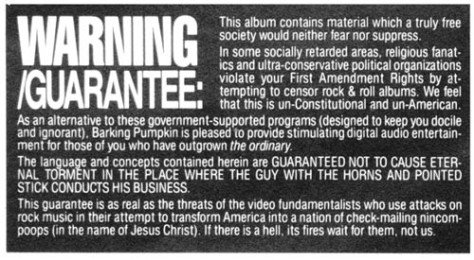
Despite his massive catalog (62 albums released in his lifetime, 43 posthumously), Zappa, like Bruce, is probably remembered more for his fights against censorship, rather than for the actual material in question (which includes some pretty hummable stuff, I must say). Most famously, he took on Tipper Gore and the Parents Resource Music Center in 1985, joining fellow musicians Dee Snider (from Twisted Sister) and John Denver (!) to testify at a Senate hearing over the “Parental Advisory” sticker controversy.
One of the highlights of the film is a clip from a 1986 appearance Zappa made on CNN’s Crossfire. In an observation that now seems quite prescient, Zappa opines, “The biggest threat to America today is not Communism, its moving America toward a fascist theocracy, and everything that’s happened under the Reagan administration is steering us down that pipe.” Of course now, I almost long for those “good old days”, when the Republican Party was but a tool for the Religious Right-in lieu of, uh, whatever it is now.
That said, I should point out that Zappa was not an artist who went out of his way seeking dragons to slay; it’s just that somehow, the dragons had a tendency to seek him out. While he definitely leaned Libertarian when it came to freedom of expression, he was otherwise politically…fluid. Through the course of the film (culled from archival interview/performance footage and contextualized via Schutte’s editing choices), Zappa dumps on the Left, the Right, Hippies, politicians, religion, pop music, record companies, consumer culture (his pet rant), corporate America, and even on his own most rabid fans.
As far as those rabid fans were concerned, the more curmudgeonly and autocratic Zappa’s stance became (regardless of whether or not it was just show biz shtick), the more they loved him (in that narrow context, there’s a weird parallel with Donald Trump…the obvious difference being that Trump has never really created anything that is of value to anyone but himself). Zappa was kind of an asshole, but in that Mozart kind of way, as he was an extremely gifted and prolific asshole (was Tipper his secret Salieri? Discuss). Like Picasso, he kept experimenting and creating until he expired (after a long battle, Zappa succumbed to cancer at 52 in 1993).
Let me be up front…this documentary will play best for members of the choir (guilty!). If you’ve never been much of a Zappa fan, the largely non-contextualized pastiche of vintage clips will likely do little to win you over. This impressionistic approach can still paint a compelling portrait; if you’re patient enough to observe, and absorb (consider 32 Short Films About Glenn Gould, which remains my favorite biopic, despite the fact that I had never even heard of him when I first saw it, and I still don’t own any of his albums).
There is genuine poignancy as well. In a Today Show interview, an obviously gravely ill Zappa is asked how he wants to be remembered. “It’s not important to even be remembered.” After an awkward silence that implies his interviewer did not see that one coming, he continues, “The people who worry about being remembered are guys like Reagan, Bush…these people want to be remembered, and they’ll spend a lot of money and do a lot of work to make sure that remembrance is just terrific.” “And for Frank Zappa?” she presses. Without missing a beat, he replies “Don’t care.” Back to you, Katie.
I suspect you really did care, Frank. But I know if I ask, I’ll end up eating that question.
# # #
In case you’ve forgotten what a lyrical player he was (when he chose to be)
46 years ago today, the 3-day 1970 Atlanta International Pop Festival opened. Attendees were estimated to be around 200,000.
Historically overshadowed by Woodstock (held 11 months earlier), it still boasted an equally impressive roster of performers. Granted, a number of Woodstock luminaries were there (Jimi Hendrix, Johnny Winter, Ten Years After, John Sebastian, Richie Havens, Mountain et.al.), but there were top acts exclusive to the Atlanta Festival like The Allman Brothers, B.B. King, The Chambers Brothers, Procol Harum, Grand Funk Railroad, Spirit, Rare Earth, Mott the Hoople, and It’s A Beautiful Day (just to name a few).
The cost of a ticket? $14. I’ll spell that out, so you don’t think it’s a typo: fourteen dollars. Yes, I know, inflation, yadda yadda…but still (a front row seat at this fall’s Desert Trip will only set you back $9,400).
But I digress. Back to Atlanta, 1970. At midnight on July 4th, Jimi Hendrix performed to the biggest domestic audience of his career (sadly, just over two months later, he was gone forever). He played a rousing set, which is documented in the excellent 2015 Showtime production, Jimi Hendrix: Electric Church (currently available on Showtime’s In-Demand feature, if you haven’t caught it yet). Hendrix included his idiosyncratic “Star Spangled Banner” salute (how could he not do it on the Fourth?), with fireworks. Pretty awesome stuff.
Unfortunately, despite the “right of the people peaceably to assemble” (not to mention that whole freedom of expression thing) someone didn’t find Jimi’s paean so awesome (there’s one in every crowd). The “someone”? Governor Lester Maddox. Two days after the festival, he announced he was going to push for legislation to ban any future such DFH events in his state. Because you know…freedom.
(Originally posted on Digby’s Hullabaloo on April 23, 2016)
While the line dividing politics from show-biz has always been tenuous, the White House meeting between Elvis Aaron Presley and Richard Milhous Nixon in 1970 remains one of the more surreal moments in United States presidential history. From Smithsonian.com:
Around noon, Elvis arrived at the White House with Schilling and bodyguard Sonny West, who’d just arrived from Memphis. Arrayed in a purple velvet suit with a huge gold belt buckle and amber sunglasses, Elvis came bearing a gift—a Colt .45 pistol mounted in a display case that Elvis had plucked off the wall of his Los Angeles mansion.
Which the Secret Service confiscated before Krogh escorted Elvis—without his entourage—to meet Nixon.
“When he first walked into the Oval Office, he seemed a little awe-struck,” Krogh recalls, “but he quickly warmed to the situation.”
While White House photographer Ollie Atkins snapped photographs, the president and the King shook hands. Then Elvis showed off his police badges.
Nixon’s famous taping system had not yet been installed, so the conversation wasn’t recorded. But Krogh took notes: “Presley indicated that he thought the Beatles had been a real force for anti-American spirit. The President then indicated that those who use drugs are also those in the vanguard of anti-American protest.”
“I’m on your side,” Elvis told Nixon, adding that he’d been studying the drug culture and Communist brainwashing. Then he asked the president for a badge from the Bureau of Narcotics and Dangerous Drugs.
“Can we get him a badge?” Nixon asked Krogh.
Krogh said he could, and Nixon ordered it done.
Elvis was ecstatic. “In a surprising, spontaneous gesture,” Krogh wrote, Elvis “put his left arm around the President and hugged him.”
I’ll bet you thought E was going to say, “Thank ya, sir…thankyahveramuch.” Amirite?
He very well may have, but since there is no verbatim transcript, it’s up for conjecture. Which brings us to Liza Johnson’s featherweight yet passably entertaining Elvis & Nixon.
Co-writers Joey Sagal (who, interestingly, played an Elvis-like character for the premiere run of Steve Martin’s play Picasso at the Lapin Agile), Hanala Sagal, and Cary Elwes frame their screenplay with the most oft-recounted anecdotal lore surrounding the meet, shored up by a fair amount of creative license. Of course, this device (nowadays referred to as “fan fiction”) is nothing new. There have been a number of such explorations done on both figures; at least one featuring them together (the 1997 TV film Elvis Meets Nixon).
What makes this romp eminently watchable are its two leads: Michael Shannon (as Elvis) and Kevin Spacey (as Nixon). While this is far from a career highlight for either, they both have the chops to rise above the uneven script and carry the day. It does take a bit of acclimation to accept the hulking Shannon as Elvis; but he is subtle enough as a character actor to convincingly transform himself into The King, despite the fact that has no physical resemblance to his real-life counterpart (neither does Spacey, for that matter, but he utilizes his gift for voice mimicry to really capture Nixon to a tee).
The film is farcical in tone, but there are brief flashes of pathos. In a scene recalling De Niro’s “who am I?” dressing room soliloquy in Raging Bull, Shannon gazes into a mirror and laments about how disassociated he feels from “Elvis” the legend. It’s a genuinely touching moment. Spacey gets to flex his instrument in a monologue where he reflects to Elvis on their commonalities; how both men rose up from humble roots to achieve greatness (yes, I know…depends on how you define “greatness”).
It’s based on historical fact, but not don’t expect any new revelations. You may forget what you’ve just watched by the time you get back to your car, but political junkies will get some laughs. There are stretches where the film threatens to morph into a glorified SNL sketch, but at a short running time of 87 minutes, it’s over before you know it. If only I could say the same for the 2016 election…
I said life is just a game, we’re all just the same
Do you want to play?
2016…the year the music died. Or at least it’s starting to feel that way. It’s all too much.
What can you say about Prince Rogers Nelson? If anyone could be labelled the “American David Bowie”, I’d wager this ever-evolving musical chameleon comes damn close. He was a true iconoclast. He was an amazingly gifted songwriter, vocalist and musician who could effortlessly segue from funk to rock, soul to psychedelia, R&B to jazz, hip-hop to techno…you name it. It’s as if he was created by a mad scientist who wanted to see what happens if you take DNA from Sly Stone, Paul McCartney, James Brown, Todd Rundgren, Jimi Hendrix, Stevie Wonder-and toss it all into a super collider.
His foray into cinema was more of a bumpy ride. Still, I have a soft spot for his semi-autobiographical 1984 vehicle, Purple Rain. While it is uneven from a narrative standpoint, the soundtrack is genius, a truly superlative song cycle in Prince’s canon. His 1986 “vanity project” Under the Cherry Moon, however, kind of put the kibosh on his acting career. It challenges Ishtar for title of Most Critically Drubbed Film of All Time. Still, its critics-to-audience score ratio on Rotten Tomatoes tells an interesting story. Only 25% of the critics “liked” it…but the audience score is 69%. As one critic wrote: “Strictly for Prince fans — but then again I am one.” Ditto. Obviously, he struck a chord.
(*sigh*) It’s getting crowded up there. Now George can thank him for this heartfelt solo:
Now cracks a noble heart. Good night, sweet prince.
And flights of angels sing thee to thy rest.
###
UPDATE: Wow. On CNN tonight, even Stevie Wonder was at a loss for words:
Stevie Wonder Thursday described Prince as “a great musician, a great producer, great song writer” — and was nearly overcome with emotion when asked to perform something that reminded him of the music icon who died at age 57.
“I think I would probably break down if I do a song right now,” Wonder told Anderson Cooper on CNN in during an interview from his Los Angeles home.
Prince, who was pronounced dead after collapsing in his Minnesota home, once described Wonder, 65, as a role model and an inspiration. “He was incredible,” Wonder told Cooper. “I’m just glad I was able to say to him I love you the last time I saw him.”
The performers had appeared together on several occasions, including the BET Awards in 2006 and in Paris four years later.
“The times we did jam together were amazing,” Wonder said.
He described Prince as “someone who allowed himself to be himself and encouraged others to be themselves.
“He was very free — and to do what he did without fear was a wonderful thing because it’s always great. It is always great when we don’t allow fear to put our dreams to sleep — and he didn’t.”
Wonder cited 1984’s “Purple Rain” as his favorite — “the whole album was incredible” — adding that Prince “was able to mix the blessing of life of God and, yet, the marriage of sex and passion.
He had fun doing it,” Wonder said. “It is rare for me that I can feel with every single breath how he just passionately loved music.”
A jury trial is now set for a lawsuit that says members of Led Zeppelin plagiarized a key element of the best-selling song “Stairway to Heaven.” The estate of Randy Wolfe, the late guitarist of the band Spirit, initially filed the federal lawsuit two years ago.
On Friday, U.S District Judge R. Gary Klausner ruled that there’s enough evidence to move ahead with a trial to decide whether Led Zeppelin and guitarist Jimmy Page unfairly appropriated the guitar line from the Spirit song “Taurus,” which Wolfe — performing as Randy California — wrote years before “Stairway to Heaven” was released in 1971.
The lawsuit was filed with a Philadelphia court back in 2014, the same year Led Zeppelin released a newly remastered version of “Stairway to Heaven.” A year later, the venue was changed to California, to the same court that recently ruled in favor of the estate of Marvin Gaye in its copyright infringement lawsuit over the 2013 hit “Blurred Lines,” by Pharrell Williams and Robin Thicke.
Among the claims in the lawsuit against Led Zeppelin: that the band perpetrated a “falsification of Rock n’ Roll History.” In his order, Klausner finds that claim “inventive—yet legally baseless,” saying that he diligently sought out anything that might support the theory.
Klausner also removed Led Zeppelin bassist John Paul Jones from the suit, along with music publishers Super Hype and Warmer Music. That leaves Robert Plant and Jimmy Page as the leading defendants in the case.
Pagey and Percy, rockin’ the docket? Talk about a witch hunt…
Live from Jimmy’s house
That’s the story of rock ‘n’ roll, man…stealing riffs! After all, there’s only 7 major chords. Look at how many classic songs Buddy Holly was able to write using just three of them (A, E, & D). And even Buddy did a little creative “borrowing”, way back in the 1950s:
…sounds awfully close to an earlier Bo Diddley song:
…which was hijacked again over 30 years later, by George Michael:
Another classic example…starting with Neil Diamond in 1967:
…which obviously influenced:
…and re-emerged later as:
Perhaps this is all best summed up by one of my favorite 70s bands:
(Originally posted on Digby’s Hullabaloo on March 12, 2016)
I once unintentionally attended a Residents gig, at a club in San Francisco, circa 1980. Technically, they weren’t really there. They were “appearing” via (mesmerizingly weird) videos. The videos were being looped, concurrently on several monitors, in a small room isolated from the main stage. This presentation functioned as a sort of passive “supporting band” for the act I was there to see, Snakefinger.
Then again, as defined in a documentary called The Theory of Obscurity: a film about The Residents (and by the artists themselves) they’re not a “band”…so much as they are an ongoing art installation. So in that context, I’ll state unequivocally that I saw The Residents (you had to be there, man!).
“The Residents Ultimate Box Set” (Museum of Modern Art)
Director Don Hardy Jr. has taken on the unenviable task of profiling a band who have not only refused to reveal their faces in any billed public appearances over a 40-year career, but continue to this day to willfully obfuscate their backstory (and the fact that publicity is handled through their self-managed “Cryptic Corporation” puts the kibosh on any hopes of discovery).
As I inferred earlier, can you even call them a “band” with a straight face? Or are they more of an “art collective”? Or are they just elaborate pranksters? One thing that does become clear as you watch the film, is they are all of the above, and more.
Attempting to describe their music almost begs its own thesis-length dissertation; it’s best understood by simply sampling it yourself. Just don’t expect anything conventional. Or consistent; they are experimental in every sense of the word.
Considering that they have over sixty albums to their credit, Hardy obviously can’t annotate their full discography in a 90-minute film, but he does spotlight some of their more seminal efforts, like The Third Reich’n’Roll (best album title ever) and the ironically entitled Commercial Album (40 delightfully dada 1-minute songs, which the band actually rotated as a 60 second spot flight on San Francisco Top 40 station KFRC in 1980…talk about a meta ad campaign!).
On a purely conceptual level (as pointed out in the film) The Residents could be seen as the antithesis of the Kardashians; whereas the latter are the poster children for those who are “famous for being famous”, the former are “famous” for shunning (and mocking) the Cult of Celebrity at every turn. Yet (paradoxically) they are lauded as innovative multimedia artists (Hardy shows how serendipity led these “failed filmmakers” into becoming a band, who then by necessity stumbled into becoming music video pioneers).
The Residents have also been more musically influential than one may assume; members of Devo, Primus, Ween and the Talking Heads are on hand to testify as such. I was a little surprised that Daft Punk isn’t mentioned, especially since they literally wear their influences on their sleeves (well, in this case, their heads). While The Residents are not for all tastes, Hardy has fashioned an ingratiating, maybe even definitive, portrait of them.
A wizard, a true star: R.I.P. Keith Emerson 1944-2016
Goddammit. What is the deal with 2016? We’re just over two months in, and I’m feeling like Dave Lister coming out of stasis in Episode 1:
I know its (still) reflexive in some snooty muso quarters to use Emerson, Lake, & Palmer as the whipping boys for 70s excess, but I don’t care…I was an ELP fan then, I am an ELP fan now, and I will be an ELP fan forever. There, I said it. Out, loud and proud. Prog rock rules!
With that said, a shout out now to the memory of one of the gods of the Moog. Keith, wherever you are, know this: Still…you turn me on.
UPDATE: I’m sad to learn that Keith apparently battled depression for several decades, according to friend and band mate Greg Lake:
“I have to be honest and say that his [apparent suicide] didn’t come as a shock to me,” [Lake] said.
“The situation with Keith didn’t happen suddenly, it had been developing from as far back as the Works Vol 1 album (1977).
At that point, I began to see things happening with Keith which didn’t look or feel right.”
Lake did his best to help his friend – “when you’re close you always hope tomorrow will be better” – but eventually he became “impossible” to work with.
“I think its a very difficult thing to actually describe what depression is,” [Lake] said.
[…]
“Part of Keith’s problem was that, especially in later years, he’d begun to develop a degenerative disease that affected his hands.
He lost control of some of his fingers.” Lake is reluctant to link this illness too firmly to his death.
[…]
“All I would say is that if anyone does have feelings like that, of being so desperate that they think it’s better off not to wake up tomorrow, then please, go and talk to somebody – the doctor, your friend, anybody.”
Wise counsel. Chronic depression is nothing to be taken lightly; whether it’s yourself or a loved one. Here are some resources:
Well, the Heavenly Choir just got themselves one hell of an arranger.
In my 2012 review of the film Produced by George Martin, I wrote:
While no one can deny the inherent musical genius of the Beatles, it’s worth speculating whether it would have reached the same dizzying heights of creativity and artistic growth (and over the same 7-year period) had the lads never crossed paths with Sir George Martin. It’s a testament to the unique symbiosis between the Fabs and their gifted producer that one can’t think of one without also thinking of the other. Yet there is still much more to Martin than his celebrated association with John, Paul, George and Ringo.
Much more. Now, he’s gone. Not such a shock at 90, but still I’m sad.
From his early days working for EMI, where he earned his bones producing and arranging everything from comedy records to symphonic sessions, through his legendary partnership with the Beatles, to composing movie soundtracks, and as recently as the 2006 Beatles remixes for the Cirque du Soleil show Love, Martin remained the embodiment of creativity, craftsmanship and class.
The anointment of “Fifth Beatle” has been liberally bestowed over the decades (Klaus Voorman, Eric Clapton, Billy Preston, etc.) but no one deserves it more than Sir George. He not only contributed defining orchestral touches to cuts like “Yesterday”, “Eleanor Rigby”, “All You Need Is Love”, “I Am The Walrus”, and “A Day in the Life”, but occasionally sat in, playing subtle flourishes like the harmonium solo on “The Word”, the lovely baroque piano on “In My Life” (both from Rubber Soul), and the harpsichord on “Fixing a Hole” (Sgt. Pepper).
Here are my picks for some of Sir George’s best post-Beatles work:
(Originally posted on Digby’s Hullabaloo on March 5, 2016)
First off, there ain’t no such thing as an Easter Bunny, OK? And as much as we’d all like to believe in this new millennium of instant, “one-mouse-click-away” validation, there is no such thing as “overnight success” – especially in the music business. You may have heard of writer Malcolm Gladwell’s “10,000 hours of practice” rule, which is equated as the minimum investment of time and effort required to master a field? Well…it’s true.
Consider pseudo-glam shock rockers Twisted Sister (I know…it’s been a while since you have). They may have appeared to come from nowhere with their breakout hit (and MTV staple) “We’re Not Gonna Take It” in 1984, but by that time the band had already labored in the trenches (i.e., the Jersey/Connecticut/L.I./Westchester County circuit) for 12 years.
Those first 10,000 hours of dive bar stage time are chronicled in an entertaining (if slightly overlong at 135 minutes) documentary from Andrew Horn called We Are Twisted Fucking Sister! (just out on DVD and Blu-ray). Horn begins in 1972, which is when longest-running member, NYC-based guitarist Jay-Jay French, joins a glitter band from New Jersey who called themselves Silver Star.
They become Twisted Sister the following year (French’s idea), and then go through a number of personnel changes before the key addition of lead singer Dee Snider in 1976, infusing stylistic changes that kick-start the gradual evolution into the version of T.S. we all know and love (or hate). Horn may be teasing for a sequel; he ducks out just as they are poised for their big break.
While I’ve never been a huge follower, I came away from the film with admiration for their hard work and the stalwart dedication of their rabid fans. It’s especially impressive considering that they built a coterie of self-proclaimed “SMF”s (acronym for Sick Mother Fuckers) the old-fashioned way-one gig at a time…sans radio play or record company support (they didn’t snag a major label deal until 1983).
And as footage from their club days reveals, they were one tight live act, from their Bowie medleys to their meta stage shtick (recalling The Tubes). In the age of America’s Got Talent and YouTube, it’s a reminder that paying your dues (putting in those 10,000 hours) still counts for something.
Don’t scrape the glitter off just yet! Here are my picks for the Top 10 glam rock movies:
The Ballad of Mott the Hoople – Mott the Hoople never consciously set out to be a glam band, yet they remain synonymous with the era due to their brief association with David Bowie, who produced their 1972 album All the Young Dudes (and penned the eponymous hit single). But leading up to that period, the band had flirted with a number of genres, from country rock to proto-metal. And they already had a great in-house songwriter on board in pianist/lead vocalist Ian Hunter, whose influences were more Dylan than Bowie. Chris Hall and Mike Kerry’s documentary is a fairly comprehensive retrospective on the band, with great anecdotes from band members and tons of rare footage. Fans will love it.
Born to Boogie – Ringo Starr directed and produced this “lost” 1973 cult film (restored and reissued direct-to-DVD in 2005), which captures late great T. Rex front man/glam icon Marc Bolan at the peak of his strutting, charismatic, androgynous rock god glory. Don’t expect an insightful portrait of the artist; it’s more of a “lightning in a bottle” capture of the era, highlighted by footage culled from two 1972 concerts.
The original theatrical version released in the U.K. ran just over an hour, but the DVD is lengthened by inclusion of both full performance sets. Film directing is not one of Ringo’s strongest suits; be prepared for some amateurish vignettes between the song sets. Still, it’s a fascinating historical document.
Hedwig and the Angry Inch – It’s your typical love story. A German teen named Hansel (John Cameron Mitchell) falls head over heels for an American G.I., undergoes a (less than perfect) sex change operation so they can marry, and ends up seduced and abandoned in a trailer park. Now completely adrift (geographically as well as sexually) the desperate Hansel opts for the only logical way out of this mess…by creating an alter-ego named Hedwig, putting a band together, and setting out to conquer the world. How many times have we heard that tired old tale?
But seriously, this is an amazing tour de force on the part of Mitchell, who not only acts and sings his way through this wildly entertaining musical like nobody’s business, but directed and co-wrote (with composer Steven Trask, with whom Mitchell also co-created the original stage version).
Jobriath A.D. – There have been a good number of “rags-to-riches-to-rags” show biz tales that played out to their inevitably sad denouement within the walls of New York City’s Chelsea Hotel…this may be the saddest one yet (and that’s saying a lot). That’s where one Bruce Wayne Campbell (aka Jobriath) checked out permanently in 1983, dead from AIDS at 36. As you learn in Kieran Turner’s documentary, it all began promisingly enough.
Proclaimed a child prodigy due to his proficiency on piano, he made his show biz entrée in the late 60s, when he landed a plum role in the original west coast production of Hair, which he soon left to begin finding his own way as a singer-songwriter. In 1972, he was “discovered” by Carly Simon’s original manager, Jerry Brandt (either the savior or the villain of the piece, depending on who you believe). Before Bruce knew it, his newly forged persona of “Jobriath” had a two-record deal with Elektra, and was hyped as the “American David Bowie” and “True Fairy of Rock and Roll” before the public heard a note (no pressure). See it to discover how it all played out.
The Mayor of the Sunset Strip – George Hickenlooper’s fascinating portrait of Sunset Strip fixture Rodney Bingenheimer (whose English Disco club served as the west coast HQ for the U.S. glam scene from 1972-1975) doubles as a whirlwind time trip through rock music’s evolution, filtered through a coked-out L.A. haze.
The diminutive, skittish and soft-spoken Bingenheimer comes off like Andy Warhol’s west coast doppelganger. The ongoing photo montages of Rodney posing with an A-Z roster of (seemingly) every seminal figure in rock ’n’ roll recalls Woody Allen’s fictional Alfred Zelig, a nondescript milquetoast who morphs with whomever he is with at the time.
he film is peppered with appearances and comments from the likes of music producer Kim Fowley (whose whacked-out rock ’n’ roll career warrants his own documentary), Pamela des Barres (legendary super-groupie and former member of Frank Zappa protégés The GTO’s) and her husband, actor-musician Michael des Barres (who steals the show with priceless backstage tales). Brilliantly made, and essential viewing!
The Phantom of the Paradise – To describe writer-director Brian DePalma’s 1974 horror schlock-rock musical take-off on The Phantom of the Opera as “over the top” would be understatement.
Paul Williams (who composed the memorable soundtrack) chews all the available scenery as ruthless music mogul “Swan”, a man with a curious predilection for insisting his artists sign their (somewhat long-term) contracts in blood. One who becomes so beholden is Winslow (William Finely) a talented composer hideously disfigured in a freak accident (and that’s only the least of his problems). Jessica Harper plays the object of poor Winslow’s unrequited desire, who is slowly falling under Swan’s evil spell.
Musical highlights include the haunting ballad “Old Souls” (performed by Harper, who has a lovely voice) and “Life at Last”, a glam rock number performed by “The Undead”, led by a scene-stealing, campy Gerrit Graham as the band’s lead singer “Beef”.
The Rocky Horror Picture Show– 40-odd years have not diminished the cult status of Jim Sharman’s film adaptation of Richard O’Brien’s original stage musical about a hapless young couple (Barry Bostwick and Susan Sarandon) who stumble into the lair of one Dr. Frank-N-Furter (Tim Curry) one dark and stormy night.
O’Brien co-stars as the mad doctor’s hunchbacked assistant, Riff-Raff. Much singing, dancing, cross-dressing, axe-murdering, cannibalism and hot sex ensues-with broad theatrical nods to everything from Metropolis, King Kong and Frankenstein to cheesy 1950s sci-fi, Bob Fosse musicals, 70s glam-rock and everything in between. Runs out of steam a bit in the third act, but with such spirited performances (and musical numbers) you won’t notice.
Slade in Flame – Akin to Mott the Hoople, it may be arguable among music geeks as to whether Slade was truly “glam” (they were a bit on the “blokey” side- as the Brits would say), but they are nonetheless considered so in some circles, and this 1974 film was released during the heyday of space boots and glitter, so there you go.
The directorial debut for Richard Loncraine (Brimstone and Treacle, The Missionary, Richard III) the film is a gritty, semi-biographical “behind the music” drama (don’t expect A Hard Day’s Night) about a working-class band called Flame (suspiciously resembling the four members of Slade, wink-wink) who get chewed up and spit out of the star-making machine (this just in: managers and A & R people are back-stabbing weasels).
While not a genre masterpiece, the film is bolstered by a great soundtrack (all Slade originals) and the casting of Tom Conti (who plays a soulless record exec with great aplomb). An amusing scene where lead singer Noddy Holder’s character gets locked into a stage coffin presages a similar hardware malfunction depicted in This Is Spinal Tap. Another memorable scene has the band risking life and limb to access the broadcast booth for an on-air interview at an offshore pirate radio station (the story is set in the late 1960s).
Velvet Goldmine – You could call this the Citizen Kane of glam rock movies. While Todd Hayne’s 1998 love letter to the 70s glitter scene has its flaws (let’s just say that there are a few glaring anachronisms) he gets credit for being one of the few latter-day filmmakers who has revisited the era with any palpable sense of earnestness.
Set in the mid-1980s, the story concerns a British journalist (Christian Bale) assigned to uncover “whatever happened to” a glam-rock star (Jonathan Rhys Meyers, in flashback) who may not be “dead” after all (long story). Ewan McGregor’s Iggy-ish character might hold the key. Also with Toni Collette.
The story is obviously inspired by (as opposed to “based on”, which is an important distinction to make here) the professional and (and purely speculative) personal relationship between David Bowie and Iggy Pop; also reminiscent of The Hours and Times (a speculation on John Lennon and Brian Epstein’s relationship).
Ziggy Stardust: The Motion Picture – It’s fun to speculate if director D.A. Pennebaker (Don’t Look Back, Monterey Pop) had been given a clandestine “heads up” that he was about to capture Ziggy Stardust’s “retirement party” for posterity as he was setting up to film a 1973 David Bowie concert at London’s Hammersmith venue.
It was news to Bowie’s backup band, The Spiders From Mars who (as the story goes) didn’t have a clue that their boss was about to undergo one in a series of alter-ego ch-ch-ch-changes until he made his mid-set announcement to the audience that this was to be the Spiders’ “last show…ever.” The moment is captured on camera (in Pennebaker’s signature cinema verite style) along with a dynamic set by Bowie, Ronno & co., who are on fire. A must-see for fans.
Does anyone know the way? There’s got to be a way! Here’s a couple of my favorite glam bands to play us out, beginning with The Sweet:
Glam did have its artier side, as demonstrated in this Old Grey Whistle Test performance by the Sensational Alex Harvey Band: