Category Archives: Drug Culture

The Edge is Still Out There: Gonzo, the Life and Work of Hunter S. Thompson ***

By Dennis Hartley

(Originally posted on Digby’s Hullabaloo on July 12, 2008)

No fun to hang around
Feeling that same old way
No fun to hang around
Freaked out for another day
No fun my babe no fun

 -The Stooges

 “No More Games. No More Bombs. No More Walking. No More Fun. No More Swimming. 67. That is 17 years past 50. 17 more than I needed or wanted. Boring. I am always bitchy. No Fun — for anybody. 67. You are getting Greedy. Act your old age. Relax — This won’t hurt.”

 -Hunter S. Thompson

It’s been just over three years now since the godfather of gonzo journalism eschewed his beloved typewriter to scrawl those words with a magic marker, four days prior to pulling a Hemingway. Ever the contrarian, Thompson couldn’t resist adding a twist of gonzo irony to his suicide note, by entitling it “Football Season is Over.”

Since then, several quickie “tell-all” books have played Monday morning quarterback with the life and legacy of the iconoclastic writer, with what one would assume would be a wildly varying degree of accuracy. That’s because Hunter S. Thompson was a mass of  contradictions. His work was imbued with DFH political idealism and tempered by full commitment to sex, drugs and rock ‘n’ roll; yet he loved to collect guns, blow shit up and counted the likes of Pat Buchanan among his personal friends. I don’t envy his biographers.

In Gonzo: the Life and Work of Hunter S. Thompson, director Alex Gibney (Taxi to the Dark Side, Enron: the Smartest Guys in the Room) may have discovered the right formula. He takes an approach as scattershot and unpredictable as the subject himself; using a frenetic pastiche of talking heads, vintage home movies,  film clips, animation, audio tapes and snippets of prose (voiced by Johnny Depp, who has become to Thompson what Hal Holbrook is to Mark Twain). While Gibney keeps the timeline fairly linear, he does make interesting choices along the way-and equally interesting omissions (e.g., Thompson’s formative years are given the bum’s rush).

Gibney begins with the 1966 book Hell’s Angels: A Strange and Terrible Saga, which first established Thompson’s groundbreaking style of journalism (as one interviewee observes, he essentially “embedded” himself with the notorious motorcycle gang). An overview of his Rolling Stone reportage ensues, highlighted by the assignment that resulted in Fear and Loathing in Las Vegas. There’s a fascinating account of how Thompson’s bacchanalian propensities caused him to blow his coverage of the Ali-Foreman bout in Zaire, posited by Gibney as the first inkling that personal excesses were starting to affect HST’s ability to consistently knock one out of the park with each piece.

A lion’s share of the film is devoted to two particular chapters of Thompson’s life: his quasi-serious run for sheriff of Aspen, Colorado and his coverage of the 1972 presidential elections (which provided fodder for Thompson’s Fear and Loathing: On the Campaign Trail ’72).

The segment regarding the 1972 campaign is so riveting and well-crafted that I wished Gibney had turned it into a full-length companion documentary. Gibney reveals how the Eagleton VP nomination debacle and resultant death knell for the McGovern campaign was also a crushing blow to Thompson’s personal sense of 1960s idealism, signaling the beginning of an escalating disillusionment and bitterness that would permeate his political writing from that point on. The director also reminds us that Thompson was quite instrumental in bringing then-governor Jimmy Carter into the national political spotlight by championing his 1974 Law Day Speech.

I think political junkies are going to dig this film more than the those chiefly enamored with Hunter S. Thompson’s superficial substance-fueled “rebel” persona. Excepting the depiction of Thompson’s relatively unproductive latter years, spent ensconced in his Colorado compound, too distracted by guns, drugs and sycophants to do little else but slowly disappear up his own legend (like Elvis at Graceland) the director suppresses the urge to play up the public notoriety and revel in the writer’s recreational excesses, just to sell more movie tickets. If you’re expecting a sequel to Gilliam’s film, this is not for you.

The film is not without its flaws; the frequent use of Depp clips from Fear and Loathing in Las Vegas becomes distracting and begins to feel like cheating (by contrast, there is only one brief nod to Bill Murray’s turn in Where the Buffalo Roam.) This is a minor quibble, because there are some real treasures here. Devotees will delight in listening to the audio snippets from the original cassettes that Thompson made while cruising through the Nevada desert with his attorney, as well as the recording of a shouting match between the writer and his long-time collaborator Ralph Steadman while they were in Zaire (let us pray that the DVD will bonus more from those priceless tapes).

This is not a hagiography; several ex-wives and associates  make no bones about reminding us that the man could be a real asshole. On the other hand, examples of his genuine humanity and idealism are brought to the fore as well, making for an insightful and fairly balanced overview of this “Dr. Gonzo and Mr. Thompson” dichotomy. What the director does not forget is that, at the end of the day, HST was the most unique American political commentator/ social observer who ever sat down to peck at a bullet-riddled typewriter.

Bastard. We could sure as shit use him now.

DIggin’ the scene with a gangster lean: American Gangster ***

By Dennis Hartley

(Originally posted on Digby’s Hullabaloo on November 10, 2007)

http://www.popcornreel.com/jpgimg/denrus.jpg

There is a key scene in Ridley Scott’s crime epic American Gangster that defines the personal code that drives its main protagonist. “Look at the way you’re dressed,” impeccably groomed, tastefully attired 1970s Harlem drug kingpin Frank Lucas (Denzel Washington) says in disgust, to his ostentatiously clothed brother Huey (Chiwetel Ejiofor), “…it’s a look that says: ‘arrest me’. Remember, the loudest one in the room is also the weakest one in the room.”

It’s one of the axioms Lucas picked up working as a driver for his mentor, an old-school Harlem crime lord (Clarence Williams III). By the time his boss keels over from a heart attack, Lucas has been thoroughly schooled in the shrewd business acumen of how to be a wolf in sheep’s clothing. No matter how venal your methods are for clawing your way to the top, if you can swing it while maintaining a respectable public appearance, everybody will still love you.

Scott’s film is all about “appearances”; judging a book by its cover, if you will. When New Jersey police detective Richie Roberts (Russell Crowe) first appears onscreen, it’s unclear whether we’re observing a cop and his partner serving a warrant…or watching a disheveled street thug and his pal pulling a B & E.

While his personal grooming habits may be questionable, it is apparent his integrity is of the highest order. Not only is he an honest cop in a department soaked with corruption (he’s sneered at as a “boy scout” when he turns in a million in cash discovered in a dealer’s car), he is also diligently studying to pass the bar exam so he can prosecute criminals in court as well. Ironically, he is concurrently entangled in a messy child custody battle with his ex-wife.

Lucas, on the other hand, maintains the appearance of an upstanding citizen; while surreptitiously operating on the opposite side of the law. He has prospered via an ingenious Southeast Asian heroin pipeline that bypasses pesky “middlemen”. He buys an estate in the suburbs and sets up house for his brothers and his mother (played by the great Ruby Dee). He marries a beautiful Latina (Lymari Nadal) and ingratiates himself as a pillar of the community, mingling with the hoi polloi and contributing to charitable causes.

Most interestingly, Lucas is largely enabled to “hide in plain sight” due to a culture of institutional racism running through law enforcement during this era (the early to mid 1970s). it was  beyond the ken of the law enforcement community to even consider that such a sophisticated, large-scale drug operation could be helmed by an African-American.

Steven Zailian’s screenplay is based on true events; it is set in the same NYC milieu asThe French Connection, Serpico and Prince of the City; namely, the occasionally blurry line between a “cop” and a “robber”. Scott also uses a trick that worked well for Michael Mann in Heat, building dramatic tension by keeping his two stars apart for most of the film, while teasing us with the inevitability that the pair’s “professional” paths are destined to cross. When Washington and Crowe finally do share a scene, it proves worth the wait (keep an eye on the coffee cup that serves as  a metaphorical chess piece during the exchange; it’s a masterclass in “object work”  by both actors).

Scott utilizes his patented slick visual style (although a grittier look might have better served the story). One bone to pick: despite the deliberate pacing for the first 2 hours, something about the denouement feels curiously rushed. That aside, honorable mentions need to go out to Josh Brolin, for his full-blooded performance as a corrupt Special Investigations Unit cop, and Armand Assante as a mob big shot. I liked the period soundtrack as well, although we need to declare a moratorium on Bobby Womack’s “Across 110th Street”. It’s a great song, but it’s now been used in three films!

SIFF 2007: Monkey Warfare ***

By Dennis Hartley

(Originally posted on Digby’s Hullabaloo on June 23, 2007)

https://alchetron.com/cdn/Monkey-Warfare-images-70306555-1e0f-4051-8032-fbfd39a3dff.jpg

Monkey Warfare, written and directed by Reginald Harkema, is a nice little cinematic bong hit of low-key political anarchy. The film stars Don McKellar and Tracy Wright (the Hepburn and Tracy of quirky Canadian cinema) as a longtime couple who are former lefty radical activists-turned “off the grid” Toronto slackers.

Dan and Linda dutifully hop on their bicycles every morning at the crack of dawn to go dumpster-diving for “antiques” to sell on the internet. They live in a ramshackle rental, filled with the type of posters and memorabilia that suggest an aging hippie mindset, with a particular interest and nostalgic attachment to 1960’s radical politics.

The longtime couple’s relationship has become platonic; they interact with the polite diffidence of roommates making a conscious attempt to avoid pushing each others buttons. We quickly get the sense that Dan and Linda also have a stronger bond that transcends the relationship itself; perhaps a shared secret from their past that feeds a just-barely palpable sense of chronic paranoia tempered only by smoking pot. A lot of pot.

Panic sets in when their regular dealer is suddenly hauled off to jail. Despair quickly turns to relief when our heroine rides into town-not on a white horse, but on a bicycle (merrily flipping off honking motorists like Emily Lloyd in Wish You Were Here). Enter Susan (Nadia Litz) a spirited twenty-something pot dealer/budding anarchist who keeps her basket full of some heady shake she calls “B.C. Organic”.

When Dan invites Susan over to make her first weed delivery, she becomes intrigued by his extensive library of subversive literature. Dan, who is deliriously baked on the B.C. and flushed by the attention of such an inquisitive young hottie, decides to give Susan a crash course in revolutionary politics, which (hilariously) includes dusting off his old MC5 and Fugs LPs.

However, when he loans her his treasured “mint copy” of a book about the Baader-Meinhof Gang, Dan unintentionally triggers a chain of events that will reawaken long dormant passions between himself and Linda (amorous and political) and profoundly affect the lives of all three protagonists.

Monkey Warfare is not exactly a comedy, but Harkema’s script is full of great lines, and the actors deliver them in that peculiarly Canadian deadpan style (I call it the “time-released zinger”). I also like  how Harkema cleverly makes political statements without being heavy-handed.  For instance, all of the principal characters (including a gang of eco-terrorists) ride bicycles. Obviously, Harkema is thumbing his nose at the oil companies, but almost subliminally.

There is also some basis in reality; the director partially modeled the characters of Dan and Linda on the real-life “Vancouver Five”, members of the Canadian anarchist scene who were arrested in 1983 for their links to several politically motivated attacks, including an explosion at a Litton Industries factory where a component for the U.S. cruise missile was being manufactured.

By the way, if you do get an opportunity to screen this film (outside of Canada), be sure to hang around until after the credits roll. There is an audacious scene tacked on the very end in which a gentleman demonstrates, step by step, “how to make” a Molotov Cocktail as he prattles on in (non-subtitled) French (the scene was greeted with some nervous titters, even though it is mostly played for laughs.)

At any rate, it’s certainly not something you see every day at the multiplex. According to the director, who was at the screening I attended, this scene has been censored by the Canadian government and must be excised from any prints that are to be distributed in his home country. (Welcome to our brave new world.)

Endless rain into a paper cup (with dancing!) – Across the Universe ***

By Dennis Hartley

(Originally posted on Digby’s Hullabaloo on September 22, 2007)

http://cdn.funcheap.com/wp-content/uploads/2012/05/beatles_musical.jpg

When I first heard that there was a new movie musical based on interpretations of classic Beatle songs, that nervous tic in my left eye started up again. I don’t think I have ever quite fully recovered from the trauma of watching Sgt. Pepper’s Lonely Hearts Club Band, the final straw that broke the back of entertainment mogul Robert Stigwood’s empire back in 1978. Sometimes, during those long dark nights of my soul, the apparition of George Burns still appears unbidden before me; singing “Fixing a Hole” (shudder!). (And let’s pretend that All This and World War II never even happened, OK?).

However, when I found out that the gifted film and stage director Julie Taymor (Titus) was at the helm, I decided to give her new piece a chance. Across the Universe is fundamentally a collection of visually stunning, slickly choreographed production numbers, all propelled by Beatles covers loosely connecting the requisite “boy meets girl” motif. Toss in 60s references (Vietnam, Leary, Kesey, Owsley, the Weathermen, Hendrix, Joplin, etc.)…and voila! The narrative is a bit thin; this will likely be a sticking point for anyone looking for a deeper meditation on the peace love and dope generation.

The story’s central character is Jude (Jim Sturgess), a young working class Liverpudlian who stows away illegally to the States in search of his father, an American GI who had a brief wartime fling with his mother. He ends up at Princeton University, where he finds out his father now works as a janitor. Jude soon falls in with Max (Joe Anderson), a free-spirited Ivy League slacker, through whom he meets the love of his life, Max’s sister Lucy (Evan Rachel Wood).

Eventually, the trio decides to drop out and move to Manhattan, where they find an apartment managed by the (sexy!) Sadie (Dana Fuchs), a hippie earth mother archetype who also is an up and coming rock singer (replete with bluesy Janis Joplin wail). The three roommates are soon sucked into the vortex of 60’s turbulence. Max is drafted and shipped to Vietnam; Lucy throws herself into political activism and the mercurial Jude, still trying to find himself, flirts with becoming an artist.

There are other main characters, but they are somewhat underwritten and largely there for color. For example, one character named Prudence (I assume you’ve caught on to the name game by now?) appears to exist solely to make her grand entrance in the film’s lamest visual pun-she comes in through the bathroom window .

There are some memorable cameos. Joe Cocker belts out a great version of “Come Together”, U-2’s Bono dispenses hallucinogens and hams it up as the day tripping “Dr. Robert”, crooning “I Am The Walrus” and Eddie Izzard (bearing an eerie resemblance to the late Oliver Reed as he appeared in Ken Russell’s Tommy) cavorts with a chorus line comprised of Blue Meanies, to the strains of “For the Benefit of Mr. Kite”.

Inevitably, a few of the more exuberant numbers recall Milos Forman’s 1979 film version of Hair. In fact, one could say that some elements of the story line in Across the Universe recall Hair as well; but I think Taymor is sharp enough to navigate that fine line between “inspiration” and “plagiarism” (or as film makers are fond of calling it: “paying homage”). I also gleaned clever references to The Graduate and Alice’s Restaurant.

If the film has a weakness, it lies in the casting of the two leads. The character of Jude, as written, has obvious parallels John Lennon’s life; Liverpool roots, an estranged father, his creative angst and inherent cynicism. Sturgess doesn’t quite have the depth that a more seasoned actor might have put into those elements of the character. Wood sleepwalks through her role; it’s a disappointing follow-up to her acclaimed performance in Thirteen.

At the end of the day, however, we must keep in mind that this is, after all, a musical. Audiences seem to be much more forgiving about rote line readings when there’s lots of good singing and dancing. Even a genuine genre classic like West Side Story had weaknesses on that front; Richard Beymer was no Brando, and Natalie Wood could have used a better dialect coach. But what do people remember most about that film? The kickass choreography and the incredible music score. And do you want to know what the best part is about Across the Universe is? The Bee Gees are nowhere in sight.

Thursday’s child is Sunday’s clown: Factory Girl **1/2

By Dennis Hartley

(Originally posted on Digby’s Hullabaloo on August 18, 2007)

https://thedandylife.files.wordpress.com/2011/01/screenshot2010-12-13at5-13-40pm.png

(This review is based on the “extended” director’s cut of the film that appears on the DVD; I have not screened the original theatrical version.)

One of the more interesting trends to emerge with the narrowing window between the moment a first-run film leaves the multiplex and its  DVD release is what I like to call the “auto repair cut” of box-office flops (“OK, I think I’ve found the problem -try starting it now.”)

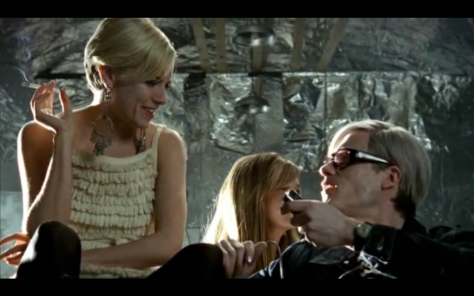
Consider George Hickenlooper’s extended cut of Factory Girl, his biopic about the pin-up girl of the 1960s underground, Andy Warhol discovery Edie Sedgwick. Plagued by production problems and prematurely rushed into theaters late last year, the film did marginal box office, and was even less enthusiastically received by some of the surviving real-life participants in the Warhol Factory scene

Edie Sedgwick was the Paris Hilton of the 1960s; a trust fund babe imbued with no discernible talent aside from the ability to attract the paparazzi by associating with  the right people at just the right places at just the right time. Despite growing up as a child of privilege, Sedgwick’s childhood was less than idyllic (two of her brothers committed suicide and her mother was institutionalized).

She arrived in NYC in the mid 60s and was drawn to the downtown art scene, where she was  spotted by Warhol. Taken by herwaif-like beauty,  he vowed to make her a “superstar”. He featured her in his experimental films, and she became the iconic symbol of the “Factory”, where Warhol worked on his projects and played host to a co-op of avant-garde artists, musicians, actors and hangers-on.

Sedgwick fell from grace with Warhol when she became strung out on various substances and was financially cut off by her family. She sought treatment and cleaned up, only to tragically die of a drug overdose at age 28.

Hickenlooper’s  affection for the subject is evidenced in his canny visual replication of the 60s underground art scene; he alternates grainy, b&w film footage with saturated 16mm color stock and utilizes hand-held cinema verite shots, aping the look of Warhol’s own experimental films. The fashion, the music, and the overall vibe of the era is pretty much captured in a bottle here.

But what about the narrative? Ay, there’s the rub. The director’s pastiche plays like the Cliff’s Notes version of Warhol and Sedgwick’s partnership. A lot of things are left unexplained; peripheral characters come and go without exposition (it wasn’t until the credits rolled that I learned tidbits like “Oh, that was supposed to be Moe Tucker from the Velvet Underground?”

In a narrative film, you can get away with creating bit parts like “Man #2 with suitcase” or “Crazy bag lady in subway”, but when you are dramatizing a true story…well, I think you see my point. (Ironically, the 30 minute documentary extra on the DVD, featuring recollections from friends and family. offers more insight into what made Sedgwick tick than the full length feature does).

You can’t fault the actors. Sienna Miller gives her all in the lead role and does an admirable job portraying the full arc of Edie’s transition from an innocent pixie, fresh from a pastoral country estate, to a haggard junkie, encamped in a dingy room at the Chelsea Hotel.

The always excellent Guy Pearce “becomes” Warhol. It’s not as easy as one might think to convincingly inhabit Warhol’s deadpan persona; actors have made valiant efforts (David Bowie, Jared Harris and Crispin Glover) but generally end up doing little more than donning a white wig and delivering a rote lank stares and signature catch phrases (“Umm, yeah. That’s great.” “Yeah, hi.”).

Even the traditionally wooden Hayden Christensen registers a pulse with his performance and delivers a  spirited impression of Bob Dylan. Sorry-did I say ‘Bob Dylan’? I meant to say, ‘Billy Quinn’ (as in “The Mighty Quinn”?), referred to as a “famous folk singer”.

Factory Girl is perhaps not quite as dismal as many have led you to believe, but it is still not as good as one might have hoped.

Six degrees of Woody Harrelson: A Scanner Darkly (***) & Grass (***1/2)

By Dennis Hartley

(Originally posted on Digby’s Hullabaloo on January 27, 2007)

https://pbs.twimg.com/media/E_-OCTGXsAAXqZx?format=jpg&name=small

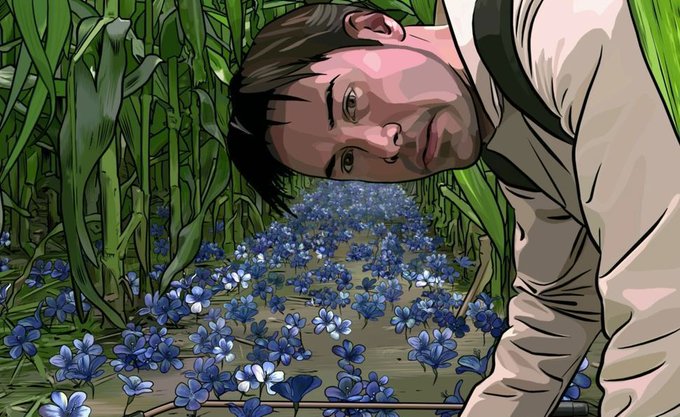
Richard Linklater entered the sci-fi arena in 2006 with his adaptation of the late Phillip K. Dick’s semi-autobiographical novel A Scanner Darkly (now on DVD). Set in a not-so-distant future L.A., the story injects themes of existential dilemma, drug-fueled paranoia and Orwellian government surveillance  into what is otherwise a fairly standard “undercover-cop-who’s-gone-too-deep” yarn.

Keanu Reeves stars as a dazed and confused narc that has become helplessly addicted to the mind-altering drug that he has been assigned to help eradicate (“substance D”). Robert Downey Jr., Woody Harrelson, Winona Ryder and Linklater alumni Rory Cochrane are his fellow D-heads who may not exactly be whom they appear to be on the surface.

Adding to the mood of hallucinatory psychosis is Linklater’s use of rotoscoping (as per his underrated Waking Life). The rotoscoping technique does present challenges for the actors; Downey, with his Chaplinesque knack for physical expression, pulls it off best, while the more inert performers like Reeves and Ryder are literally akin to watching oil paintings.

Linklater’s script keeps fairly close to its source material-particularly in relation to the more cerebral elements (Linklater’s propensity for lots of talk and little action may be a turn-off for those expecting another Minority Report).

Depending on what you bring with you, the film is a) a cautionary tale about addiction, b) a warning about encroaching technocracy, c) an indictment on the government’s “war” on drugs, d) a really cool flick to watch while stoned, e) the longest 99 minutes of your life or f) all of the above.

https://images.squarespace-cdn.com/content/v1/55b2472be4b00ed078112262/1454521620110-4WOMIGYLWWNSLFB2IGP5/image-asset.jpeg?format=1500w

Speaking of the “war” on drugs-here’s a sleeper you may have missed. Grass is a unique, well-produced documentary dealing (er, pun intended) with the history of anti-marijuana legislation  in the United States. Far from a dry history lesson, the film builds its own “counter-myth” of sorts, by exposing the hypocrisy of the government’s anti-marijuana propaganda machine over the years; from the  histrionics of the 1930’s howler Reefer Madness to the Reagan administration’s “Just Say No” campaign in the 1980’s.

There is also an eye-opening  tally of all the tax money the various law-enforcement agencies have spent (thrown away?) attempting to eradicate marijuana usage…from the days of Elliot Ness to the present. The filmmakers ladle some well-chosen period music over a wealth of archive footage (maximized for full ironic effect). Woody Harrelson, who has famously lived through a series of herb-related legal problems, off-screen, narrates with winking bemusement. Whether you are for or against legalization, you should find this one quite informative and highly (sorry!) entertaining.