(Originally posted on Digby’s Hullabaloo on December 24, 2016)
In his 2009 Vanity Fair article, “A Clash of Camelots”, Sam Kashner gives a fascinating account of the personal price author William Manchester ultimately paid for accepting Jackie Kennedy’s invitation to write an authorized account of JFK’s assassination. Death of a President sold well, but by the time it was published in 1967, Manchester had weathered “…a bitter, headline-making battle with Jackie and Bobby Kennedy.” Among other things, Kashner’s article unveils Manchester’s interesting take on Jackie K. herself:
On April 7, 1964, Jacqueline, dressed in yellow Capri pants and a black jersey, closed the sliding doors behind her in her Georgetown home, and Manchester came face-to-face with the president’s widow for their first official meeting. “Mr. Manchester,” she said in her soft, whispery voice. Manchester was struck by her “camellia beauty” and thought she looked much younger than her 34 years. “My first impression—and it never changed—was that I was in the presence of a very great, tragic actress.… There was a weekend in American history when we needed to be united in our sadness,” he later wrote, and Jacqueline Kennedy had “provided us with an unforgettable performance as the nation’s First Lady.”
That particular aspect of Jacqueline Kennedy’s persona – the “very great, tragic actress” – is a tragedian’s dream, an opportunity seized by director Pablo Larrain and screenwriter Noah Oppenheim, who take it and run with it in the speculative historical drama, Jackie.
The film is fueled by a precisely measured, career-best performance from Natalie Portman in the titular role, and framed by a (fictional) interview session that the recently widowed Jackie has granted to a probing yet acquiescing journalist (Billy Crudup), which serves as the convenient launching platform for a series of flashbacks and flash-forwards.
Most of the narrative focuses on the week following the president’s assassination, as Mrs. Kennedy finds herself immediately thrown into the minutiae of moving her family and belongings out of the White House, planning her husband’s funeral, and preserving his presidential legacy; all while still reeling from the horror and shock of what happened in Dallas just days before (which I’m certain would be enough to completely crack anyone).
Therein lays the genius of this film. Who among us (old enough to remember that day) hasn’t speculated on what it must have been like to be inside Jackie’s head on November 22, 1963? You wake up that sunny fall morning, you’re beautiful, glamorous, admired by millions, and married to the most powerful leader in the free world. By that night, you’re in shock, gobbling tranquilizers like Pez, standing in the cramped galley of Air Force One in a daze, still wearing that gore-spattered pink dress, watching the Vice President being sworn in as the new POTUS…while realizing you are already getting brushed to the side.
No one but Jackie herself will ever truly know what it was like to be inside her head in the wake of this zeitgeist-shattering event, and she took that with her to her grave. That gives the film makers much creative leeway, but there are still many points grounded in reality. For example, it’s no secret that Jackie fiercely (and famously) guarded her privacy; so the insinuations that she shrewdly cultivated her image (in one scene, she demands the right of final edit for the journalist’s article) are not necessarily exaggerated.
That said, the narrative (and crucially, Portman’s performance) is largely internalized; resulting in a film that is more meditative, impressionistic and personalized than your standard-issue historical drama. Two films came to mind while I was watching Jackie that I would consider stylistic cousins: Francois Girard’s 1993 Thirty-Two Short Films about Glenn Gould and Satoshi Kon’s 2001 Millennium Actress; the former for its use of episodic vignettes from its subject’s life to construct a portrait, and the latter for doing the same, but with the added similarity of using a journalist’s interview for a framing device.
Larrain also evokes Kubrick, in his use of classical-style music, meticulously constructed shots (with lovely photography throughout by cinematographer Stephane Fontaine) and deliberate pacing. The film ultimately belongs to Portman, who may not physically resemble Jackie, but uncannily captures her persona, from her “soft, whispery voice” and public poise, to her less-guarded side (replete with chain-smoking and sardonic wit). There is excellent supporting work from the aforementioned Crudup, Peter Sarsgaard (as Robert F. Kennedy), and a cameo by the always wonderful John Hurt (as Jackie’s priest).
Understandably, the question of “why now?” could arise, to which I would reply (paraphrasing JFK)…why not? To be sure, Jacqueline Kennedy’s story has been well-covered in a myriad of documentaries and feature films; like The Beatles, there are very few (if any) mysteries about her life and legacy to uncover at this point. And not to mention that horrible, horrible day in Dallas…do we really need to pay $15 just to see the nightmare reenacted for the umpteenth time? (Spoiler alert: the President dies at the end).
I think that “we” do need to see this film, even if we know going in that there was no “happy ever-aftering” in this Camelot. It reminds us of a “brief, shining moment” when all seemed possible, opportunities were limitless, and everything was going to be all right, because Jack was our king and Jackie was our queen. So what if it was all kabuki, as the film implies; merely a dream, invented by “a great, tragic actress” to unite us in our sadness. Then it was a good dream, and I think we’ll find our Camelot again…someday.
(Originally posted on Digby’s Hullabaloo on December 17, 2016)
Growing up as a military brat is not easy. It’s a nomadic life; not so much by choice as by assignment. In the military, you follow orders, and if you have a family, they follow you. To this day, no matter where I’m living, or how long I have lived there, I feel like a perennial “outsider”.
And so it was, back in the summer of 1968, that my dad received a reassignment from Ft. Wainwright, Alaska (where we had been stationed for 4 ½ years) to Clinton County Air Force Base, Ohio (yes, he was in the Army, but certain Army units were attached there…I could explain why, but if I did, I would then unfortunately have to kill you, and I am a man of peace).
Now, understand that Fort Wainwright was a sizable installation; and my family lived on-base. Living in the “family quarters” of a large army base is analogous to living in a dense metropolitan environment. Nobody is “from” the locality where you all happen to be thrown together; consequently there’s a rich diversity in a concentrated area…social, racial, religious, and cultural.
Not so much in the sleepy hamlet of Sabina (also known as “The Eden of Ohio”), which is where my family ended up living “off-base” from 1968-1969. The 2010 census counted 2,564 souls, of which 97.0% were white, 0.9% African American, 0.3% Native American, 0.43% Asian, 0.07% from other races, and 1.12% from one or more races. Hispanic or Latino of any race were 1.15% of the population. I don’t have the town’s ethnic breakdown for 1968, but between my memories and my suspicions, those ratios likely have not deviated much since Sabina was founded in 1830.
You’re probably getting the picture here that Sabina’s populace is the opposite of “diversity”. There is also a tendency (I have found) in your smaller burgs, in your more rural areas, for the locals to be less than welcoming to “outsiders” and somewhat clannish (and since we are talking about Ohio, you could spell that with a “k” and not be historically inaccurate).
Now, before y’all get riled up and start to accuse yours truly of “flyover state” stereotyping, or painting with broad strokes (sins of the fathers, and all that), let me say that I am sure 99.9% of the folks currently living in beautiful Sabina, Ohio are good-hearted people…and fine, upstanding citizens.
However, my own personal interactions with some Sabina locals, specifically from autumn of 1968 through late summer of 1969, do not exactly make for pleasant memories. In fact, my 7th grade year was a living fucking hell. I’m aware that nearly anybody you would care to ask has an anecdote about getting “picked on” at school while they were growing up; the law of averages guarantees that you will be bullied at some point in your 12 years of public schooling.
But what I’m talking about here isn’t an isolated incident or two. What I’m talking about is unrelenting harassment, verbal and physical. What I’m talking about is being informed that “we’re going to be waiting for you after school to kick your ass” on a daily basis.
I’d been bullied before, but there was an added element to the intimidation unique to my Sabina experience. This was the first (but unfortunately, not the last) time someone ever called me a “kike” while pushing me around. I managed to keep most of this from my folks, until the day one of these bushwhacking yahoos sat behind me on the bus and boxed my ears so hard I had to see a doctor.
Good times.
So what does my personal memoir of woe have to do with this week’s film review? Well, as fate would have it, of all the gin joints in all the towns in all the world, filmmaker Michael Moore has intuited the Clinton County seat of Wilmington as the perfect microcosm of what he calls “Trumpland” (Wilmington is only about ten miles from my old “stomping” grounds in Sabina).
Michael Moore in Trumpland (***) was an “October surprise” of sorts; sprung by Moore on an unsuspecting public with no advance hype. The high-concept title of this 73-minute film, (documenting a “one night only” performance piece by Moore) says it all…whether you are a fan or a hater-you know this is going to be a “fish-out-of-water” narrative, layered with irony. First, there’s the venue, the historic Murphy Theater. It’s prime benefactor? Glenn Beck (it burns!). And Moore takes pains to point out he’s in Clinton County, which is antipodal to Clinton country.
Aside from an opening montage featuring locals parroting Breitbart memes and reinforcing the more cartoonish stereotypes of the “typical” Trump voter, Moore suppresses any further urges to shoot fish in a barrel. In fact, Moore telegraphed his good intentions not only by making his show admission-free, but requested that “Trump Voters Welcome” be added to the theater’s marquee.
After taking a “show of hands” census to establish how many in the audience support Hillary, how many support Trump, and who is undecided or supporting independent candidates, it appears that he is dealing with a fairly balanced mix. Employing his trademark mix of entertaining shtick and genuine empathy, Moore attempts to build rapport with the Trump supporters, and really seems to get inside their heads. At least for the first 30 minutes…then, he pulls a bait-and-switch.
It’s subtle. After disarmingly confiding he’s never voted for either Clinton, he mentions the chapter “My Forbidden Love for Hillary” from “Downsize This!” to segue into…his forbidden love for Hillary. By the time he’s finished with what morphs into an impassioned summation of the humanity that’s always driven her dedication to public service, obscured and weather-beaten as it may be from enduring years of anti-Hillary vitriol and character assassination, there’s nary a dry eye in the house…Trump supporters included. It is a master class in rhetorical showmanship.
While my description of that rhapsodic interlude could indicate otherwise, the film is not a Hillary hagiography. For example, Moore makes no bones about his disappointment regarding some of Hillary’s voting decisions while she was serving in the Senate; and he promises to hold her feet to the fire on her campaign promises if she wins. But he also waxes hopeful; launching into a speculative Utopian reverie on how things will be once Hillary becomes POTUS (*sigh*).
It was clearly Moore’s intention that Trumpland (filmed October 7 and released a scant 2 weeks afterwards) would ideally be seen by as many people as possible before November 8. However, he was careful to cover all his bases. If there is one consistency about Michael Moore’s films, it is that they are prescient…and already, I can identify at least one nail he hit squarely on the head.
This comes in the form of another speculative scenario Moore lays out, this one for Trump supporters to envision, should the election go their way. Moore assures them that he feels their pain; as a fellow Midwesterner from a manufacturing town in neighboring Michigan, he “gets” the frustrations that have been building up within the ranks of a certain white, working-class demographic, why they are feeling squeezed out, and why Trump might appear to be their savior.
Suddenly, in a wonderfully theatrical flourish, Moore seems to shapeshift into a Trump voter. He talks about how they are going to feel on Election Day, how incredibly empowering it will be to put that “x” in the Trump box on their ballot card. It’s going to be the “…biggest ‘fuck you’ ever recorded in human history” when their boy takes the White House. “It’s going to feel REAL good,” Moore assures them, “for about…a week.” Uh-oh. “A week?” What’s he mean by that?
It will kind of be like Brexit, Moore explains after a suitable dramatic pause to let things soak in. Remember how eager the Brexit supporters were to shake things up in their country, and give a big “fuck you” to Europe? Sure, they “won”. But then, buyer’s regret set in. There was even a desperate stab to petition for a re-vote, spearheaded by many of the very people who supported it!
OK, so maybe Trump voters haven’t quite reached that stage yet, but they will. Their soon-to-be Fearless Leader is sending up oodles of red flags with kleptocratic cabinet appointment after kleptocratic cabinet appointment. Now, that seems to be in direct contradiction to his campaign stance as champion of the working class…d’ya think? So…just give them time (and pitchforks).
That’s what I say about Moore’s film…give it time. And here’s a stock tip: go long on pitchforks.
So I was fast-forwarding past the vapid, over-choreographed, auto-tuned corporate muzak on the AMAs tonight (thank the gods for DVRs), hoping against hope I’d stumble across something that resembled an organic, analog performance…when this happened:
No, you heard it right: “No Trump! No KKK! No Fascist USA!”
Oh, yeah. Kick out the jams, motherfuckers.
Can’t wait to see the president-elect’s 3am tweets about that one…
(Originally posted on Digby’s Hullabaloo on November 5, 2016)
If you’re like me (and isn’t everybody?) you’ve either mailed your ballot or made up your mind already, so you’ve just about had it up to “here” what with the negative ads and the polling and gnashing of teeth. And this election in particular has me in an unprecedented state of anxiety as November 8 approaches. I’m not sure why, I mean, there’s not much riding on it…except the future of American democracy, and the possibility of an orange fascist sitting in the Oval Office come January. However, being a glutton for punishment (and applying the inoculation theory), I’ve found that one of the best therapies for getting through the final several days of pins and needles before Election Tuesday is to dust off a few of my favorite election-themed movies and give them a spin:
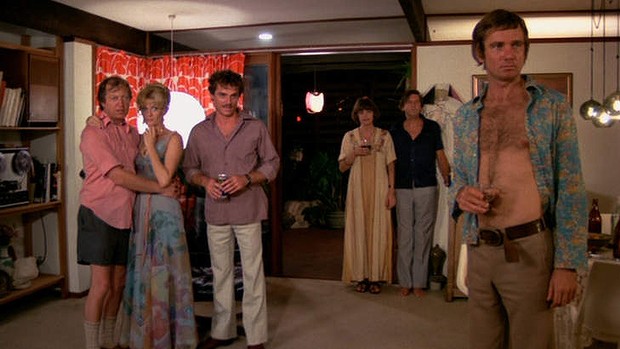
Don’s Party – Oddly enough, my favorite election night film has nothing to do with American politics. Director Bruce Beresford (Breaker Morant) sets his story on Australia’s election night, 1969. Outgoing host Don and his uptight wife are hosting an “election party” for old college chums at their middle-class suburban home.
Most of the guests range from the recently divorced to the unhappily married. Ostensibly a gathering to watch election results, talk politics and socialize, Don’s party deteriorates into a primer on bad human behavior as the booze kicks in. By the end of the night, marriages are on the rocks, friendships nearly broken and guests are skinny dipping in the vacationing neighbor’s pool.
Yet, this is not just another wacky party film. David Williamson’s script (which he adapted from his own play) offers many keen observations about elitism, politics, and adult relationships. Savagely funny, brilliantly written and splendidly acted.
Election – Writer-director Alexander Payne and creative partner Jim Taylor (Sideways, About Schmidt) followed up their 1995 feature film debut, Citizen Ruth, with this biting 1999 sociopolitical allegory, thinly cloaked as a teen comedy (which it decidedly is not).
Reese Witherspoon delivers a pitch perfect performance as the psychotically perky, overachieving Tracy Flick, who makes life a special hell for her brooding civics teacher, Mr. McAllister (Matthew Broderick). Much to Mr. McAllister’s chagrin, Tracy is running a meticulously organized and targeted campaign for school president. Her opponent is a more popular, but politically and strategically clueless jock (why does that sound so familiar?).
Payne’s film is very funny at times, yet it never pulls its punches; there are some painful truths about the dark underbelly of suburbia bubbling beneath the veneer (quite similar to American Beauty, which interestingly came out the same year).
Medium Cool – What Haskell Wexler’s unique 1969 drama may lack in narrative cohesion is more than made up for by its importance as a sociopolitical document. Robert Forster stars as a TV news cameraman who is fired after he makes protestations to station brass about their willingness to help the FBI build files on political agitators via access to raw news film footage and reporter’s notes.
He drifts into a relationship with a Vietnam War widow (Verna Bloom) and her 12 year-old son. They eventually find themselves embroiled in the mayhem surrounding the 1968 Democratic Convention (the actors were filmed while caught up amidst one of the infamous “police riots” as it actually occurred). Many of the issues Wexler touches on (especially regarding media integrity and responsibility) would be more fully explored in films like Network and Broadcast News.
Shampoo – Sex, politics, and the shallow SoCal lifestyle are mercilessly skewered in Hal Ashby’s classic 1975 satire. Warren Beatty (who co-scripted with Robert Towne) plays a restless, over-sexed hairdresser with commitment issues regarding the three major women in his life (excellent performances from Lee Grant, Goldie Hawn and Julie Christie). Beatty allegedly based his character on his close friend, celebrity hairdresser Jay Sebring (one of the victims of the infamous 1969 Tate-LaBianca slayings). The most memorable scene takes place at an election night event.
This was one of the first films to satirize the 1960s zeitgeist with some degree of historical detachment. The late great cinematographer Laszlo Kovacs infuses the L.A. backdrop with a gauziness that appropriately mirrors the protagonist’s fuzzy way of dealing with adult responsibilities.
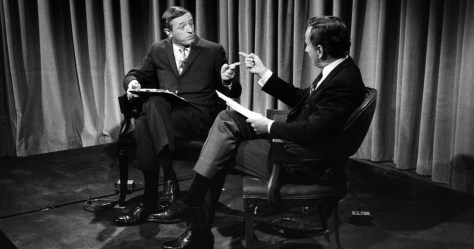
Best of Enemies – In this absorbing 2015 doc, co-directors Morgan Neville and Robert Gordon recount ABC’s 1968 Democratic/Republican conventions coverage debates between William F. Buckley (from the Right!) and Gore Vidal (from the Left!), culminating in an apoplectic Buckley’s threat (live, on national TV) to give Vidal a right, and a left…after calling Vidal a “queer”. It was not only the birth of TV punditry, but the opening salvo in the (still raging) culture wars. Still, compared to the odious climate of the 2016 election cycle, it almost seems quaint. This is a “must-see” for political junkies.
“I think it’s the duty of the comedian to find out where the line is drawn and cross it deliberately.” – George Carlin
In my recent review of Absolutely Fabulous: The Movie, I noted an observation by actress Joann Lumley (one of the film’s co-stars), excerpted from a Stylist interview:
[… ] And now the world is much more sensitive. People take offence at the smallest things, which in [the 1990s] were just funny. In the future, it’s going to be harder to write anything.
To which I added my 2 cents worth:
I’m going to risk crucifixion here (won’t be the first time) and heartily concur with [Joann Lumley’s] point regarding the intersection of P.C. and Funny these days. Now, I’m a card-carryin’, tree-huggin’, NPR-listenin’ pinko lib’rul, and I fully understand the subjective nature of humor. But speaking as a lifelong comedy fan (and ex-standup performer myself), I remain a firm believer in the credo that in comedy, nothing is sacred. I don’t always agree with Bill Maher, but I’m with him 100% on his crusade to counter a new Bizarro World Hays Code from segments of the Left that has even forced mainstream fixtures like Jerry Seinfeld to swear off playing college gigs.
Life is hard out on the streets for professional funny people. But don’t feel singled out, fellow liberals…for The Uptight Brigade is a non-partisan club, with members hailing from Left, Right, and Center. All you need to join is a sense of moral superiority and an active Twitter account. Consider the hot water that self-deprecating comic Jim Gaffigan got into in 2013 with a fairly benign “men are from Mars/women are from Venus” tweet:
So yesterday, stand-up-comedian-slash-fat dad Jim Gaffigan decided to make what he thought was a mostly harmless joke about women and their nails.
“Ladies I hope getting your nails done feels good because not a single man notices you got them done,” Gaffigan tweeted to his 1.6 million followers.
Ha! Women be getting their nails done, am I right fellas?
Anyway, commence TOTAL MELTDOWN:
“If you think I make my nails pretty for anyone other than myself, you are a fool,” replied @gesa “or maybe some women do things not to impress other people,” offered @oceana roll. “you’re such an asshole,” @phaserstostun. And the tweets kept coming. Dozens every minute.
“If you think people are overreacting to my edgy ‘nails done’ post here,” Gaffigan followed up a short while ago, “you have to see the anger on my Tumblr.”
And sure enough, since the joke was posted there yesterday, it has racked up over 100,000 notes, most of them far less subtle than those being made on Twitter. […]
For his part, Gaffigan did issue a worrying apology, telling those who were offended by his “edgy ‘nails done’ joke’ that he’s sorry and he’ll “attempt to be more sensitive in the future.”
Do people get irony anymore? Obviously (well, to me) he was making a point about how self-centered and clueless men are. Gaffigan got the last laugh, using the incident as fuel for one of this current season of The Jim Gaffigan Show’s best episodes. In “The Trial”, Gaffigan (who plays ‘himself’, a la Seinfeld, Louis, and Maron) is in a Kafkaesque alternate reality where he gets tossed into Social Outrage Jail (his cellmate Carrot Top has been doing time “since the mid-90s”) and tried in The Court of Public Opinion (presiding judge: comic Judy Gold) as a result of his offensive nail tweet. Jim is saved by the bell when shocking news arrives that Ricky Gervais just tweeted ‘Miley Cyrus has a dad bod’. Pitchforks are issued immediately, a mob forms and the courtroom empties out.
(*sigh*)
August 3rd marked the 50th anniversary of Lenny Bruce’s death; in my tribute, I wrote:
For years following his passing, he was arguably more famous for the suffering he endured for his art, rather than the visionary nature of it.
In fact, it wasn’t until 2003, after years of lobbying by members of the entertainment industry and free speech advocates, that New York governor George Pataki issued Bruce an official posthumous pardon for his 1964 obscenity conviction. It is worth noting that no comedians have been jailed in America for telling jokes to roomfuls of drunks since Bruce died. […]
Of course by now everybody has jumped on the bandwagon and acknowledges the man’s genius and the groundbreaking nature of his material. But I can’t help but wonder how Lenny would have fared in the age of social media, or in front of a modern college audience (oy).
I’m not alone in that speculation, as evidenced by a new documentary called Can We Take a Joke? (available on VOD), throughout which Lenny Bruce frequently serves as a touchstone. Writer-director Ted Balaker’s film examines the impact of “outrage culture” on modern comedy. Balaker assembles a sizable coterie of comics who thrive on pushing the envelope, like Lisa Lampanelli, Jim Norton, Adam Carolla, Gilbert Gottfried, and Penn Jillette. He also invites opinions from social observers and free speech advocates.
The film’s underlying thesis (in so many words) boils down to that good old school yard chestnut: “If you can’t take it, don’t dish it out.” As one interviewee puts it, “Along with the right to speak freely, comes a responsibility to have a thick skin. Words can be hurtful, but they are not the same as violence; and they can be countered with other words. And that’s our responsibility…the responsibility to put up with being offended.”
Balaker offers anecdotal evidence that seems to indicate not only that America’s skin is stretching ever thinner, but suggests something more threatening is occurring as a result. One of the interviewees offers this tidbit: “There was this huge study that’s done every year; and they ask citizens whether or not they think the First Amendment went too far. 47% of people between the ages of 18 and 30 said that the First Amendment goes too far. This is terrifying to those of us who care about free speech and the future of free speech.”
Is he just concern trolling? Consider this further observation: “One of the first things you know when a society is turning authoritarian is the comedians start to worry. When they start going for the comedians, everyone else needs to sweat.”
One of the more notable examples cited regarding this creeping trend of “chilling speech” occurred at the WSU campus in Pullman, Washington (where, oddly enough, I once did a comedy gig). African-American student Chris Lee created a satirical play (“Passion of the Musical”), which he admitted was designed “to offend everybody.” It caused such a ruckus that he earned the nickname “Black Hitler”. But that’s not the disturbing part, which is that WSU administrators comped studentswho wanted to attend for the sole purpose to disrupt it.
Again, is this a tempest in a teapot? How bad can it get? Two words: Charlie Hebdo. The Hebdo massacre is mentioned in the film, but only in passing; this is one avenue that the film glosses over. It’s a bit of a missed opportunity, especially in light of what’s happening in our current political climate, which begs some glaring questions. Namely, is there in fact, despite what the great George Carlin said, a “line” no one should dare cross?
Amy Goodman featured a rare interview with political satirist Garry Trudeau just this week on her Democracy Now radio program. She brought up a controversial piece he wrote for The Atlantic in 2015, called “The Abuse of Satire”. It’s a great read, and presents a flipside view to the thrust of Can We Take a Joke? Here’s a pertinent excerpt:
I, and most of my colleagues, have spent a lot of time discussing red lines since [the Charlie Hebdo massacre]. As you know, the Muhammad cartoon controversy began eight years ago in Denmark, as a protest against “self-censorship,” one editor’s call to arms against what she felt was a suffocating political correctness. […]
And now we are adrift in an even wider sea of pain. Ironically, Charlie Hebdo, which always maintained it was attacking Islamic fanatics, not the general population, has succeeded in provoking many Muslims throughout France to make common cause with its most violent outliers. This is a bitter harvest. […]
By punching downward, by attacking a powerless, disenfranchised minority with crude, vulgar drawings closer to graffiti than cartoons, Charlie wandered into the realm of hate speech, which in France is only illegal if it directly incites violence. […]
What free speech absolutists have failed to acknowledge is that because one has the right to offend a group does not mean that one must. Or that that group gives up the right to be outraged. They’re allowed to feel pain. Freedom should always be discussed within the context of responsibility. At some point free expression absolutism becomes childish and unserious. It becomes its own kind of fanaticism.
I’m aware that I make these observations from a special position, one of safety. In America, no one goes into cartooning for the adrenaline. As Jon Stewart said in the aftermath of the killings, comedy in a free society shouldn’t take courage.
There’s another twisty corollary that the film misses, concerning certain political candidates who cynically conflate themselves as if they were colleagues of professional humorists (as opposed to possible future leaders of the Free World, who should be choosing their words much more carefully). How many times now has Donald Trump gotten away with tweeting something incredibly offensive by backpedaling afterwards that “it was meant as a joke, folks”… thereby (disingenuously) positioning himself as a ‘victim’ of the P.C. police?
Clearly, there are equally viable arguments for both camps of First Amendment interpretation (i.e., the constitutional “right” for offenders to offend and for the offended to condemn). But as Garry Trudeau cautioned in his piece in The Atlantic , “Freedom should always be discussed in the context of responsibility.” Can We Take a Joke?won’t break the impasse, but it does succeed in prompting a dialog.
As Jim Norton notes in the film: “Everyone says ‘I love free speech, I love free thought, I love free expression’…but deep down they’re going: ‘Except for when, except for when.’ There’s always that little asterisk: ‘But that doesn’t apply here.’” So you see? Cracking wise is more complex than it is, erm, cracked up to be…especially in this current political climate. As Shakespearean actor Edmund Kean (allegedly) said on his deathbed: “Dying is easy. Comedy is hard.”
“There is more stupidity than hydrogen in the universe, and it has a longer shelf life.” –Frank Zappa
If there’s a missing link between today’s creative types who risk persecution in the (virtual) court of public opinion for the sake of their art, and Lenny Bruce’s battles in the actual courts for the right to even continue practicing his art as a free citizen, I would nominate composer-musician-producer-actor-satirist-provocateur Frank Zappa, who is profiled in Thorsten Schutte’s new documentary Eat That Question: Frank Zappa in His Own Words (in limited release).
Despite his massive catalog (62 albums released in his lifetime, 43 posthumously), Zappa, like Bruce, is probably remembered more for his fights against censorship, rather than for the actual material in question (which includes some pretty hummable stuff, I must say). Most famously, he took on Tipper Gore and the Parents Resource Music Center in 1985, joining fellow musicians Dee Snider (from Twisted Sister) and John Denver (!) to testify at a Senate hearing over the “Parental Advisory” sticker controversy.
One of the highlights of the film is a clip from a 1986 appearance Zappa made on CNN’s Crossfire. In an observation that now seems quite prescient, Zappa opines, “The biggest threat to America today is not Communism, its moving America toward a fascist theocracy, and everything that’s happened under the Reagan administration is steering us down that pipe.” Of course now, I almost long for those “good old days”, when the Republican Party was but a tool for the Religious Right-in lieu of, uh, whatever it is now.
That said, I should point out that Zappa was not an artist who went out of his way seeking dragons to slay; it’s just that somehow, the dragons had a tendency to seek him out. While he definitely leaned Libertarian when it came to freedom of expression, he was otherwise politically…fluid. Through the course of the film (culled from archival interview/performance footage and contextualized via Schutte’s editing choices), Zappa dumps on the Left, the Right, Hippies, politicians, religion, pop music, record companies, consumer culture (his pet rant), corporate America, and even on his own most rabid fans.
As far as those rabid fans were concerned, the more curmudgeonly and autocratic Zappa’s stance became (regardless of whether or not it was just show biz shtick), the more they loved him (in that narrow context, there’s a weird parallel with Donald Trump…the obvious difference being that Trump has never really created anything that is of value to anyone but himself). Zappa was kind of an asshole, but in that Mozart kind of way, as he was an extremely gifted and prolific asshole (was Tipper his secret Salieri? Discuss). Like Picasso, he kept experimenting and creating until he expired (after a long battle, Zappa succumbed to cancer at 52 in 1993).
Let me be up front…this documentary will play best for members of the choir (guilty!). If you’ve never been much of a Zappa fan, the largely non-contextualized pastiche of vintage clips will likely do little to win you over. This impressionistic approach can still paint a compelling portrait; if you’re patient enough to observe, and absorb (consider 32 Short Films About Glenn Gould, which remains my favorite biopic, despite the fact that I had never even heard of him when I first saw it, and I still don’t own any of his albums).
There is genuine poignancy as well. In a Today Show interview, an obviously gravely ill Zappa is asked how he wants to be remembered. “It’s not important to even be remembered.” After an awkward silence that implies his interviewer did not see that one coming, he continues, “The people who worry about being remembered are guys like Reagan, Bush…these people want to be remembered, and they’ll spend a lot of money and do a lot of work to make sure that remembrance is just terrific.” “And for Frank Zappa?” she presses. Without missing a beat, he replies “Don’t care.” Back to you, Katie.
I suspect you really did care, Frank. But I know if I ask, I’ll end up eating that question.
# # #
In case you’ve forgotten what a lyrical player he was (when he chose to be)
Today is the 50th anniversary of comedian Lenny Bruce’s death.
On August 3, 1966, he was found dead in his Hollywood Hills home, from (what was ruled as) an accidental overdose of morphine.
For years following his passing, he was arguably more famous for the suffering he endured for his art, rather than the visionary nature of it.
In fact, it wasn’t until 2003, after years of lobbying by members of the entertainment industry and free speech advocates, that New York governor George Pataki issued Bruce an official posthumous pardon for his 1964 obscenity conviction. It is worth noting that no comedians have been jailed in America for telling jokes to roomfuls of drunks since Bruce died (yet…I’m currently working on a review for a sobering new documentary called Can We Take a Joke? It’s an eye-opener).
Of course by now everybody has jumped on the bandwagon and acknowledges the man’s genius and the groundbreaking nature of his material. But I can’t help but wonder how Lenny would have fared in the age of social media, or in front of a modern college audience (oy).
Would today’s audiences grasp the subtlety of this bit, for example? Or would Lenny suffer a virtual lynching by an outraged Twitter mob before he could reach the end, when its true message becomes clear?
“Lenny Bruce”, by Bob Dylan
Lenny Bruce is dead but his ghost lived on and on Never did get any Golden Globe award, never made it to Synanon He was an outlaw, that’s for sure More of an outlaw than you ever were Lenny Bruce is gone but his spirit’s living on and on.
Maybe he had some problems, maybe some things that he couldn’t work out But he sure was funny and he sure told the truth and he knew what he was talking about Never robbed any churches, nor cut off any babies heads He just took the folks in high places and he shined a light in their beds He’s on some other shore, he didn’t want to live anymore.
Lenny Bruce is dead but he didn’t commit any crime He just had the insight to rip off the lid before its time I rode with him in a taxi once, only for a mile and a half Seemed like it took a couple of months Lenny Bruce moved on and like the ones that killed him, gone.
They say he was sick ’cause he didn’t play by the rules He just showed the wise men of his day to be nothing more than fools They stamped him and they labeled him like they do with pants and shirts He fought a war on a battlefield where every victory hurts Lenny Bruce was bad, he was the brother that you never had.
(Originally posted on Digby’s Hullabaloo on July 16, 2016)
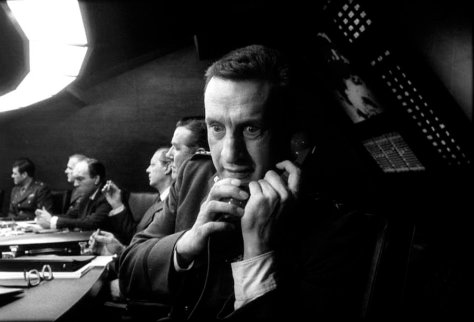
Now then, Dmitri, you know how we’ve always talked about the possibility of something going wrong with the Bomb…The *Bomb*, Dmitri… The *hydrogen* bomb!…Well now, what happened is… ahm…one of our base commanders, he had a sort of…well, he went a little funny in the head… you know…just a little…funny. And, ah…he went and did a silly thing…Well, I’ll tell you what he did. He ordered his planes…to attack your country…
–from Dr. Strangelove (1964)
That’s POTUS Merkin Muffley (Peter Sellers), making “the call” to the Russian premier from the War Room, regarding an unfortunate chain of events that may very well signal the end of civilization as we know it. It’s a nightmare scenario, precipitated by a perfect storm of political paranoia, bureaucratic bungling and ideological demagoguery that enables the actions of a lone nutcase to trigger global thermonuclear war. Sound familiar?
“Mein fuehrer! I can walk!” Although we have yet (knock on wood) to experience the global thermonuclear annihilation that ensues following the wheelchair-bound Dr. Strangelove’s joyous (if short-lived) epiphany, so many other depictions in Stanley Kubrick’s seriocomic 1964 masterpiece about the tendency for people in power to eventually rise to their own level of incompetence have since come to pass, that you wonder why Kubrick and company bothered to make it all up.
In case you skipped the quote at the top of this piece, it’s the movie about an American military base commander who goes a little funny in the head (you know…”funny”) and sort of launches a nuclear attack on the Soviet Union. Hilarity (and oblivion) ensues.
You rarely see a cast like this: Peter Sellers (playing three characters), George C. Scott, Sterling Hayden, Slim Pickens, Keenan Wynn, James Earl Jones and Peter Bull (who can be seen breaking character as the Russian ambassador and cracking up as Strangelove’s prosthetic arm seems to take on a mind of its own).
There are so many great lines, that you might as well bracket the entire screenplay (by Kubrick, Terry Southern and Peter George) with quotation marks.
Vodka. That’s what they drink, isn’t it? Never water? On no account will a Commie ever drink water, and not without good reason. Water is the source of all life. Seven-tenths of this earth’s surface is water. Why, do you realize that 70 percent of you is water? And as human beings, you need fresh, pure water to replenish our precious bodily fluids. Are you beginning to understand? –Gen. Jack D. Ripper (Sterling Hayden), from Dr. Strangelove
Dr. Strangelove or: How I Learned to Stop Worrying and Love the Bomb (its full title) did not necessarily spring from a, you know, “funny” place. Indeed, Red Alert, ex-RAF officer Peter George’s 1958 source novel, was anything but; and did not even include the character of Dr. Strangelove, the ex-Nazi scientist who emerges from the shadows of the war room just in time to contextualize all that inspired madness of the film’s third act. “He” was the invention of Kubrick and screenwriter Terry Southern.
In a 1994 Grand Street article called “Notes from the War Room”, Southern recounts Kubrick’s epiphany:
[Kubrick] told me he was going to make a film about “our failure to understand the dangers on nuclear war.” He said that he had thought of the story as a “straightforward melodrama” until this morning when he “woke up and realized that nuclear war was too outrageous, too fantastic to be treated in any conventional manner.” He said he could only see it now as “some kind of hideous joke.”
Kubrick had approached Southern as a collaborator on the basis of having read his social satire The MagicChristian (which was itself adapted for the screen in 1969). You have to keep in mind that while Kubrick’s film was in production, the October 1962 Cuban Missile Crisis was still fresh in the minds of a nervous public.
This was the height of the Cold War; few people found nuclear annihilation to be, you, know, “funny”…least of all studio suits. When Sellers backed out of the role of Major Kong (to Kubrick’s chagrin), it was first offered to Bonanza star Dan Blocker. Southern recalls (from the same article):
[Kubrick] made arrangements for a script to be delivered to Blocker that afternoon, but a cabled response from Blocker’s agent arrived in quick order: “Thanks a lot, but the material is too pinko for Dan. Or anyone else we know, for that matter. Regards, Leibman, CMA.”
As I recall, this was the first hint that this sort of political interpretation of our work in progress might exist. Stanley seemed genuinely surprised and disappointed.
But it worked out in the end. Could you imagine anyone but Slim Pickens as Maj. Kong?
Survival kit contents check. In them you’ll find: one forty-five caliber automatic; two boxes of ammunition; four days’ concentrated emergency rations; one drug issue containing antibiotics, morphine, vitamin pills, pep pills, sleeping pills, tranquilizer pills; one miniature combination Russian phrase book and Bible; one hundred dollars in rubles; one hundred dollars in gold; nine packs of chewing gum; one issue of prophylactics; three lipsticks; three pair of nylon stockings. Shoot, a fella’ could have a pretty good weekend in Vegas with all that stuff. –Major Kong prepping his B-52 crew
It was in the interest of possible “political interpretation” that a critical revision had to be made to that memorable monolog in post-production. In an eerie bit of kismet, Kubrick had scheduled the first test screening of Dr. Strangelove for November 22, 1963…the day of JFK’s assassination; in view of that zeitgeist-shattering event, the film’s originally slated December premiere was postponed until late January of 1964.
But that wasn’t the spookiest part. Originally, the last line of the bit was: “Shoot, a fella’ could have a pretty good weekend in Dallas with all that stuff.” Pickens had to be recruited to re-loop the line as we now know it. If you listen carefully during the scene, you can pick up on the edit.
However it did manage to fall together is really moot; the final product stands the test of time as a satire that will never lose relevancy (one could say that about any Kubrick film, as each ultimately points to the absurdity of all these self-important hominids, scurrying about blissfully oblivious to their insignificance within a vast, randomly cruel cosmos).
Hell, Mr. President…I could do a 2,000 word dissertation on the Freudian subtext alone; from the opening montage of aircraft engaging in (decidedly coital) airborne re-fueling maneuvers, to General Ripper firing the .50 caliber machine gun from his crotch, not to mention his cigar and his monolog about why he denies women his “essence”, to the character’s names (Dr. Strangelove, President Muffley, Buck Turgidson, Mr. Staines), and of course all of that phallic weaponry, and montage of nuclear explosions at the end.
But I won’t.
“Oh…and uh, shug? Don’t forget to say your prayers!”
Fans of the film will be glad to hear that Dr. Strangelove has been given the Criterion treatment, with the release of their Blu-ray edition. The restored 4k transfer is gorgeous; the best print I’ve seen of the film on home video (this is the third digital version I’ve owned…it’s a sickness, I know).
They’ve really piled on the extras; there’s a plethora of archival interviews, as well as featurettes produced exclusively for this edition, like audio essays by film scholars and interviews with Kubrick collaborators and archivists. So fans can immerse themselves in the Strangelovian universe…if that doesn’t seem redundant.
Oh, when November rolls around…don’t forget to say your prayers.
In Paul Verhoven’s 1987 sci-fi crime thriller, Robocop, the director and his screenwriters Edward Neumeier and Michael Miner envision a “near-future” Detroit that has become a dystopian nightmare. Vicious gangs of criminals with high-powered weapons plunder and terrorize the city with impunity. Local law enforcement has been farmed out to a corporatized paramilitary outfit (a la Blackwater). Under-manned and out-gunned, the beat cops have become increasingly ineffectual at keeping up with the crime wave. A gravely wounded cop becomes a guinea pig for the corporation’s R & D division, which has been experimenting with robotic enhancements.
The meme reappeared in Neill Blomkamp’s 2015 film Chappie. The backdrop is South Africa, but the tableau is similar. From my review:
In this outing, Blomkamp returns to his native Johannesburg (which provided the backdrop for his 2009 debut, District 9). And for the third time in a row, his story takes place in a dystopian near-future (call me Sherlock, but I’m sensing a theme). Johannesburg has become a crime-riddled hellhole, ruled by ultra-violent drug lords and roving gangs of thugs. In fact, the streets are so dangerous that the police department is reticent to put its officers on the front lines. So they do what any self-respecting police department of the dystopian near-future does…they send droids out to apprehend bad guys.
Imagine that.
Hang on, this just in…the future is now. It started Thursday, in Dallas:
Now, I’m sure we can all agree that the use of deadly force was appropriate to neutralize the Dallas shooter; as Chief Brown outlined in his CNN interview this morning, the perpetrator was barricaded in such a manner as to render direct assault too dangerous for officers, and despite 2 hours of attempted negotiation, the gunman continued to taunt and threaten the police. With five dead, seven wounded, and all practical possibilities exhausted, the standoff simply had to end.
That said, now that the smoke has cleared, this troubling precedent begs some ethical (and legal) questions. While robotic technology has been an accepted law enforcement tool for some time now, it’s chiefly purposed for reconnaissance and surveillance, so officers needn’t take unnecessary personal risks in precarious situations.
The robots have also proven an invaluable tool for bomb squad units as well; they are used to seek out and/or safely detonate otherwise unreachable explosive devices. Naturally, it was only a matter of time (and circumstance) where the light bulb would go off over someone’s head, somewhere: “It can retrieve a bomb. It can detonate a bomb. Doesn’t it stand to reason that it can deliver, then detonate a bomb?”
I’ll be Captain Obvious and mention the use of drones, which have become de rigeur for facilitating this type of “special delivery” to bad guys in exotic lands. Then again, that is one of the primary missions of our military (to take out bad guys in exotic lands). Last I checked, the primary mission of domestic law enforcement is to protect and serve.
I am aware that it’s easy for me to Monday morning quarterback Chief Brown’s decision. I wasn’t there, and he was, amid the horror and the carnage. The buck stopped with him. He didn’t have time to stand around pondering the history of social unrest in America, and/or the possible ripple effects of setting such a precedent. I’m sure that he felt that his priority, his mission, if you will, was to do everything in his power to avoid further horror and carnage. And he did. He brought the standoff to an end, and likely saved many lives.
So why does this still trouble me? The “precedent” is the delivery system only; the bomb (C4) is eerily familiar. From my 2013 review of Let the Fire Burn, a documentary about the the 1985 MOVE incident:
[MOVE leader] John Africa (an adapted surname that all followers used) was a charismatic person. He founded the group in 1972, based on an odd hodgepodge of tenets borrowed from Rastafarianism, Black Nationalism and green politics; with a Luddite view of technology (think ELF meets the Panthers…by way of the Amish). Toss in some vaguely egalitarian philosophies about communal living, and I think you’re there.
The group, which shared a town house, largely kept itself to itself (at least at first) but started to draw the attention of Philadelphia law enforcement when a number of their neighbors began expressing concern to the authorities about sanitation issues (the group built compost piles around their building using refuse and human excrement) and the distressing appearance of possible malnutrition among the children of the commune (some of the footage in the film would seem to bear out the latter claim). The city engaged in a year-long bureaucratic standoff with MOVE over their refusal to vacate, culminating in an attempted forced removal turned-gun battle with police in 1978 that left one officer dead. Nine MOVE members were convicted of 3rd-degree murder and jailed.
The remaining members of MOVE relocated their HQ, but it didn’t take long to wear out their welcome with the new neighbors (John Africa’s strange, rambling political harangues, delivered via loudspeakers mounted outside the MOVE house certainly didn’t help). Africa and his followers began to develop a siege mentality, shuttering up all the windows and constructing a makeshift pillbox style bunker on the roof. Naturally, these actions only served to ratchet up the tension and goad local law enforcement. On May 13, 1985 it all came to a head when a heavily armed contingent of cops moved in, ostensibly to arrest MOVE members on a number of indictments. Anyone who remembers the shocking news footage knows that the day did not end well. Gunfire was exchanged after tear gas and high-pressure water hoses failed to end the standoff, so authorities decided to take a little shortcut and drop a satchel of C-4 onto the roof of the building. 11 MOVE members (including 5 children) died in the resulting inferno, which consumed 61 homes.
Apples and oranges? Yes; that was then, this is now, I totally get that. But here is the heart of the matter (and the relevancy)-as I continued:
Putting aside any debate or speculation for a moment over whether or not John Africa and his disciples were deranged criminals, or whether or not the group’s actions were self-consciously provocative or politically convoluted, one simple fact remains and bears repeating: “Someone” decided that it was a perfectly acceptable action plan, in the middle of a dense residential neighborhood (located in the City of Brotherly Love, no less) to drop a bomb on a building with children inside it. Even more appalling is the callous indifference and casual racism displayed by some of the officials and police who are seen in the film testifying before the Mayor’s investigative commission (the sole ray of light, one compassionate officer who braved crossfire to help a young boy escape the burning building, was chastised by fellow officers afterward as a “nigger lover” for his trouble).
Again, what happened in Philadelphia in 1985 and what happened in Dallas last Thursday may be dissimilar in crucial ways, yet certain elements within our sociopolitical climate that contributed greatly to both incidents remain stubbornly constant. I hate to put sci-fi writers out of work, but if we don’t engage in some semblance of a civil and constructive discourse to address these core issues, all I can say is:
It’s happened again. Another mass shooting. Yawn. That’s not detachment, it’s numbness. I’ve written about horrific act after horrific act until my thumbs are blue. I don’t know how to react anymore; how do you even begin to make sense of such insanity? it’s overwhelming. It’s been occurring here in the land of the free and home of the heavily-armed with such frequency, and over so many decades, that it’s become as American as apple pie; so much so that I find myself reflexively compartmentalizing each incident by sub-genre anymore.
‘Sub-genre’? WTF am I raving about…you may be wondering? Allow me to explain. Take this latest incident in Dallas, for example. As soon as some of the particulars became known, my brain (in order to keep my head from exploding, no doubt) began to process it all thusly:
“OK. We have a shooter, who goes on a (allegedly) racially-fueled rampage; Ex-military. African-American. Five dead cops. Shocking, unthinkable, but sorry…not unique. Been there, done that, America.”
Mark Essex’s campaign of terror against the New Orleans police climaxed on Jan. 7 in an 11-hour rampage at the Howard Johnson’s hotel on Loyola Avenue, where he killed seven people, including three police officers, and wounded eight.
A week earlier, he had killed two other police officers and wounded one.
Mark James Robert Essex was born in Emporia, Kansas. Kicked out of the Navy after two years with a general discharge for unsuitability for “character and behavior disorders,” the 23-year-old took up radical Black Panther politics and developed an intense hatred for the police. He came to the city to meet up with a friend who shared his politics.
In late December 1972, Essex mailed a note to WWL-TV warning about a Dec. 31 attack on the New Orleans Police Department. The note wasn’t opened until the day before the hotel attack. And indeed, On New Year’s Eve, he gunned down a police cadet and another officer who chased him to Gert Town. He eluded police for a week until he wounded a Gert Town grocer and then headed for the Howard Johnson’s.
In front of room 1829, Essex shot to death Dr. Robert Steagall and his wife Betty Steagall. He soaked telephone books with lighter fluid and set them ablaze under the curtains of the Steagalls’ room. On the 11th floor, Essex shot his way into rooms and set more fires. He killed Frank Schneider, the hotel’s assistant manager, and shot Walter Collins, the hotel’s general manager.
As dusk approached, Essex was trapped in a block house on the hotel roof. The U.S. Marines volunteered a helicopter to get to him. During passes over the roof, officers poured gunfire at the block house while Essex popped out sporadically to fire back.
For hours after they killed him, police searched vainly for a second sniper who they erroneously believed was on the loose. In the days before SWAT squads, the police response was chaotic.
While we obviously do not have a complete pathology of the Dallas shooter yet, there are a lot of spooky parallels . But I’m not going to dwell on matching the psychological profiles; I’ve been there, done that in enough posts over the past several years, and it leads nowhere.
No, crazy is as crazy does; whether you’re white (the Charleston shooter), Muslim (the Orlando shooter), or African-American (the Dallas shooter). My point is, if America has reached a juncture where we can circle back and cite historical precedent for nearly every such unthinkable, heinous variation of mass violence…it’s been going on for far.too.fucking.long. But hey, now’s not the time to talk about gun control legislation, amirite? Oh look, America’s Got Talent is on!








 “Oh…and uh, shug? Don’t forget to say your prayers!”


