Category Archives: Documentary

The Docu-horror Picture Show: Top 13 documentaries for Halloween

By Dennis Hartley

(Originally posted on Digby’s Hullabaloo on October 22, 2022)

https://i0.wp.com/digbysblog.net/wp-content/uploads/2022/10/image-87.png?resize=1005%2C1024&ssl=1

Hey…you wanna see something really scary? Real life. Because, let’s face it. Try as they might, Hollywood can never match the thrills, the chills…the abject horror of, say, watching the news, peeking in on your 401k, popping into a Denny’s at 3am, or waiting for the upcoming election results. Documentary filmmakers have been on to this little secret for years.

So forget the exploding squibs, the fake Karo syrup blood and severed prosthetic limbs-here’s my Top 13 list of creepy, scary, frightening, haunting, spine-tingling tales that you literally could not make up (as per usual, in no particular ranking order). Er….”enjoy”?

https://i0.wp.com/digbysblog.net/wp-content/uploads/2022/10/image-89.png?w=1000&ssl=1

The Act of Killing – “At first, we beat them to death… [but] there was too much blood…to avoid the blood, I [devised] this system,” explains former Indonesian government death squad leader Anwar Congo, the “star” of Joshua Oppenheimer’s audacious documentary, and then helpfully gives us an instructive (and macabre) demonstration of his patented garroting method (with the assistance of a stick, some metal wire, and a giggly “victim”).

Then, the eupeptic Congo breaks into an impromptu cha-cha dance.

This is but one of many surreal moments in Oppenheimer’s film (exec produced by Errol Morris and Werner Herzog). Congo is a self-described “gangster” who claims to have personally snuffed out 1,000 lives during the state-sanctioned liquidation of an estimated 1,000,000 “communists” that followed in the wake of the 1965 overthrow of the Indonesian government.

Congo and Koto were not only amenable to happily skip down memory lane revisiting the scenes of their crimes, but offered to reenact their exploits by portraying themselves in a Hollywood-style gangster epic. This counter-intuitive mash-up of hard-hitting investigative journalism and ebullient “Hey, I have a barn, let’s put on a show!” participation from the very parties the filmmaker aims to expose could make some viewers’ heads explode.

I know what you’re thinking: These men are morally reprehensible, untouchable and beyond redemption, so why indulge them this sick fantasy? (Picture the warm and fuzzy feeling you’d get if the next Powerball winner turned out to be one of those 97 year-old former Nazi camp guards). What’s Oppenheimer’s point? Is he crazy? He’s crazy all right. Like a fox. Because something extraordinary happens to one of our “heroes” when he insists on playing one of his own victims in an execution reenactment. Watch it and be amazed. (Full review)

https://i0.wp.com/digbysblog.net/wp-content/uploads/2022/10/image-88.png?resize=1024%2C576&ssl=1

The Atomic Cafe – Whoopee, we’re all gonna die! But along the way, we might as well have a few laughs. That seems to be the impetus behind this 1982 collection of cleverly reassembled footage culled from U.S. government propaganda shorts from the Cold War era (Mk 1), originally designed to educate the public about how to “survive” a nuclear attack (all you need to do is get under a desk…everyone knows that!).

In addition to the Civil Defense campaigns (which include the classic “duck and cover” tutorials) the filmmakers have also drawn from a rich vein of military training films, which reduce the possible effects of a nuclear strike to something akin to a barrage from, oh I don’t know- a really big field howitzer. Harrowing, yet perversely entertaining. Written and directed by Jayne Loader, Pierce Rafferty and Kevin Rafferty (Kevin went on to co-direct the similarly constructed 1999 doc, The Last Cigarette, a take down of the tobacco industry).

https://i0.wp.com/digbysblog.net/wp-content/uploads/2022/10/image-90.png?resize=1024%2C576&ssl=1

Brother’s Keeper– An absolutely riveting true-crime documentary about a dirt-poor, semi-literate rural upstate New York farmer named Delbert Ward, who was charged with murdering his brother in 1990. Filmmakers Joe Berlinger and Bruce Sinofsky follow a year or so in the life of Delbert and his two surviving brothers, as they weather pressures of the trial and the surrounding media circus .

The clock seems to have stopped around 1899 on the aging bachelor brothers’ run-down farm, where they live together in relative seclusion in a small, unheated shack (at times, one is reminded of the family in the classic X-Files episode, “Home”)

The prosecution claims the brothers conspired to kill their ailing sibling, coming up with some odd motives. The defense attorney’s conjecture is that the victim died of natural causes, and that Delbert was coerced by law enforcement into signing a written confession (admitting a “mercy killing”), taking advantage of the fact that he is poor and uneducated. He also cagily riles up the town folk to rally behind “the boys” by portraying the D.A. and investigating authorities as city slickers, out to railroad a simple farmer.

Is Delbert really “simple”? Watch and decide for yourself.

https://i0.wp.com/digbysblog.net/wp-content/uploads/2022/10/image-91.png?resize=768%2C432&ssl=1

The Corporation – While it’s not news to any thinking person that corporate greed and manipulation affects every life on this planet, co-directors Mark Achbar and Jennifer Abbott deliver the message in a unique and engrossing fashion. By applying a psychological profile to the rudiments of corporate think, Achbar and Abbott build a solid case; proving that if the “corporation” were corporeal, then “he” would be Norman Bates.

Mixing archival footage with observations from some of the expected talking heads (Michael Moore, Noam Chomsky, etc.) the unexpected (CEOs actually sympathetic with the filmmakers’ point of view) along with the colorful (like a “corporate spy”), the film offers perspective not only from the watchdogs, but from the belly of the beast itself. Be warned: there are enough exposes trotted out here to keep conspiracy theorists, environmentalists and human rights activists tossing and turning in bed for nights on end.

https://i0.wp.com/digbysblog.net/wp-content/uploads/2022/10/image-92.png?w=1000&ssl=1

The Cruise– A number of years ago I became friends with a co-worker who would pace his living room, quaffing beers and expounding on the universe. Sometimes, he would stop dead in his tracks, give me a faraway look, and say, “Trust me, Dennis-you don’t want to be in here,” while stabbing a finger at his forehead. Then, he would resume his pacing and pontificating. The idea of being in someone else’s head is always a bit “horror show”, don’t you think?

If you can take it, Bennett Miller’s one-of-a-kind 1998 documentary portrait spends nearly 80 minutes in “here”. Specifically, inside the head of one Tim “Speed” Levitch, a tour guide for Manhattan’s double-decked Gray Line buses. Levitch’s world view is …interesting, to say the least. And he is nothing, if not verbose. Is he crazy? Is he some kind of post-modern prophet? Or is he yet another eccentric, fast-talking New Yorker? It’s a strange, unique and weirdly exhilarating roller coaster ride through the consciousness of being.

https://i0.wp.com/digbysblog.net/wp-content/uploads/2022/10/image-93.png?resize=1024%2C576&ssl=1

The Devil and Daniel Johnston-The true horror of schizophrenia can only be known by those afflicted, but this 2005 rockumentary about cult alt-folk singer-songwriter Daniel Johnston is the next worse thing to being there. Johnston has waged an internal battle between creative inspiration and mental illness most of his life (see: Brian Wilson, Syd Barrett, Roky Erickson and Joe Meek).

As recounted in Jeff Feuerzig’s film, Johnston, like Chance the Gardener in Being There, repeatedly stumbles into the right place at the right time, steadily amassing a sizeable grass roots following. Everything is in place for his Big Break, until an ill-advised tryst with hallucinogenic substances sends him (literally) spiraling into complete madness. While on a private plane flight with his pilot father, Johnston has a sudden epiphany that he is Casper the Friendly Ghost, and decides to wrest the controls, causing the plane to crash. Both men walk away relatively unscathed, but Daniel is soon afterwards committed to a mental hospital.

The story becomes even more surreal, as Johnston is finally “discovered” by the major labels, who engage in a bidding war while their potential client is still residing in the laughing house (only in America). By turns darkly humorous, sad, and inspiring.

https://i0.wp.com/digbysblog.net/wp-content/uploads/2022/10/image-95.png?resize=1024%2C573&ssl=1

Gimme Shelter – It’s unfortunate that Albert and David Maysles’ 1970 film is chiefly known for its inclusion of (unwittingly captured) footage of the infamous incident at a 1969 Rolling Stones’ free concert at the Altamont Speedway in California where a man near the front of the stage was stabbed to death in full view of horrified fellow concertgoers by members of the Hell’s Angels (who were providing “security” for the show)-but there you have it (and hence its inclusion here). Those scant seconds of the doc’s running time have forever tainted what is otherwise (rightfully) hailed as one of the top rockumentaries. One of the (less morbid) highlights of the film is footage of the Stones putting down the basic tracks for “Wild Horses” and “Brown Sugar” at Alabama’s legendary Muscle Shoals Studios.

https://i0.wp.com/digbysblog.net/wp-content/uploads/2022/10/image-94.png?resize=1024%2C691&ssl=1

Grey Gardens– “The Aristocrats!” There’s no murder or mayhem involved in this real-life Gothic character study by renowned documentary filmmakers Albert and David Maysles (Salesman, Gimme Shelter), but you’ll still find it to be quite creepy.

Edith Bouvier Beale (in her early 80s at the time of filming) and her middle aged daughter Edie were living under decidedly less than hygienic conditions in a spooky old dark manor in East Hampton, L.I. with a menagerie of cats and raccoons when the brothers profiled them (their “high society” days were, needless to say, behind them).

The fact that the women were related to Jackie O (Edith the elder was her aunt) makes this Fellini-esque nightmare even more twisted. You are not likely to encounter a mother-daughter combo quite like “Big Edie” and “Little Edie” more than once in a lifetime. The cult appeal of the Edies was not lost on Broadway; a musical adaptation ran for 2 years.

https://i0.wp.com/digbysblog.net/wp-content/uploads/2022/10/image-96.png?w=690&ssl=1

In the Realms of the Unreal-Artist Henry Darger is not usually mentioned in the same breath as Picasso, but he is a fascinating study. Darger was a recluse who worked as a janitor for his entire adult life. He had no significant relationships of record and died in obscurity in 1973. While sorting out the contents of the small Chicago apartment he had lived in for years, his landlady discovered a treasury of artwork and writings, including over 300 paintings.

The centerpiece was an epic, 15,000-page illustrated novel, which Darger had meticulously composed in long hand over a period of decades (literally his life’s work). The subject at hand: A mythic universe largely populated by young, naked hermaphrodites (the”Vivian Girls”).

Although it’s tempting to dismiss Darger as a filthy old perv, until you have actually seen the astounding breadth of Darger’s imaginary world, spilled out over so many pages and so much canvas, it’s hard to convey how weirdly mesmerizing it all is (especially if you view an exhibit, which I had a chance to do at Seattle’s Frye Art Museum back in 2007). The doc mixes Darger’s bio with animation of his work, with actors reading excerpts from the tome.

https://i0.wp.com/digbysblog.net/wp-content/uploads/2022/10/image-97.png?resize=1024%2C681&ssl=1

An Inconvenient Truth– It’s the end of the world as we know it. Apocalyptic sci-fi has become scientific fact-now that’s scary. In Davis Guggenheim’s 2006 doc, former VP Al Gore is a Power Point-packing Rod Serling, submitting a gallery of nightmare nature scenarios for our disapproval. I’m tempted to say that this chilling look at the results of unchecked global warming is only showing us the tip of the proverbial iceberg…but it’s melting too fast.
https://i0.wp.com/digbysblog.net/wp-content/uploads/2022/10/image-98.png?resize=1024%2C576&ssl=1

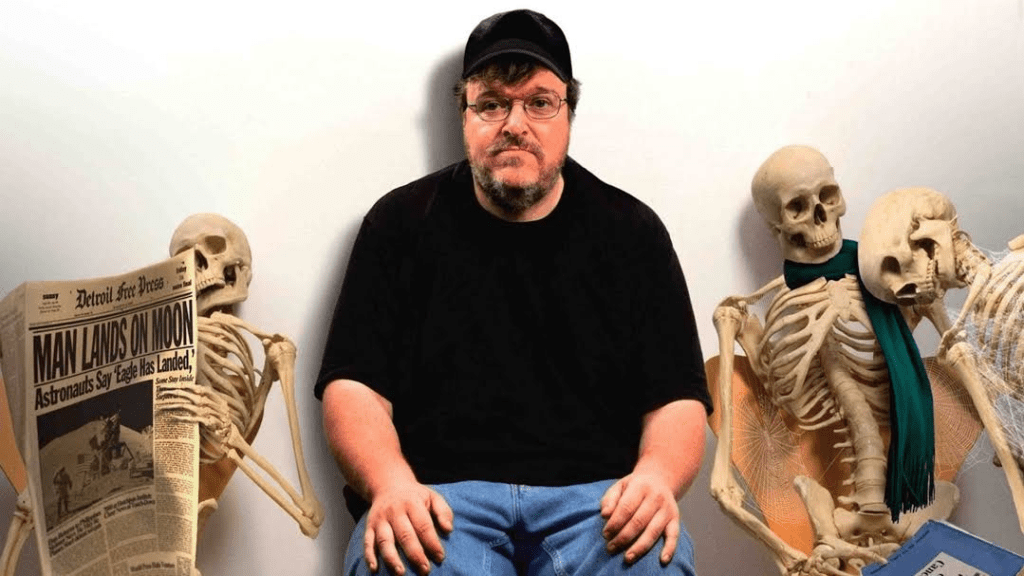
Sicko– Torture porn for the uninsured! Our favorite agitprop filmmaker, Michael Moore, grabs your attention right out of the gate with a real Buñuel moment. Over the opening credits, we are treated to shaky home video depicting a man pulling up a flap of skin whilst patiently stitching up a gash on his knee with a needle and thread, as Moore deadpans in V.O. (with his cheerful Midwestern countenance) that the gentleman is an avid cyclist- and one of the millions of Americans who cannot afford health insurance.

The film proceeds to delve into some of the other complexities contributing to the overall ill health of our current system; such as the monopolistic power and greed of the pharmaceutical companies, the lobbyist graft, and (perhaps most horrifying of all) the compassion-challenged bureaucracy of a privatized health “coverage” system that focuses first and foremost on profit, rather than on actual individual need. Better eat your Wheaties. (Full review)

https://i0.wp.com/digbysblog.net/wp-content/uploads/2022/10/image-99.png?w=720&ssl=1

Standard Operating Procedure – There was a fascinating documentary on the National Geographic Channel called Nazi Scrapbooks from Hell. It was the most harrowing depiction of the Holocaust I’ve seen, but it offered nary a glimpse of the atrocities themselves. Rather, it focused on photos from a scrapbook that belonged to an SS officer assigned to Auschwitz.

Essentially an organized, affably annotated gallery of the “after hours” lifestyle of a “workaday” concentration camp staff, it shows cheerful participants enjoying a little outdoor nosh, catching some sun, and even the odd sing-along, all in the shadow of the notorious death factory where they “worked”.

If it weren’t for the Nazi uniforms, you might think it was just folks from the office, hamming it up for the camera. As the filmmakers point out, it is the everyday banality of this evil that makes it so chilling. The most amazing fact is that these pictures were taken in the first place.

What were they thinking?

This is the same rhetorical question posed by an interviewee in Standard Operating Procedure, Errol Morris’ 2008 documentary about the Abu Ghraib prisoner abuse scandal. The questioner is a military C.I.D. investigator who had the unenviable task of sifting through the hundreds of damning photos taken by several of the perpetrators. The “answer” is complicated…and what ensues not easy to watch. Nonetheless, Morris’ film is a compelling treatise on the fine line between “the fog of war” and state-sanctioned cruelty. (Full review).

https://i0.wp.com/digbysblog.net/wp-content/uploads/2022/10/image-100.png?w=770&ssl=1

Zoo-It was disturbing enough when the Seattle press broke the story in 2005 about a Boeing engineer dying from a perforated colon as the result of his “love” of horses. But when it was subsequently revealed that the deceased was a member of a sizable group of like-minded individuals, calling themselves “zoophiles”, who traveled from all over the country to converge on a farm where their “special needs” were catered to, I remember thinking that here was a scenario beyond the ken of a Cronenberg or a Lynch; this was true horror.

That said, there is still a “bad car wreck” fascination about the tale, which makes this an eerie and compelling Errol Morris-style documentary about the darkest side of (in) human desire. To their credit, writer-director Robinson Devor and his co-writer Charles Mudede maintain a sensitive, neutral tone throughout; the film is not as exploitative as one might assume.

You Will Go to the Moon: A NASA film festival

By Dennis Hartley

(Originally posted on Digby’s Hullabaloo on July 23, 2022)

https://i0.wp.com/digbysblog.net/wp-content/uploads/2022/07/image-43.png?w=1200&ssl=1

53 years ago this week, Apollo 11 astronauts Neil Armstrong and Buzz Aldrin became the first humans to set foot on the moon. I know-you’ve heard this story a million times; don’t worry, I’ll keep this short.

For those of us of “a certain age”, that is to say, old enough to have actually witnessed the moon landing live on TV… the fact that “we” were even able to achieve this feat “by the end of the decade” (as President Kennedy projected in 1961) still feels like a pretty big deal to me.

Of course, there are still  big unanswered questions out there about Life, the Universe, and Everything, but I’ll leave that to future generations. I feel that I’ve done my part…spending my formative years plunked in front of a B&W TV in my PJs eating Sugar Smacks and watching Walter Cronkite reporting live from the Cape.

It is in this spirit that I have curated a NASA film festival for you. Blast off!

https://i0.wp.com/digbysblog.net/wp-content/uploads/2022/07/image-44.png?w=800&ssl=1

Apollo 11– This 2019 documentary was a labor of love for director Todd Douglas Miller, who also produced and edited. Miller had access to a trove of previously unreleased 70mm footage from Apollo 11’s launch and recovery, which he and his production team was able to seamlessly integrate with archival 35mm and 16mm footage, as well as photos and CCTV. All audio and visual elements were digitally restored, and Miller put it together in such a way that it flows like a narrative film (i.e., no new voice-over narration or present-day talking heads intrude). The result is mesmerizing.

https://i0.wp.com/digbysblog.net/wp-content/uploads/2022/07/image-47.png?resize=1536%2C864&ssl=1

Apollo 13– While overly formal at times, Ron Howard’s 1995 dramatization of the ill-fated mission that injected “Houston, we have a problem” into the zeitgeist is still an absorbing history lesson. You get a sense of the claustrophobic tension the astronauts must have felt while brainstorming out of their harrowing predicament. Tom Hanks, Kevin Bacon and Bill Paxton have great natural chemistry as crew mates Lovell, Swigert and Haise, and Ed Harris was born to portray Ground Control’s flight director, Gene Kranz.

https://i0.wp.com/digbysblog.net/wp-content/uploads/2022/07/image-48.png?w=630&ssl=1

The Dish– This wonderful 2000 sleeper from Australia is based on the true story behind one of the critical components that facilitated the live TV images of Neil Armstrong setting foot on the moon: a tracking station located on a sheep farm in New South Wales. Quirky characters abound in Rob Sitch’s culture-clash comedy (reminiscent of Bill Forsythe’s Local Hero). It’s not all played for laughs; the re-enactment of the moon-landing telecast is genuinely moving. Sam Neill heads a fine cast. Director Sitch and co-writers Santo Cilauro, Tom Gleisner, and Jane Kennedy also collaborated on another film I recommend checking out: The Castle (1997).

https://i0.wp.com/digbysblog.net/wp-content/uploads/2022/07/image-49.png?resize=1536%2C872&ssl=1

The Farthest–  Remember when NASA spaceflights were an exciting, all-day news event? We seem to have lost that collective feeling of wonder and curiosity about mankind’s plunge into the cosmos (people are too busy looking down at their phones to stargaze anymore). Emer Reynolds’ beautifully made 2017 documentary about the twin Voyager space probes rekindles that excitement for any of us who dare to look up. And if the footage of Carl Sagan’s eloquent musings regarding the “pale blue dot” that we call home fails to bring you to tears, then surely you have no soul.

https://i0.wp.com/digbysblog.net/wp-content/uploads/2022/07/image-50.png?w=770&ssl=1

For All Mankind– Former astronaut Al Reinert’s 1989 documentary was culled from thousands of feet of mission footage shot by the Apollo astronauts over a period of years. Don’t expect standard exposition; this is simply a montage of (literally) out-of-this-world imagery with anecdotal and philosophical musings provided by the astronauts. Brian Eno composed the soundtrack. A mesmerizing visual tone poem in the vein of Koyaanisqatsi.

https://i0.wp.com/digbysblog.net/wp-content/uploads/2022/07/image-51.png?resize=1536%2C1001&ssl=1

In the Shadow of the Moon– The premise of this 2007 documentary (similar to For All Mankind) is simple enough; surviving members of the Apollo moon flights tell their stories, accompanied by astounding mission footage (some previously unseen). But somehow, director David Sington has managed to take this very familiar piece of 20th century history and infuse it with an exhilarating sense of rediscovery.

https://i0.wp.com/digbysblog.net/wp-content/uploads/2022/07/image-52.png?w=728&ssl=1

The Right Stuff– Director and writer Philip Kaufman’s 1983 film (based on Tom Wolfe’s book) is a stirring drama about NASA’s Mercury program. Considering the film was modestly budgeted (by today’s standards), it has quite an expansive scope. The rich characterizations also make it an intimate story, beautifully acted by a dream cast including Ed Harris, Sam Shepard, Dennis Quaid, Scott Glenn, Barbara Hershey, Fred Ward, Pamela Reed, Lance Henriksen, Scott Wilson, Veronica Cartwright, Jeff Goldblum, Harry Shearer and the late Levon Helm.

BONUS TRACK!
Singing us out… Moxy Fruvous.


Inconceivable differences: Battleground (***)

By Dennis Hartley

(Originally posted on Digby’s Hullabaloo on July 9, 2022)

https://i0.wp.com/digbysblog.net/wp-content/uploads/2022/07/image-31.png?resize=1024%2C577&ssl=1

41% of Americans believe Jesus will come back by 2050.

Rolling Stone journalist, from the 2022 documentary Battleground

If Jesus came back and saw what was being done in his name, he’d never stop throwing up.

-from Hannah and Her Sisters, screenplay by Woody Allen

When I switched on the news and saw a coterie of fresh-faced female activists literally cheering the Supreme Court’s reactionary ruling overturning Roe v. Wade, I reflexively yelled at my TV (imitating Richard Dreyfuss in Close Encounters of the Third Kind) …

“Who ARE you people?!”

Well…

The rollback of abortion rights has been received by many American women with a sense of shock and fear, and warnings about an ominous decline in women’s status as full citizens.

But for some women, the decision meant something different: a triumph of human rights, not an impediment to women’s rights.

“I just reject the idea that as a woman I need abortion to be successful or to be as thriving as a man in my career,” said Phoebe Purvey, a 26-year-old Texan. “I don’t think I need to sacrifice a life in order to do that.”

The Supreme Court decision overturning Roe v. Wade was a political victory, accomplished by lobbyists, strategists and campaign professionals over the course of decades. But it was also a cultural battle, fought by activists across the country including those in the exact demographic that abortion-rights advocates warn have the most to lose in the new American landscape: young women.

Often pointed to by anti-abortion leaders as the face of the movement, a new generation of activists say they are poised to continue the fight in a post-Roe nation. Many, but not all of them, are Christian conservatives, the demographic that has long formed the core of the anti-abortion movement. Others are secular and view their efforts against abortion as part of a progressive quest for human rights. All have grown up with once unthinkable access to images from inside the womb, which has helped convince them that a fetus is a full human being long before it is viable.

Many believe the procedure should be banned at conception — that even the earliest abortion is effectively murder. But they embrace the mainstream anti-abortion view that women are victims of the abortion “industry” and should not be prosecuted, putting them at odds with the rising “abolitionist” wing of the movement calling for women to be held legally responsible for their abortions. And overwhelmingly, these young women reject the notion that access to abortion is necessary to their own — or any woman’s — success.

That’s nice. So…who ARE you people?

In my 2013 review of the documentary Let The Fire Burn, which recounted what led up to a 1985-gun battle between Philadelphia police and members of the MOVE organization (resulting in the death of 11 of its members, including 5 children), I wrote:

Depending upon whom you might ask, MOVE was an “organization”, a “religious cult”, a “radical group”, or all the above. The biggest question in my mind (and one the film doesn’t necessarily delve into) is whether it was another example of psychotic entelechy. So, what is “psychotic entelechy”, exactly? Well, according to Stan A. Lindsay, the author of Psychotic Entelechy: The Dangers of Spiritual Gifts Theology, “it” would be:

…the tendency of some individuals to be so desirous of fulfilling or bringing to perfection the implications of their terminologies that they engage in very hazardous or damaging actions.

In the context of Lindsay’s book, he is expanding on ideas laid down by literary theorist Kenneth Burke and applying them to possibly explain the self-destructive traits shared by the charismatic leaders of modern-day cults like The People’s Temple, Order of the Solar Tradition, Heaven’s Gate, and The Branch Davidians. He ponders whether all the tragic deaths that resulted should be labeled as “suicides, murders, or accidents”.

Now, I’m not drawing a direct comparison between the “new generation of [anti-abortion] activists” mentioned in the New York Times piece to members of The People’s Temple or the Branch Davidians; although the anti-abortion movement does share certain theological roots, and its history is not violence-free (clinics bombed, doctors murdered).

One thing apparent in Battleground, Cynthia Lowen’s timely portrait of three pro-life activists (Kristan Hawkins, president of Students for Life of America, Marjorie Dannenfelser, president of Susan B. Anthony List, and self-described “atheist/liberal/pro-lifer” Terrisa Bukovinac, executive director of the Progressive Anti-Abortion Uprising) is her subjects’ evangelical fervor for their political cause. Put another way, these chirpily hell-bent Christian soldiers all appear to have supped deeply of the sacramental Flavor-Ade.

Lowen opens her documentary with chilling audio-only excerpts (that I’ve never heard before) from a closed-door meeting held 40 days before the 2016 elections between then-candidate Donald J. Trump, members of his inner circle and leaders of the religious right:

Male 1: We’ve all been paid handsomely by the Trump organization.

Male 2: I don’t know about you, but let me just tell you, I do what Mr. Trump says, right? [laughter]

Trump [entering the room]: Hello, everybody. [half-jokingly] This is real power! […]

Steve Bannon [addressing the religious leaders]: The key that picks the lock to this election…is you. Conservative Catholics and Evangelicals who have not voted, who have not been motivated to vote, have to come to the polls. If we don’t win on November 8th, it’s because Evangelical and Catholic leaders have not delivered. Your fate is in your own hands. […]

Pastor Robert Jeffress: There is only one candidate running in this election who is pro-life, pro religious liberty, pro-conservative Justices to the Supreme Court, and there is only one candidate who treats the views of conservative Christians with respect…and that candidate is Donald Trump. […]

Trump: And this president could choose, I mean it could be five. It’s probably going to be three. It could very well be four, but it could even be five Justices. So you get a Hillary Clinton in there, and it’s over. […]

There’s more, but if you were awake and cognizant during the 4 (endless) years of the Trump administration, you’ve already had a major spoiler as to whether that promise was kept.

The anti-abortion forces had another (arguably even more powerful) political ally—Senator Mitch McConnell, who is shown in the film addressing a Susan B. Anthony List meeting:

As Senate Majority Leader, one thing that I get to do that the other 99 [senators] don’t get to do is to decide what we’re going to do. [pauses for laughter] And obviously, that was on full display when I decided not to fill the Scalia vacancy. [cheers and applause].

Oh, that Mitch…he’s a caution, isn’t he?

McConnell may have been winking at the choir with his braggadocio, but the power that one man holds in context of America’s increasingly polarizing culture wars is frightening. As Lowen points out in her Director’s Statement, “Abortion is the low-hanging fruit that compels anti-choice voting blocks to the polls, and what’s at stake is a much broader agenda: the end of separation between church and state. Outlawing abortion is just the beginning.”

Battleground is a thought-provoking, well-made study, but it’s a bit of a dilemma as to whether I can “recommend” it…it’s almost too close to this week’s headlines for its own good (“Tell me something I don’t know.”) Political junkies likely will not find its lede revelatory; namely, that there has been a well-organized, highly motivated political machine laser-focused on overturning Roe v. Wade for decades.

That said, now that it appears anti-abortion activists are one step closer to their coveted “post-Roe nation”, it’s critical “someone” (in this case, a filmmaker) bears witness and documents that moment Reality caught up with the cautionary adage “When Fascism comes to America, it will be wrapped in the flag and carrying a cross.”

Tribeca 2022: Angelheaded Hipster: The Songs of Marc Bolan and T. Rex ***

By Dennis Hartley

(Originally posted on Digby’s Hullabaloo on June 18, 2022)

https://i0.wp.com/digbysblog.net/wp-content/uploads/2022/06/image-30.png?resize=1024%2C576&ssl=1

Flying saucer, take me away. In 1971, the year before Bowie brought Ziggy Stardust to Earth, T. Rex landed the glam rock mother ship with their breakthrough album Electric Warrior. Originally formed as the duo Tyrannosaurus Rex in 1967, songwriter-vocalist-guitarist Marc Bolan and percussionist/obvious Tolkien fan Steve Peregrin Took (aka Steve Porter) put out several albums of psychedelia-tinged folk before splitting in 1970. Mickey Finn replaced Took, and Bolan recruited additional personnel and shortened the name to T. Rex in 1970.

Bolan’s coupling of power chord boogie with pan-sexual stage attire turned heads, making him the poster boy for what came to be labeled “glam-rock” (although, to my ears Bolan’s songs are rooted in traditional Chuck Berry riffs and straight-ahead blues-rock…albeit with enigmatic and absurdist lyrics). Tragically, Bolan died in a car accident in 1977 at 29. An amazingly prolific songwriter, he left behind a substantial catalogue and a legion of fans.

Ethan Silverman’s film traces Bolan’s career, weaving in footage from the sessions for the 2020 multi-artist tribute album Angelheaded Hipster: The Songs of Marc Bolan and T. Rex (Silverman was also involved in the production of the album). In addition to archival Bolan interviews and T. Rex performances (much of the latter taken from Ringo Starr’s 1973 Born to Boogie doc), tribute album participants like U2, Nick Cave Joan Jett, and Rolan Bolan weigh in. There are also comments (some archival) from Gloria Jones, Elton John, David Bowie, Billy Idol, Tony Visconti, Ringo and Cameron Crowe.  While it may not be a definitive portrait, it’s a heartfelt nod to a rock icon whose lasting influence cannot be overstated.

Tribeca 2022: Billion Dollar Babies: The True Story of the Cabbage Patch Kids ***

By Dennis Hartley

(Originally posted on Digby’s Hullabaloo on June 18, 2022)

https://i0.wp.com/digbysblog.net/wp-content/uploads/2022/06/image-31.png?w=1020&ssl=1

Andrew Jenks’ documentary connects the dots between two uniquely American traditions: Appalachian folk art, and shoppers trampling each other at Black Friday sales (“USA! USA! USA!”). But seriously…Cabbage Patch Kids. I’m old enough to remember the phenomena, but when they hit store shelves in the early 80s, I was in my mid-20s and too old to care.

Irregardless, I found some parts of the origin story weirdly fascinating, particularly the brick-and-mortar “hospital” where purchasers could view their doll’s “delivery” (from a head of cabbage) and then sign official “adoption papers” (more akin to Motel Hell than a Disney movie). And then there were the plagiarism lawsuits. Not essential viewing, but if you’re in the mood for a fun wallow in 80s nostalgia, you’ll dig it (hey…it’s even narrated by Neil Patrick Harris).

Tribeca 2022: Hallelujah: Leonard Cohen, A Journey, A Song ****

By Dennis Hartley

(Originally posted on Digby’s Hullabaloo on June 18, 2022)

https://i0.wp.com/digbysblog.net/wp-content/uploads/2022/06/image-32.png?resize=1024%2C702&ssl=1

Several years ago, I saw Tom Jones at the Santa Barbara Bowl. Naturally, he did his cavalcade of singalong hits, but an unexpected moment occurred mid-set, when he launched into Leonard Cohen’s “Tower of Song”. Jones’ performance felt so intimate, confessional and emotionally resonant that you’d think Cohen had tailored it just for him. When Jones sang, I was born like this, I had no choice/I was born with the gift of a golden voice, I “got” it. Why shouldn’t Tom Jones cover a Cohen song? I later learned “Tower of Song” has also been covered by the likes of U2, Nick Cave, and The Jesus and Mary Chain.

A truly great song tends to transcend its composer, taking on a life of its own. The reasons why can be as enigmatic as the act of creation itself. In an archival clip in Dan Geller and Dayna Goldfine’s beautifully constructed documentary, the late Cohen muses, “If I knew where songs came from, I’d go there more often.” Using the backstory of his beloved composition “Hallelujah” as a catalyst, the filmmakers take us “there”, rendering a moving, spiritual portrait of a poet, a singer-songwriter, and a seeker.

Tribeca 2022: Lakota Nation vs. The United States ***½

By Dennis Hartley

(Originally posted on Digby’s Hullabaloo on June 18, 2022)

https://i0.wp.com/digbysblog.net/wp-content/uploads/2022/06/image-34.png?resize=1024%2C577&ssl=1

The history of the Black Hills is a microcosm of America’s “founding” …discovery, expansion, exploitation, and genocide (and not always in that order). I put “founding” in quotes because, of course, “someone” was already here when Columbus (and eventually, the Pilgrims) landed. In the case of the Black Hills (1.2 million acres encompassing adjoining sections of South Dakota and Wyoming), those residents were the Očéti Šakówiŋ (aka the Sioux Nation).

Writer-narrator Layli Long Soldier makes it clear in the introduction to the film (which is directed by Jesse Short Bull and Laura Tomaselli) that it is not going to be a chronological history, with reenactments of key events. In other words, don’t expect a Ken Burns joint here…but that’s a good thing, because essentially the documentary is a tone poem that embodies the spirit of the Oyate people and beautifully conveys their deep connections to the Black Hills (after all, Long Soldier is a poet).

There is plenty of history in the film; sadly, most of it bleak, revealing an endless string of broken treaties and general lack of respect for sacred land (from the Indian Wars of the 1800s to President Trump’s boorish Fourth of July rally at Mt. Rushmore in 2020). But Long Soldier holds out hope for the future as well, with profiles of longtime Native American activists and a new generation of community leaders and organizers. Powerful.

Tribeca 2022: The Wild One ***

By Dennis Hartley

(Originally posted on Digby’s Hullabaloo on June 18, 2022)

https://i0.wp.com/digbysblog.net/wp-content/uploads/2022/06/image-37.png?resize=1024%2C576&ssl=1

Tessa Louise-Salomé directs this biography of theater and film director Jack Garfein. A Czechoslovakian-born Holocaust survivor, Garfein (who passed away in 2019) only directed two feature films, The Strange One (1957) and Walk on the Wild Side (1961); but each was notable for tackling then-taboo issues (homosexuality in the former and rape in the latter). Garfein tells his own story, with a wealth of archival clips and photographs woven throughout.

Most affecting are his recollections of the concentration camps, and how this harrowing experience informed his work as an artist. He also recalls his longtime marriage to actress Carroll Baker (which I was previously unaware of) and his involvement with The Actor’s Studio in New York (he later moved to Hollywood and co-founded Actors Studio West). An engrossing and intimate portrait.

Tribeca 2022: The Lost Weekend: A Love Story ***1/2

By Dennis Hartley

(Originally posted on Digby’s Hullabaloo on June 11, 2022)

https://i0.wp.com/digbysblog.net/wp-content/uploads/2022/06/image-20.png?resize=1024%2C683&ssl=1

As a lifetime Beatle fan, I like to think that everything I don’t know about the Fabs wouldn’t fill a flea’s codpiece…but I’ll confess that I learned a new thing or two about John Lennon’s infamous mid-life crisis in this engrossing documentary, directed by Eve Brandstein, Richard Kaufman, and Stuart Samuels.

This “lost weekend” (coined as such by Lennon himself) lasted approximately a year and a half, from 1973 into 1974, and was precipitated by a rocky period in his storied marriage with Yoko Ono. According to the mythology, Yoko gave John “permission” to sow his wild oats for a spell.

She had a caveat…the couple’s devoted personal assistant May Pang was to accompany John as his “girlfriend”. No matter how you look at it, this was an unconventional separation. It’s no secret that Lennon and Pang became a very public item. History has not always been kind to Ms. Pang, who was arguably caught in the middle of a marital power struggle between her employers.

With this film, Pang finally gets a chance to tell her story…and it’s a real eye-opener. Her entrée into the rarefied air of the Beatles’ inner circle by the tender age of 19 plays like a fairy tale, especially considering her modest beginnings growing up in Spanish Harlem. Her parents were Chinese immigrants; a rocky relationship with her dismissive father drove her to seek solace in rock and roll music (and of course, to discover the Beatles).

The expected anecdotes associated with “the lost weekend” are here-Lennon’s purloined bacchanal with “The Hollywood Vampires”, the wild studio sessions with Phil Spector, et.al. (and a few you may not have previously heard). But the real heart of the film is the story of how Pang’s relationship with Lennon developed (more organically than has been generally assumed). Julian Lennon is also on hand to offer his perspective. A lovely and affecting memoir by Pang, and a treat for Beatle fans.

Tribeca 2022: Dreaming Walls: Inside the Chelsea Hotel ***

By Dennis Hartley

(Originally posted on Digby’s Hullabaloo on June 11, 2022)

https://i0.wp.com/digbysblog.net/wp-content/uploads/2022/06/image-19.png?resize=1024%2C576&ssl=1

Since 1883, the Hotel Chelsea in New York City has been the center of the universe for bohemian culture. It has been the hostelry of choice for the holiest of hipster saints over the years, housing just about anybody who was anybody in the upper echelons of poets, writers, playwrights, artists, actors, directors, musicians, and free thinkers over the past century.

Maya Duverdier and Amélie van Elmbt’s documentary is an impressionistic portrait of the venerable landmark, vacillating between dredging up the ghosts of its past and profiling some of the current residents as they go about their daily lives (obviously selected for their, ah …colorful eccentricities). Nearly every tenant has an opinion on the extensive renovations that were in progress during filming; some welcome the upgrade, others see it as something akin to sacrilege (the latter camp tend to be longtime residents).

While it may lack cohesion at times, the film is beautifully photographed, with several compelling and hypnotic sequences, as well as unexpected emotional resonance.