All posts by Dennis Hartley

Can you see the real me? – Marwencol ****

By Dennis Hartley

(Originally posted on Digby’s Hullabaloo on November 27, 2010)

From whence it follows, that one thing cannot have two beginnings of existence, nor two things one beginning; it being impossible for two things of the same kind to be or exist in the same instant, in the very same place; or one or the same thing in different places.

-John Locke, from An Essay Concerning Human Understanding

When I was 10 years old, I was obsessed with G.I. Joes. My best friend George and I would spend hours staging little dramas with the dolls for our amusement. It’s probably a good thing that we did this for our own amusement, because a casual observer might conclude that these two kids were kind of weird.

We very rarely dressed our G.I. Joes “correctly”. We never fantasized “war” scenarios; rather we used the dolls to create our own individual super-hero avatars, by mixing and matching uniforms and accoutrements from the four branches of military service to create gestalt entities. I was Mar-navy Man, George was Air-Army Man. We were so into our characters that, in addition to acting out, we created our own series of meticulously hand-made comic books, so we could document our adventures. OK, I guess I was a weird kid.

This little childhood anecdote doesn’t come up in everyday conversation; nor have I ever felt compelled to share it with readers (and as a pick-up line, I think we can safely say that it is right out). However, as I watched Jeff Malmberg’s extraordinary documentary, Marwencol, (which plays like a mash-up of Memento, Lars and the Real Girl, and Pecker) those memories came flooding back, and I found myself empathizing with the film’s subject, Mark Hogancamp, in emotionally resonant ways I could never have predicted.

Hogancamp’s unique journey was one borne of tragedy. In 2000, he was at death’s door, following a brutal beating by five men outside a bar in Kingston, N.Y. His situation was touch and go for the first week or so (the first 9 of his 40 days in the hospital were spent in a coma), but he eventually recovered enough from his physical injuries to become somewhat self-sufficient again. Unfortunately, however, the brain damage he sustained was permanent; as a result, he had virtually no memories of his life prior to the incident.

Photos and home movies indicate that he was happily married at one time, to a woman who he, in essence, only “knows” from her pictures (I can’t even fathom how strange of a head space that would put someone in). People “tell” him that he was fond of the bottle; interestingly he now has no craving for alcohol whatsoever.

On this aspect of his former life, he does have some tangible documentation-in his own handwriting. He shows the filmmaker piles of notebooks, which he refers to as his “drunk journals”. These diaries fascinate him, yet fail to trigger any cognizance of personal identity. Also, there are reams of fantasy artwork that he had produced before the attack;it’s all quite good, actually, in a Neal Adams/Frank Frazetta kind of vein. However, none of these clues can prepare the viewer for a tour of a little “town” called Marwencol.

Now, the Mark Hogancamp, that is to say, the corporeal being we perceive as “Mark Hogancamp” may exist and “live” in Kingston, N.Y., but as far as Mark himself is concerned, he actually lives in “Marwencol”. And Marwencol actually does “exist”. That being said, you’re not going to find Marwencol on Google Earth, because the entire town is located within the confines of Mark’s back yard. It’s a stunningly realistic 1/6 scale WW 2-era town, populated by G.I. Joes and Barbies, meticulously constructed over a period of years.

This is not a hobby; it is on-going therapy (a luxury that he could not afford). Every doll has a back story; many are alter-egos of his friends and neighbors (including himself). Although the period detail is captured to a tee, Mark takes liberties with his storylines. For example, there are “good” and “bad” German soldiers (the “town Germans” get along fine with the American G.I.s, and the “SS” are the “bad” Germans). Even Mark’s assailants have alter-egos (SS, of course) who have faced the firing squad once or twice.

The story gets curiouser and curiouser, especially once a local professional photographer sort of stumbles onto Mark’s unique flair with a camera (he had been photo-documenting “daily life” in Marwencol for some time) and he is “discovered” by the New York art world (leaving Mark cautiously flattered, and more than a bit puzzled). There are even more surprises in store, as the many layers of this remarkable individual are very deliberately peeled away by the filmmaker (judge not a book by its cover, my friends).

This aspect of the story strongly recalls Jessica Yu’s 2004 documentary, In the Realms of the Unreal, about artist Henry Darger, an elderly recluse who in point of fact had no clue that he was an “artist” up to his dying day. Like Hogancamp, he had a “second life” spent completely immersed in his own fantasy world; the main difference being that his “Marwencol” (if you will) was a mythic, Tolkien-like construct, dutifully annotated and rendered in art and prose, and discovered by others only after his death, when over 300 paintings and a lavishly illustrated 15,000 page novel were found in his cramped apartment. However (Monday morning psychological quarterbacking aside) what drove Darger (a nondescript janitor by day) into his rich alternate reality, remains a mystery.

Although the film has a discomfiting, want-to-look-away-but-you-can’t Grey Gardens vibe at the outset, it’s more than yet another “quirky portrait of a eccentric”. It’s a journey into the very essence of what defines human identity and the consciousness of “self”. It also demonstrates that the idea of reinventing oneself is not just an elective luxury, exclusive to the creative class. For some persevering souls, it is a means of survival.

Land and freedom: Tibet in Song ***

By Dennis Hartley

(Originally posted on Digby’s Hullabaloo on  December 4, 2010)

Did you know that the Tibetans have a traditional song for milking your yak? And yet another to sing while churning said milk into butter? That might sound like the setup for a bad joke, but it’s not. Far from it-especially if you know this: if the Chinese government got wind that you were warbling the yak-milking song (or any traditional Tibetan music) in public, you could be imprisoned. Or maybe tortured. Or killed. Or-how about all three?

I learned all this and more from a fascinating documentary called Tibet in Song, which is really two films in one. Primarily, it is the film that director Ngawang Choephel initially set out to make back in 1995, when he returned for a visit to his homeland after years of exile in India and the United States (his mother had fled Tibet in 1966 with her then 2-year-old son.)

The filmmaker’s intent was to seek out and document the remaining vestiges of traditional Tibetan song and dance, which had become increasingly elusive in the wake of the Cultural Revolution imposed on the country by the Chinese government following the Tibetan Rebellion of 1959.

The first third of the film does deliver a sampling of the region’s folk dances and unique indigenous music, which shares a tonality with Native American chants. One thing it does not share so much in common with is Chinese music. While this latter observation is most certainly not lost on Tibetans, it seems to have been to the Chinese government, which has made concerted efforts, beginning with the Cultural Revolution era and going forward, to replace all traditional Tibetan melodies with Chinese pop songs singing praises to the regime.

One Tibetan interviewee (now an exile) recounts the introduction of radio broadcasts in the 1960s that blasted a steady din of the propagandist pop. Most Tibetans, who are culturally ingrained to express themselves daily in song and dance, had never even seen a radio; it was referred to as “the sound box”. “From that thing, there’s nothing to hear,” his father warned him, “It’s just for transforming ‘us’ into ‘them’.”

The film also recounts a very personal story, precipitated by a profoundly life-changing event that occurred two months into filming. While driving to visit his father, Choephel was stopped at a checkpoint and grilled by Chinese intelligence agents, who confiscated his camera, videotapes and notes. He was immediately accused of “spying” and sentenced to 18 years in prison (no trial).

Undaunted, Choephel continued his project. Fellow prisoners (many of them political dissidents) were happy to share their knowledge of traditional songs, which the director transcribed on cigarette wrappers. When this makeshift archive was discovered and seized by prison officials, Choephel began to commit the songs to memory (shades of Fahrenheit 451).

The studious and mild-mannered Choephel experienced a classic prison conversion, from objective researcher to political activist. “I had joined the (Free Tibet movement),” he recounts in voiceover. Thankfully, after a tireless one-woman campaign by his devoted mother, he was released in 2002, after six years of imprisonment.

Tibet in Song may begin as an academic culture study, but, not unlike the director’s own personal transformation, it becomes an unexpectedly inspirational and moving story. What more could you demand from a film? Singing and dancing? Well, actually…

Pressure drop: Alamar ***1/2

By Dennis Hartley

(Originally posted on Digby’s Hullabaloo on December 4, 2010)

It’s not time to make a change

Just relax, take it easy

You’re still young, that’s your fault

There’s so much you have to know

 Cat Stevens, from “Father and Son”

To say that “nothing happens” in Pedro Gonzalez-Rubio’s leisurely paced cinematic tone-poem, Alamar, set against the backdrop of Mexico’s intoxicating  Banco Chinchorro, is to deny that the rhythm of life has a pulse. That is because, analogous to the complex and delicate eco-system that sustains the reef, there is  more going on just beneath the surface of Rubio’s sparse story than meets the eye.

Granted, the narrative is simple. A Mexican man named Jorge (Jorge Machado) has been separated from his Italian-born wife, Roberta (Roberta Palombini) for several years. The couple has a five-year-old son named Natan (Natan Machado Palombini). Roberta has decided to leave Mexico and move to Rome, taking Natan with her. Before he says goodbye to his son, Jorge wants to bond with him by taking him on a special trip to the place he grew up-the Chinchorro Reef (on Mexico’s Caribbean coast) where the pair are greeted by Jorge’s mentor Nestor (Nestor Marin), a leathery, weathered elder fisherman (with a requisite twinkle in his eye) who seems to have strolled straight out of a Hemingway tale.

Over the next several weeks, young Natan (and the astute viewer) is given a crash-course in becoming one with nature and living completely in the “now”. It actually doesn’t feel like a “crash course”, because the message is subtly delivered through a a series of episodic, Zen-like vignettes.

Young Natan waits quietly in the boat, contemplating sea birds circling overhead, while his father and Nestor spearfish for lobster on the reef’s bed. Jorge teaches Natan how to hand-cast lines to catch snapper and barracuda. Father and son wrestle playfully; their joyful giggles are infectious and speak volumes about the genuine bond between them. Jorge and Natan hand-feed an egret, a scene-stealing sea bird (whom they nickname “Blanquita”) that decides to adopt the fishermen for a spell.

I am sure there will be viewers who will find the film too “slow” and uneventful, but that’s OK. If you can’t wait for it to end so you can turn your phone back on and check all those “important” messages, I suspect that the film’s message, telegraphed in the sunlit shimmer of a crystalline coral reef, or in the light of love on a father’s face as he watches his son slowly drift off to sleep, is destined to never get through to you anyway.

And what is the message? Perhaps it is best summed up by Nestor, relaxing with a cup of coffee after another day of fishing, who says, “It’s beautiful here at sea. That’s why I’m sitting here, watching the night. It’s as simple as that. I sit here alone and drink my coffee, watching for a while and then off to sleep.”

Alamar is a beautiful film. It’s as simple as that.

In a rit of fealous jage: A tribute to Blake Edwards

By Dennis Hartley

(Originally posted on Digby’s Hullabaloo on December 18, 2010)

http://media.aintitcool.com/coolproduction/ckeditor_assets/pictures/34/original/Edwards%203.jpg?1292536099

When I heard that director Blake Edwards had died earlier this week, at 88, I felt like I had lost an old friend. I grew up watching his films. He dabbled in many genres, and was proficient in all, but especially adept at comedy. He was one of a handful of filmmakers who could sell me on slapstick; he had a knack for choreographing sequences of pratfalls (executed with balletic precision) that became funnier and funnier the longer they ran on. He was a superb screenwriter as well. Here are my top ten picks from the Blake Edwards oeuvre (37 feature films from 1955-1995), alphabetically:

https://img.buzzfeed.com/buzzfeed-static/static/enhanced/webdr06/2013/6/10/12/enhanced-buzz-orig-22184-1370881979-11.jpg?downsize=715:*&output-format=auto&output-quality=auto

Breakfast at Tiffany’s-Edwards turned Truman Capote’s novel about a farm girl who moves to the Big Apple and reinvents herself as a Manhattan socialite into a damn near perfect film (Mickey Rooney’s unfortunate role as a  racial stereotype aside). Audrey Hepburn and George Peppard (both at the peak of their attractiveness) are a stunning screen couple. A funny, sophisticated, and bittersweet story, wonderfully directed, acted, written (George Axelrod adapted) and set to a great Henry Mancini score (it wasn’t the first time Edwards collaborated with the composer, and certainly not the last-they worked together on close to 30 films over several decades).

http://3.bp.blogspot.com/-3qAyM7W5-t8/Uccm6aJwkNI/AAAAAAAAHRk/yo4yzcAJI1s/s1600/DaysWineRoses2.jpg

Days of Wine and Roses-This shattering drama was jarring for its time (apparently prompting a rash of opening-week walkouts by Jack Lemmon fans expecting another comic role). The film still packs a wallop in its depiction of a couple (Lemmon and Lee Remick) and their descent into a co-dependent alcoholic hell. Lemmon and the frequently underrated Remick deliver their finest performances.

Everyone remembers the  “greenhouse scene”, but for me the most memorable moment arrives in the “padded room” scene, with a sweating, screaming, strait-jacketed Lemmon writhing in withdrawal. Call it “method” or whatever, but it remains one of the top examples of an actor completely “in the moment” ever captured on film. Henry Mancini won an Oscar for the lovely theme song.

https://s-media-cache-ak0.pinimg.com/736x/f5/9f/18/f59f18a9e5e2760354a5689b13a33d66--the-great-race-jack-lemmon.jpg

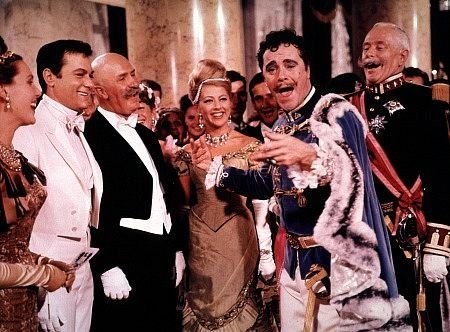
The Great Race– While this 1965 Edwards comedy-adventure about a turn-of-the-century New York to Paris auto race begins to overstay its welcome about 2/3 of the way through, after revisiting it recently, I have to say that the laughs have held up quite well. Clocking in at a whopping 160 minutes, it was released at a time when overblown, big-budgeted comedies with huge international casts were in vogue (especially in the wake of the mega-hit It’s a Mad Mad Mad Mad World in 1963). But what a cast-Jack Lemmon, Tony Curtis, Natalie Wood, Peter Falk and Keenan Wynn  (to name a few).

http://www.listefilm.com/wp-content/uploads/2017/02/Tatl%C4%B1-Budala-%E2%80%93-The-Party.jpg

The Party-Director Edwards and mercurial acting genius Peter Sellers paired up many times, but I think this 1968 gem is not only their best collaboration, but frame-for-frame, one of the all-time great screen comedies.

Sellers is Hrundi V. Bakshi, an Indian actor with a bit part in a Hollywood war epic who somehow manages to ruin an expensive day of shooting by (riotously) overplaying his death scene. The exasperated director calls for the actor’s head, and Bakshi’s name ends up on a studio exec’s hurriedly scribbled “to do” list. Through a comedy of errors, Bakshi’s name is instead added to a guest list for a party being organized by the executive’s wife. The bumbling (if well-meaning) Bakshi proceeds to make a riotous shambles of the event.

Sellers’ knack for physical comedy is right up there with the best of Chaplin and Keaton. A guitar-wielding Claudine Longet is also on board as the love interest, and purrs a jazzy number in one scene.

https://projectshadowchaser.files.wordpress.com/2011/06/vlcsnap-2011-06-25-13h16m47s243.png

S.O.B.-Whereas The Party was a relatively benign poke at Tinseltown, this 1981 dramedy offers a  more jaundiced view of the Hollywood machine, which has chewed up and spit out a producer (Richard Mulligan). He flips out after his latest film, a high-budget, G-rated musical starring his singer-actress wife (Julie Andrews) tanks with critics and flops at the box office.  Desperate to salvage it, he comes up with an idea to buy the film back from the studio, and “sex it up” by convincing his wife to re-shoot her part, including nude scenes, which would turn her “wholesome” image on its head.

Edwards’ screenplay is supposedly laced with autobiographical touches (as you may well  know, Edwards was married to a certain singer-actress…whose name rhymes with “Julie Andrews”). It’s Edwards’ most cynical film, but also quite funny. The great cast includes William Holden (sadly, his final role), Robert Vaughn, Robert Webber, Larry Hagman, Loretta Swit, and Shelly Winters. Robert Preston is priceless as a “Dr. Feelgood” MD. It’s worth the price of admission to hear a ‘luded-up Andrews utter her immortal line: “Oh…Hi, Polly! Come to see my boobies?”

https://lukasplusfilm.files.wordpress.com/2015/01/pinkpanther2mini5-1774.jpg

A Shot in the Dark-This second outing in the “Pink Panther” series is my favorite entry. The fact that the lovely Elke Sommer is in this film has no bearing on my appraisal. I wanted to make that clear. Okay, maybe it has a little bearing. Sommer is Maria Gambrelli, the maid who might have “dunnit”. That is, shot her rich employer’s limo driver. Or did she? It’s up to Inspector Jacques Clouseau (Peter Sellers) to figure that out, as more victims start dropping like flies.

There are so many great gags and classic exchanges in this one, including a memorable sequence in a nudist colony. Herbert Lom (who had previously co-starred with Sellers in several classic Ealing Studios comedies) introduces the character of Chief Inspector Dreyfus, who would become a fixture in subsequent sequels.

I feel this is the best one of the series because it strikes a perfect middle ground between the first film (which actually played it more sophisticated and fairly straight, as did Sellers) and the later films, which, while quite entertaining, became more and more far-fetched and cartoon-like as the franchise found more box office success.

https://manningtreearchive.files.wordpress.com/2015/07/4.gif?w=714

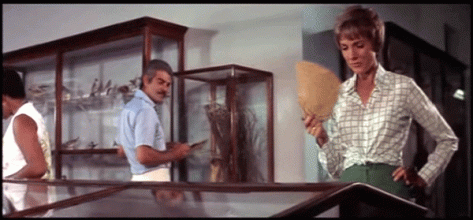
The Tamarind Seed-A largely forgotten, but absorbing and worthwhile Edwards film from 1974, this was his nod to cold war spy thrillers like From Russia With Love, The Spy Who Came in From the Cold, The Deadly Affair and Hitchcock’s Torn Curtain (the latter film which, interestingly, also featured Julie Andrews). Andrews co-stars here with Omar Sharif. She is a British civil servant, he is a Russian spy, and, well, you can guess what happens next. And yes, it does create “conflicts of interest” for the lovers, which makes for intrigue and suspense, with a sultry Caribbean backdrop. Edwards adapted the screenplay from the novel by Evelyn Anthony. Unfortunately, there is no Region 1 DVD release; perhaps there will be now?

http://cdn.moviestillsdb.com/sm/2dfb771252ba41986b78ab51e8f5f2e9/10.jpg

10– Talk about a “perfect” storm-Blake Edwards’ writing and directing skills, Dudley Moore’s impeccable comic timing, and Bo Derek’s, erm, well…Bo Derek-ness. Moore is a 40-something L.A. songwriter with a devoted girlfriend (Julie Andrews) and a long time friend/songwriting partner (Robert Webber) who both dutifully warn him that they can see signs of a looming mid-life crisis. After spotting  a beautiful young woman (Derek), he becomes obsessed with her. Temporarily insane with unrequited lust, he decides to follow her (and her boyfriend) to Mexico, where they are headed for a holiday. Much middle aged craziness (and hilarity) ensues.

Moore is so dead-on funny that you don’t really stop to consider that his character can be seen as a creepy stalker at times. The narrative does take an interesting about-face about 2/3 of the way through, turning into an introspective and melancholic morality tale. It is vastly entertaining, however, with excellent performances by all. Brian Dennehy is a standout as a philosophical bartender.

https://www.dvdtalk.com/reviews/images/reviews/76/full/1465219171_1.jpg

Victor/Victoria-A fluffy but entertaining rom-com starring (wait for it) Julie Andrews, who plays an underemployed, classically-trained soprano scraping by in 1930s Paris. She befriends another unemployed singer (Robert Preston), who was recently booted from his gig at a cabaret. He cooks up a scheme that he is convinced will get them both out of the poorhouse: He will be her manager, and she will pose as a “he”, who impersonates a “she” onstage. Get it? Genius! Are there complications? Of course there are-and that’s when the fun starts. James Garner and Lesley Ann Warren are wonderful. Henry Mancini is on board again with a great musical score. Triple-threat Andrews sings, acts and dances with her usual aplomb.

https://lh4.googleusercontent.com/-pFoMAVi8mGc/TXej4kxOrTI/AAAAAAAAD1Y/FvzfcVNd-Kc/s1600/WR1.bmp.jpg

Wild Rovers-Blake Edwards made a western? Yes, he did, and not a half-bad one at that. A world-weary cowhand (William Holden) convinces a younger (and somewhat dim) co-worker (Ryan O’Neal) that since it’s obvious that they’ll never really get ahead in their present profession, they should give bank robbery a shot. They get away with it, but then find themselves on the run, oddly, not so much from the law, but from their former employer (Karl Malden), who is mightily offended that anyone who worked for him would do such a thing. Episodic and leisurely paced, but ambles along quite agreeably, thanks to the charms of the two leads, and the beautiful, expansive photography by Philip Lathrop. Ripe for rediscovery.

10 more to explore: Operation Petticoat, Experiment in Terror, The Pink Panther, What Did You Do in the War, Daddy?, The Carey Treatment, The Return of the Pink Panther, The Pink Panther Strikes Again, Micki + Maude, Blind Date, Switch.

Blu-ray reissue: THX-1138 ***

By Dennis Hartley

(Originally posted on Digby’s Hullabaloo on December 11, 2010)

https://coolidge.org/sites/default/files/featured_images/THX_Duvall2%20copy.jpg

THX-1138 (The George Lucas Director’s Cut) – Warner Blu-ray

Is it just me, or is it a fact that the farther back you go in George Lucas’ catalog, the more “mature” his films become? At any rate, I still like to revisit his 1971 debut now and then, and marvel at how prophetic it was in many ways; although its unifying theme, if it has one, remains elusive. Lucas gives his own imaginative take on an Orwellian “future”, where people have become dehumanized “product”, barely distinguishable from each other or from the stark technology that coddles and enslaves them (been to the mall lately?).

And, just like in 1984, or the cult TV series The Prisoner, the biggest crime one can commit in this strictly regimented society is to be a non-conformist. Robert Duvall (as the eponymous character) gives an interesting physical performance that at times borders on mime (think Chaplin’s Modern Times-except without the laughs).

Oddly, Lucas’ predominately white on white color scheme is even more striking in high-def. There are tons of extras to plow through on this Warner Blu-ray, including Lucas’ original student film version.

Blu-ray reissue: The Seven Samurai ****

By Dennis Hartley

(Originally posted on Digby’s Hullabaloo on December 11, 2010)

https://didyouseethatone.files.wordpress.com/2015/01/seven-samurai-31.jpg

The Seven Samurai – Criterion Collection Blu-ray

“The greatest film ever made” may be one of the most overused hyperbolic superlatives in film criticism-but Akira Kurosawa’s 1954 masterpiece comes pretty damn close. Set in the 16th century, during Japan’s feudal period, it’s an elemental tale about farmers who have reached the end of their rope with marauding bandits, who swoop into their valley like clockwork for an annual raid on the food stores that they toil for all season to grow and harvest.

Although they can offer little more than some meager bags of rice as payment, they manage to convince a down-on-his-luck yet forthright samurai to take care of their “problem” once and for all. He recruits six fellow out-of-work warriors and sets to work. The story may be simple, but there can be much beauty in simplicity, especially in the hands of a craftsman like Kurosawa-san.

This is literally a movie with something for everyone-adventure, action, comedy, drama, romance, and perhaps most importantly, genuine heart and soul. This one movie has inspired and influenced the work of so many other filmmakers that it boggles the mind.

Criterion’s 2010 Blu-ray set carries over the same beautifully restored print and the extras from their 2006 reissue set, plus new features. And…the film has never looked this good!

Blu-ray reissue: Paths of Glory ****

By Dennis Hartley

(Originally posted on Digby’s Hullabaloo on December 11, 2010)

https://static.rogerebert.com/uploads/review/primary_image/reviews/great-movie-paths-of-glory-1957/Paths-of-Glory-image-2017-2.jpg

Paths of Glory – Criterion Collection Blu-ray

Stanley Kubrick really came into his own with his third film (fourth, if you include his never-officially-released “lost film”, Fear and Desire). Kirk Douglas is in top form as a WWI French regiment commander caught between the political machinations of his superiors and the empathy he feels for his battle-weary soldiers, who are little more than cannon-fodder to the paper-pushing top brass.

After an artillery unit serving under Douglas refuses to execute an insane directive from a glory-hungry field general to lay a barrage into their own forward positions, the commanding generals decide that the best way to ensure against any such future “mutiny” is to select three scapegoats from the rank and file to be court-martialed and shot.

Despite all the technical innovations in film making  that have evolved in the 50+ years since this film was released, the battle sequences still make you scratch your head in wonder as to how Kubrick was able to render them with such verisimilitude. The insanity of conflict has rarely been parsed onscreen with such economy and clarity. A true classic. Criterion’s Blu-ray print has been transferred with an obvious attention to quality and detail that befits a Kubrick film.

Blu-ray reissue: The Night of the Hunter ****

By Dennis Hartley

(Originally posted on Digby’s Hullabaloo on December 11, 2010)

http://1.bp.blogspot.com/-q4WJKGIaOqQ/U6ugoRaRPVI/AAAAAAAAB44/YHSKag3ix3E/s1600/Night-of-the-Hunter.png

The Night of the Hunter – Criterion Collection Blu-ray  (2-disc)

Is it a film noir? A horror movie? A black comedy? A haunting American folk tale? The answer would be yes. The man responsible for this tough-to-categorize 1957 film was one of the greatest acting hams of the 20th century, Charles Laughton, who began and ended his directorial career with this effort. Like a great many films now regarded as “cult classics”, this one was savaged by critics and tanked at the box office upon its initial release (enough to spook Laughton from ever returning to the director’s chair).

Robert Mitchum is brilliant (and genuinely scary) as a knife-wielding religious zealot who does considerably more “preying” than praying. Before his condemned cell mate (Peter Graves) meets the hangman, he talks in his sleep about $10,000 in loot  stashed on his property. When the “preacher” gets out of the slam, he makes a beeline for the widow (Shelly Winters) and her two young’uns. A disturbing tale unfolds. The great Lillian Gish is on board as well. It’s artfully directed by Laughton and beautifully shot by DP Stanley Cortez.

Criterion has done their usual voodoo with a gorgeous transfer. The 160-minute companion documentary nearly overshadows the feature. It was meticulously assembled over several decades by its director, who had access to a stash of disorganized rushes and outtakes from the film (that almost got tossed by Laughton’s widow). Laughton liked to keep the camera rolling between takes, which turned out to be a serendipitous choice for the benefit of future film scholars and movie buffs, because it is pretty amazing footage.

Blu-ray reissue: Metropolis (1927) ****

By Dennis Hartley

(Originally posted on Digby’s Hullabaloo on December 11, 2010)

https://assets.mubicdn.net/images/film/1507/image-w856.jpg?1760629056

The Complete Metropolis – Kino Lorber Blu-ray

For film buffs, the news that a “complete” print of Fritz Lang’s visionary expressionist 1927 sci-fi masterpiece had been discovered languishing on a dusty shelf in a film historian’s personal collection in Argentina in 2008 was akin to hearing that the Holy Grail had turned up at a church rummage sale. A box-office flop upon its first run, it was famously butchered for time by its original U.S. distributor, and censored for content by German authorities. Happily for fans, the film is now likely as close as it is ever going to get to its original presentation as intended by Lang.

Kino has one-upped their previous “definitive” DVD version with this new Blu-ray transfer of the Murnau Foundation’s latest re-tweaking, which now shores up previously choppy scenes by incorporating 20+ minutes of the Argentine footage. A recently discovered copy of the censor’s notes (containing all of the original inter-titles) was an equally valuable tool for the restoration team (especially for syncing up the original music score, which has been beautifully re-recorded). This all adds up to a new total running time of 147 minutes (compared to the tacky 90-minute Georgio Moroder-scored version that floated around for years, this is a godsend).

There is one  caveat you should be aware of.  The recovered Argentine footage was a 16mm copy of a tattered 35mm print. They cleaned it up as best they could without compromising image; be warned that these new inserts are relatively “gauzy”, albeit essential. Still, this (nearly) complete version, with its absorbing companion documentary, makes it a worthwhile investment for collectors.

Blu-ray reissue: Merry Christmas, Mr. Lawrence ***1/2

By Dennis Hartley

(Originally posted on Digby’s Hullabaloo on December 11, 2010)

https://s3.us-east-1.amazonaws.com/bomb-images/_hiresolution/BOMB114_16_krute1.jpg

Merry Christmas, Mr. Lawrence – Criterion Collection Blu-ray

I had nearly given up all hope that this largely-forgotten 1983 gem from Nagisa Oshima (In the Realm of the Senses, Empire of Passion) would ever see the light of day on DVD, much less be given the Criterion treatment on Blu-ray-but there you go. I remember at the time of its original release, the stunt casting of David Bowie and (equally flamboyant) Japanese pop star Ryuichi Sakamoto in the leads seemed to generate more interest than the film itself.

The story is set during WW2; Bowie and Ryuichi play a headstrong, defiant British officer and a disciplinarian Japanese prison camp commander who butt heads from day one. The dynamic between the two men initially recalls the relationship between Alec Guinness and Sessue Hayakawa in The Bridge on the River Kwai-but quickly moves into some more decidedly weird areas (very, very weird areas).

Tom Conti is excellent as a fellow British prisoner who attempts to mediate peace between the two. The real scene-stealer is Takeshi Kitano, as a prison guard. He injects a subtle humanity into a character that could have easily played one-dimensional. Sakamoto composed the hauntingly beautiful soundtrack (an electro-pop pioneer, he was the founder of the Yellow Magic Orchestra).

This is a film that deserves a serious reappraisal. That being said, the films of Oshima are always a challenging, and not for all tastes, so consider this a guarded recommendation; while definitely worth consideration for the collector on your list who is a confirmed fan of the director, perhaps a “test” rental first would work best for others.